Federal prosecutors cannot punish two Northern California marijuana growers for violating U.S. drug laws because Congress has protected pot suppliers who follow the state’s medical marijuana law, a federal appeals court ruled Friday.
In a 2-1 ruling, the Ninth U.S. Circuit Court of Appeals in San Francisco upheld a federal judge’s decision that two men whose property in Humboldt County was raided by federal drug agents in 2012 had complied with California’s medical marijuana law and could not be sentenced as drug dealers under federal law.
Both men had pleaded guilty to federal charges in 2014, a year before Congress barred the Justice Department from spending money to interfere with a state’s medical marijuana law. California voters approved the nation’s first such law in 1996, and 20 years later approved another law legalizing possession, use and cultivation for personal use of marijuana by adults over 21.
The appeals court had ruled in a separate case in 2016 that the budget restriction prohibited federal prosecution of growers who could prove they were following the state’s medical marijuana law. A year later, U.S. District Judge Richard Seeborg cited that ruling to bar federal sentencing of the two marijuana growers, the first such decision in the nation. Their lawyer, Ronald Richards, said Friday’s decision was the first by a U.S. appeals court to prohibit federal marijuana prosecution under the congressional restrictions.
“People are still going to prison for marijuana offenses, notwithstanding the fact that most states have medical marijuana laws and many states have legalized marijuana,” Richards said. “This ruling paves the way for others to challenge these prosecutions and not have the decision upset by an appellate court reweighing the evidence.”
He said his clients, Anthony Pisarski and Sonny Moore, would ask Seeborg to withdraw their guilty pleas.
The Justice Department did not immediately respond to a request for comment. Federal policy on the issue has varied under both the Obama and the Trump administrations. Then-Attorney General Jeff Sessions announced in January 2018 that his office would resume federal marijuana prosecutions nationwide regardless of state laws, but his successor, William Barr, promised at his Senate confirmation hearing in January 2019 that he would not prosecute growers who complied with state marijuana laws.
Pisarski and Moore were arrested in July 2012 by officers who said they found 327 marijuana plants, along with two loaded guns and $416,000 in cash on their property in a remote area of central Humboldt County. Searches over the next year uncovered more firearms, cash, and gold and silver bars.
The two men presented evidence that they grew the marijuana for nearby nonprofit collectives, which reimbursed them for their costs, and that they were abiding by the state law’s ban on growing marijuana for profit. Federal prosecutors argued that the cash, gold and silver were evidence of a profit-making business, but Seeborg disagreed, noting that such transactions were often made in cash because banks refused to serve marijuana businesses.
Upholding his ruling, the appeals court said prosecutors had not presented any evidence of past or future marijuana sales by the growers, other than the legal transactions with the collectives.
“The presence of weapons and excessive amounts of cash on the Humboldt property was equally consistent with the operation of a rural, cash-intensive enterprise as it was with an unlawful marijuana operation,” said Judge M. Margaret McKeown in the majority opinion. She was joined by Judge Eugene Siler of the federal appeals court in Cincinnati, temporarily assigned to the Ninth Circuit.
Dissenting Judge J. Clifford Wallace said the cash, guns and ammunition were evidence of a for-profit operation that would have violated California law.
Source
This is awesome. This is a huge win. Thank you 9th Circuit Court Of Appeals for seeing reason. They don't often do that.
Showing posts with label congress. Show all posts
Showing posts with label congress. Show all posts
Sunday, July 12, 2020

Monday, February 17, 2020
Saturday, February 15, 2020
Congress wants your guns
From Campaign For Liberty:
I’m growing more and more concerned the white-hot fight over gun control in Congress last fall was merely side-tracked by impeachment.
And the really troubling part is it may have given the anti-gun statists a strategic advantage to renew their all-out assault on our Second Amendment freedoms in Congress ahead of the November elections.
You see, the gun grabbers knew a major showdown over impeachment -- hot on the heels of Red Flag Gun Confiscation -- would only deplete our ability to thwart their gun control schemes.
And after wheeling their anti-gun political machine through Richmond, Virginia, they are convinced it’s the beachhead they need to DESTROY the Second Amendment and RAM their entire anti-gun agenda into law at the federal level.
Without your immediate action, it looks like they’ll be right and you and I will see the Second Amendment eviscerated.
So I’m counting on patriots like you to step up and stop them.
Won’t you please sign your DEFEND THE SECOND AMENDMENT DIRECTIVE right away?
I don’t have to tell you our Second Amendment freedoms are the ultimate safeguard to the Liberty and freedom that so many Patriots fought and died for.
And that for you and me there’s no choice when they come after our gun rights. We have to be ready for a knock-down, drag-out brawl to save our Second Amendment rights every time the gun grabbers attack!
Momentum shifting in the gun-grabbers’ direction is bad enough.
What really has me worried are the weak-kneed Republican politicians who’ve previously expressed support for various gun control proposals.
Historically, they’re prone to collapse the closer it gets to election day. November’s coming like a freight train and our Second Amendment freedoms hang by a thread.
All it will take is some madman shooting up a “gun-free” zone and those same politicians will be clamoring to cut a “deal” and grant Big Government statists BLATANTLY UNCONSTITUTIONAL powers to:
- Seize law-abiding Americans’ firearms -- with ZERO DUE PROCESS -- through so-called “Red Flag” Gun Confiscation Orders; and
- Create a Nationwide Gun Registration -- aka “Universal Background Checks”. . . to hand Government Goons the names and firearms of every single gun owner in the country.
My friend, do you think it can’t happen where you live?
IT CAN. . . and the gun grabbers are dead set on making it a reality.
That’s why now more than ever we must be prepared to FIGHT BACK.
And why I need every single patriot to dig deep to help halt the statists’ assaults on our Second Amendment freedoms.
I'm counting on you!
Won’t you help keep building the grassroots muscle to make it 100% clear to ALL your elected officials there is no room for negotiation when it comes to our Second Amendment rights?
Please sign your DEFEND THE SECOND AMENDMENT DIRECTIVE IMMEDIATELY!
And after you have, please dig deep and chip in with as generous a contribution as you can afford to help Campaign for Liberty recruit and mobilize more patriots to defend our Second Amendment freedoms!
For Liberty,
Ron Paul
Chairman
P.S. Gun-grabbers are feeling emboldened by what we just saw in Richmond, Virginia and they’re now dead set on RAMMING their anti-gun agenda into law at the federal level.
And with impeachment over, gun-grabbing politicians like Senators Lindsey Graham, Dianne Feinstein, and all the other anti-gun statists are poised to renew the horse-trading over our Second Amendment freedoms.
You and I must do everything we can to ensure we defend the Second Amendment.
So please sign your DEFEND THE SECOND AMENDMENT DIRECTIVE and pitch in whatever you can afford right away!
I’m growing more and more concerned the white-hot fight over gun control in Congress last fall was merely side-tracked by impeachment.
And the really troubling part is it may have given the anti-gun statists a strategic advantage to renew their all-out assault on our Second Amendment freedoms in Congress ahead of the November elections.
You see, the gun grabbers knew a major showdown over impeachment -- hot on the heels of Red Flag Gun Confiscation -- would only deplete our ability to thwart their gun control schemes.
And after wheeling their anti-gun political machine through Richmond, Virginia, they are convinced it’s the beachhead they need to DESTROY the Second Amendment and RAM their entire anti-gun agenda into law at the federal level.
Without your immediate action, it looks like they’ll be right and you and I will see the Second Amendment eviscerated.
So I’m counting on patriots like you to step up and stop them.
Won’t you please sign your DEFEND THE SECOND AMENDMENT DIRECTIVE right away?
I don’t have to tell you our Second Amendment freedoms are the ultimate safeguard to the Liberty and freedom that so many Patriots fought and died for.
And that for you and me there’s no choice when they come after our gun rights. We have to be ready for a knock-down, drag-out brawl to save our Second Amendment rights every time the gun grabbers attack!
Momentum shifting in the gun-grabbers’ direction is bad enough.
What really has me worried are the weak-kneed Republican politicians who’ve previously expressed support for various gun control proposals.
Historically, they’re prone to collapse the closer it gets to election day. November’s coming like a freight train and our Second Amendment freedoms hang by a thread.
All it will take is some madman shooting up a “gun-free” zone and those same politicians will be clamoring to cut a “deal” and grant Big Government statists BLATANTLY UNCONSTITUTIONAL powers to:
- Seize law-abiding Americans’ firearms -- with ZERO DUE PROCESS -- through so-called “Red Flag” Gun Confiscation Orders; and
- Create a Nationwide Gun Registration -- aka “Universal Background Checks”. . . to hand Government Goons the names and firearms of every single gun owner in the country.
My friend, do you think it can’t happen where you live?
IT CAN. . . and the gun grabbers are dead set on making it a reality.
That’s why now more than ever we must be prepared to FIGHT BACK.
And why I need every single patriot to dig deep to help halt the statists’ assaults on our Second Amendment freedoms.
I'm counting on you!
Won’t you help keep building the grassroots muscle to make it 100% clear to ALL your elected officials there is no room for negotiation when it comes to our Second Amendment rights?
Please sign your DEFEND THE SECOND AMENDMENT DIRECTIVE IMMEDIATELY!
And after you have, please dig deep and chip in with as generous a contribution as you can afford to help Campaign for Liberty recruit and mobilize more patriots to defend our Second Amendment freedoms!
For Liberty,
Ron Paul
Chairman
P.S. Gun-grabbers are feeling emboldened by what we just saw in Richmond, Virginia and they’re now dead set on RAMMING their anti-gun agenda into law at the federal level.
And with impeachment over, gun-grabbing politicians like Senators Lindsey Graham, Dianne Feinstein, and all the other anti-gun statists are poised to renew the horse-trading over our Second Amendment freedoms.
You and I must do everything we can to ensure we defend the Second Amendment.
So please sign your DEFEND THE SECOND AMENDMENT DIRECTIVE and pitch in whatever you can afford right away!
Wednesday, July 3, 2019
Congress Schedules Hearing To Discuss Ending Marijuana Prohibition
A major congressional subcommittee will hold a hearing on marijuana policy next week, Marijuana Moment has learned.
Though few details about the meeting are currently available, the House Judiciary Crime, Terrorism and Homeland Security Subcommittee are expected to discuss various legislative proposals to allow states to set their own cannabis policies without fear of federal intervention.
Several sources who did not wish to be identified shared with Marijuana Moment the names of witnesses expected to soon receive formal invitations to testify before the panel on Wednesday, July 10. Given the backgrounds of these individuals, it seems apparent that committee members will be discussing not whether the U.S. should end federal cannabis prohibition, but will focus primarily on how to do it.
Witnesses are anticipated to include Malik Burnett, a physician at Johns Hopkins Bloomberg School of Public Health who previously served as the Washington, D.C. policy manager at the Drug Policy Alliance’s Office of National Affairs, where he helped lead a successful ballot initiative campaign to legalize cannabis in the nation’s capital in 2014.
Baltimore State’s Attorney Marilyn Mosby, who announced in January that her office would no longer prosecute cannabis possession cases and would work to clear the records of certain individuals with prior marijuana convictions, is also being invited to testify.
David Nathan, a physician and board president of the pro-legalization group Doctors for Cannabis Regulation (DFCR), will also appear before the committee.
He told Marijuana Moment that he looks “forward to discussing the evidence-based health effects of cannabis, the failure of prohibition, the inadequacy of decriminalization, and the public health and social justice benefits of effective regulation.”
“DFCR physicians have successfully fought for legalization in states around the country,” Nathan said. “Now DFCR is proud to advocate for the broad majority of Americans—both Republicans and Democrats—who want our government to remove cannabis from the Controlled Substances Act and finally end the specter of federal interference with state cannabis laws.”
Finally, Neal Levine, CEO of Cannabis Trade Federation, will be the minority witness—which is noteworthy in and of itself, as Levine advocates for legalization, while one might expect the minority Republican party to invite someone who shares an opposing perspective on ending prohibition.
“I cannot comment on what has not been announced publicly by the committee, but I would welcome the opportunity to share the perspective of our members,” Levine, who previously served as a staffer for the Marijuana Policy Project, told Marijuana Moment. “We are especially well positioned to discuss the challenges arising from the inconsistency between state and federal cannabis laws.”
(Full disclosure: the Cannabis Trade Federation and its affiliate CTF Action have sponsored Marijuana Moment.)
After this story was initially published, the subcommittee posted an official notice for the hearing. It is titled “Marijuana Laws in America: Racial Justice and the Need for Reform” and will begin at 10:00 AM ET.
While lawmakers aren’t expected to vote on any particular bill at the hearing, it will nonetheless be one of the most significant congressional developments on marijuana reform to date.
The Judiciary Committee, under which this subcommittee falls, wields particular influence in advancing broad changes to federal drug laws, and Rep. Earl Blumenauer (D-OR) designated it as the panel to bring about the end of cannabis prohibition in a blueprint to legalization in the 116th Congress.
“For the first time in recent memory, there will be a candid conversation in the Judiciary Committee about the failures of marijuana prohibition in the United States and how people have been impacted,” Justin Strekal, political director of NORML, told Marijuana Moment. “We look forward to working with the subcommittee to best inform the conversation and the public at large.”
Legislation that could be marked up by the panel in the future includes the Strengthening the Tenth Amendment Through Entrusting States (STATES) Act, the Marijuana Justice Act, the Marijuana Freedom and Opportunity Act and the Ending Federal Marijuana Prohibition Act.
Rep. Jerrold Nadler (D-NY), chairman of the Judiciary Committee, is also said to be working on his own bill to end federal marijuana prohibition, but no details have yet been announced.
Notably, every single Democratic member of the full Judiciary Committee, including the chairman, voted in favor of amendment protecting cannabis programs in all states, U.S. territories and Washington, D.C. from Justice Department intervention last month. Six Republican members of the panel joined them in support of the measure, which was attached to spending legislation that has since cleared the House. The bipartisan nature of that vote indicates that further reform legislation stands a strong chance of passing in the committee.
Besides Blumenauer’s House-passed amendment protecting cannabis programs, this Congress has also seen several other hearings on cannabis issues. The House Veterans’ Affairs Committee discussed four pieces of legislation concerning veterans and marijuana last month, and the House Small Businesses Committee also convened to address opportunities and barriers for small cannabis businesses under the federal framework of prohibition.
In March, a bipartisan bill that would provide protections for banks that service cannabis businesses cleared the House Financial Services Committee following a hearing on the issue, and a full floor vote on that legislation could be coming soon.
Unlike the new Judiciary hearing, the minority witnesses at the Financial Services and Small Business hearings—representatives of the prohibitionist group Smart Approaches to Marijuana and the Heritage Foundation, respectively—opposed legalization.
Source
Though few details about the meeting are currently available, the House Judiciary Crime, Terrorism and Homeland Security Subcommittee are expected to discuss various legislative proposals to allow states to set their own cannabis policies without fear of federal intervention.
Several sources who did not wish to be identified shared with Marijuana Moment the names of witnesses expected to soon receive formal invitations to testify before the panel on Wednesday, July 10. Given the backgrounds of these individuals, it seems apparent that committee members will be discussing not whether the U.S. should end federal cannabis prohibition, but will focus primarily on how to do it.
Witnesses are anticipated to include Malik Burnett, a physician at Johns Hopkins Bloomberg School of Public Health who previously served as the Washington, D.C. policy manager at the Drug Policy Alliance’s Office of National Affairs, where he helped lead a successful ballot initiative campaign to legalize cannabis in the nation’s capital in 2014.
Baltimore State’s Attorney Marilyn Mosby, who announced in January that her office would no longer prosecute cannabis possession cases and would work to clear the records of certain individuals with prior marijuana convictions, is also being invited to testify.
David Nathan, a physician and board president of the pro-legalization group Doctors for Cannabis Regulation (DFCR), will also appear before the committee.
He told Marijuana Moment that he looks “forward to discussing the evidence-based health effects of cannabis, the failure of prohibition, the inadequacy of decriminalization, and the public health and social justice benefits of effective regulation.”
“DFCR physicians have successfully fought for legalization in states around the country,” Nathan said. “Now DFCR is proud to advocate for the broad majority of Americans—both Republicans and Democrats—who want our government to remove cannabis from the Controlled Substances Act and finally end the specter of federal interference with state cannabis laws.”
Finally, Neal Levine, CEO of Cannabis Trade Federation, will be the minority witness—which is noteworthy in and of itself, as Levine advocates for legalization, while one might expect the minority Republican party to invite someone who shares an opposing perspective on ending prohibition.
“I cannot comment on what has not been announced publicly by the committee, but I would welcome the opportunity to share the perspective of our members,” Levine, who previously served as a staffer for the Marijuana Policy Project, told Marijuana Moment. “We are especially well positioned to discuss the challenges arising from the inconsistency between state and federal cannabis laws.”
(Full disclosure: the Cannabis Trade Federation and its affiliate CTF Action have sponsored Marijuana Moment.)
After this story was initially published, the subcommittee posted an official notice for the hearing. It is titled “Marijuana Laws in America: Racial Justice and the Need for Reform” and will begin at 10:00 AM ET.
While lawmakers aren’t expected to vote on any particular bill at the hearing, it will nonetheless be one of the most significant congressional developments on marijuana reform to date.
The Judiciary Committee, under which this subcommittee falls, wields particular influence in advancing broad changes to federal drug laws, and Rep. Earl Blumenauer (D-OR) designated it as the panel to bring about the end of cannabis prohibition in a blueprint to legalization in the 116th Congress.
“For the first time in recent memory, there will be a candid conversation in the Judiciary Committee about the failures of marijuana prohibition in the United States and how people have been impacted,” Justin Strekal, political director of NORML, told Marijuana Moment. “We look forward to working with the subcommittee to best inform the conversation and the public at large.”
Legislation that could be marked up by the panel in the future includes the Strengthening the Tenth Amendment Through Entrusting States (STATES) Act, the Marijuana Justice Act, the Marijuana Freedom and Opportunity Act and the Ending Federal Marijuana Prohibition Act.
Rep. Jerrold Nadler (D-NY), chairman of the Judiciary Committee, is also said to be working on his own bill to end federal marijuana prohibition, but no details have yet been announced.
Notably, every single Democratic member of the full Judiciary Committee, including the chairman, voted in favor of amendment protecting cannabis programs in all states, U.S. territories and Washington, D.C. from Justice Department intervention last month. Six Republican members of the panel joined them in support of the measure, which was attached to spending legislation that has since cleared the House. The bipartisan nature of that vote indicates that further reform legislation stands a strong chance of passing in the committee.
Besides Blumenauer’s House-passed amendment protecting cannabis programs, this Congress has also seen several other hearings on cannabis issues. The House Veterans’ Affairs Committee discussed four pieces of legislation concerning veterans and marijuana last month, and the House Small Businesses Committee also convened to address opportunities and barriers for small cannabis businesses under the federal framework of prohibition.
In March, a bipartisan bill that would provide protections for banks that service cannabis businesses cleared the House Financial Services Committee following a hearing on the issue, and a full floor vote on that legislation could be coming soon.
Unlike the new Judiciary hearing, the minority witnesses at the Financial Services and Small Business hearings—representatives of the prohibitionist group Smart Approaches to Marijuana and the Heritage Foundation, respectively—opposed legalization.
Source
Sunday, February 10, 2019
The First Marijuana Hearing Of The New Congress Has Been Scheduled
Congressional Democrats are already moving ahead with plans to consider broad changes to federal marijuana laws in 2019.
Whereas the Republican-controlled House for the past several years had blocked votes on most cannabis-related measures, the chamber's new Democratic majority on Wednesday announced it has scheduled a hearing for next week to examine the difficulties that marijuana businesses face in opening and maintaining bank accounts.
Titled, “Challenges and Solutions: Access to Banking Services for Cannabis-Related Businesses,” the hearing will take place on February 13 before a subcommittee of the House Financial Services Committee.
Although a growing number of states are moving to legalize marijuana for medical or recreational use, cannabis remains federally prohibited. As a result, and despite a 2014 guidance memo released on the topic by the Obama administration aimed at clearing up the issue, many financial services providers remain reluctant to work with the industry out of fear of violating money laundering or drug laws.
"When we introduced this bill six years ago, we warned that forcing these businesses to deal in cash was threatening public safety. No hearing was given," Rep. Denny Heck (D-WA) said in an email, referring to marijuana banking legislation he and Rep. Ed Perlmutter (D-CO) have filed for the past several Congresses.
He lamented that Republican leadership didn't schedule a hearing on the proposal even after a security guard at a Colorado dispensary was killed during a robbery.
"Chairwoman Waters has made it one of her first priorities to address this urgent and overdue issue, demonstrating that she understands the threat to public safety and the need for Congress to act," Heck said of the committee's new leader. "We have a bipartisan proposal to allow well-regulated marijuana businesses to handle their money in a way that is safe and effective for law enforcement to track. I am eager to get to the work of refining it and passing it into law."
That a hearing on the issue was in the works was first noted earlier this week by Politico, and Marijuana Moment reported that the full committee is also actively planning to vote on a marijuana banking bill in the coming months.
The newly scheduled marijuana hearing is a signal that Democrats intend to move cannabis legislation this year, and is likely to be the first in a series of committee-level actions across the House on the issue.
"The upcoming hearing presents a real opportunity for the Democratic Party to assert their leadership by finally beginning the conversation on how we end the failed policy of marijuana criminalization," Justin Strekal, political director for NORML, said.
While two limited medical cannabis research bills were able to advance out of House committees last year, they never made it to the floor for votes. Meanwhile, Republican leaders consistently prevented members from offering marijuana-related amendments—including ones on banking issues—to larger legislation.
In contrast, Rep. Earl Blumenauer (D-OR) suggested in a memo to party leaders late last year that they pursue a step-by-step approach to legalize marijuana in 2019. His plan recommends that Financial Services and other committees first begin holding hearings on incremental reforms like banking access, research expansion and medical cannabis for military veterans before passing bills on those issues as part of a lead up to ultimately approving broader legislation to formally end federal marijuana prohibition by the end of the year.
A House bill to protect banks from being punished for working with state-legal marijuana businesses that Heck and Perlmutter introduced garnered 95 cosponsors in the last Congress, and 20 senators signed onto a companion bill, but neither were given hearings or brought up for votes.
"Depriving state-legal cannabis businesses of basic banking services and forcing them to operate entirely in cash presents a significant safety risk, not just to those businesses and their employees, but to the public," Don Murphy, director of federal policies for the Marijuana Policy Project, said in an email. "Support for addressing the cannabis banking problem is strong and bipartisan, and it appears Congress may be ready to adopt a real, commonsense solution. Members concerned about public safety should be jumping at the chance to express their support for this legislation."
Congress has held only a handful of hearings on marijuana reform issues in recent years, and never before has any come at a time when broad cannabis reform legislation seemed to be conceivably on its way to passage.
"This hearing is historic for cannabis policy reform advocates, business owners and the banking sector, and could directly lead to the first in what is hopefully a series of positive changes in the 2019 legislative cycle," Morgan Fox, media relations director for the National Cannabis Industry Association, said in an email. "Allowing banks to work with cannabis businesses more easily will benefit public safety, increase transparency, provide more financing options for small businesses and communities that have been targeted by prohibition, and help companies thrive so they can further displace the illicit market."
Outside of the two committee markups of cannabis research legislation last year, which were not preceded by formal hearings on the relevant issues, Senate panels have on a few occasions held lengthy discussions on marijuana.
In 2013, for example, the Senate Judiciary Committee convened a hearing to dig into the fact that a growing number of states were legalizing marijuana in contrast with federal law.
The Senate Caucus on International Narcotics Control, which is not a formal standing committee of the body, hosted a discussion on federal marijuana enforcement in 2016. Its two cochairs, Sens. Charles Grassley (R-IA) and Dianne Feinstein (D-CA), have long been among Congress's most vocal opponents of cannabis reform, though Feinstein began to shift her position last year.
Also in 2016, the Senate Judiciary Committee's Subcommittee on Crime and Terrorism held a hearing on the risks and potential benefits of medical cannabis, but it did not lead to votes on any marijuana legislation.
Meanwhile, pressure to address cannabis banking has been growing. Several top Trump administration officials have indicated they support clarifying the issue.
Treasury Secretary Steven Mnuchin, for example, suggested in testimony before a House committee early last year that he supports letting marijuana businesses store their profits in banks.
“I assure you that we don’t want bags of cash,” he said. “We do want to find a solution to make sure that businesses that have large access to cash have a way to get them into a depository institution for it to be safe.”
In a separate hearing Mnuchin revealed that addressing the issue is at the “top of the list” of his concerns.
Federal Reserve Chairman Jerome Powell said that the growing gap between state and federal marijuana laws “puts federally chartered banks in a very difficult situation... It would great if that could be clarified."
And last month, Comptroller of the Currency Joseph Otting called on Congress to "act at the national level to legalize marijuana if they want those entities involved in that business to utilize the U.S. banking system."
Meanwhile, although many major financial institutions are staying away from the cannabis industry, federal data does show that an increasing number of banks are beginning to work with marijuana growers, sellers, processors and related businesses.
It hasn't yet been announced who will be testifying at next week's cannabis banking hearing before the Consumer Protection and Financial Institutions Subcommittee.
Source
Whereas the Republican-controlled House for the past several years had blocked votes on most cannabis-related measures, the chamber's new Democratic majority on Wednesday announced it has scheduled a hearing for next week to examine the difficulties that marijuana businesses face in opening and maintaining bank accounts.
Titled, “Challenges and Solutions: Access to Banking Services for Cannabis-Related Businesses,” the hearing will take place on February 13 before a subcommittee of the House Financial Services Committee.
Although a growing number of states are moving to legalize marijuana for medical or recreational use, cannabis remains federally prohibited. As a result, and despite a 2014 guidance memo released on the topic by the Obama administration aimed at clearing up the issue, many financial services providers remain reluctant to work with the industry out of fear of violating money laundering or drug laws.
"When we introduced this bill six years ago, we warned that forcing these businesses to deal in cash was threatening public safety. No hearing was given," Rep. Denny Heck (D-WA) said in an email, referring to marijuana banking legislation he and Rep. Ed Perlmutter (D-CO) have filed for the past several Congresses.
He lamented that Republican leadership didn't schedule a hearing on the proposal even after a security guard at a Colorado dispensary was killed during a robbery.
"Chairwoman Waters has made it one of her first priorities to address this urgent and overdue issue, demonstrating that she understands the threat to public safety and the need for Congress to act," Heck said of the committee's new leader. "We have a bipartisan proposal to allow well-regulated marijuana businesses to handle their money in a way that is safe and effective for law enforcement to track. I am eager to get to the work of refining it and passing it into law."
That a hearing on the issue was in the works was first noted earlier this week by Politico, and Marijuana Moment reported that the full committee is also actively planning to vote on a marijuana banking bill in the coming months.
The newly scheduled marijuana hearing is a signal that Democrats intend to move cannabis legislation this year, and is likely to be the first in a series of committee-level actions across the House on the issue.
"The upcoming hearing presents a real opportunity for the Democratic Party to assert their leadership by finally beginning the conversation on how we end the failed policy of marijuana criminalization," Justin Strekal, political director for NORML, said.
While two limited medical cannabis research bills were able to advance out of House committees last year, they never made it to the floor for votes. Meanwhile, Republican leaders consistently prevented members from offering marijuana-related amendments—including ones on banking issues—to larger legislation.
In contrast, Rep. Earl Blumenauer (D-OR) suggested in a memo to party leaders late last year that they pursue a step-by-step approach to legalize marijuana in 2019. His plan recommends that Financial Services and other committees first begin holding hearings on incremental reforms like banking access, research expansion and medical cannabis for military veterans before passing bills on those issues as part of a lead up to ultimately approving broader legislation to formally end federal marijuana prohibition by the end of the year.
A House bill to protect banks from being punished for working with state-legal marijuana businesses that Heck and Perlmutter introduced garnered 95 cosponsors in the last Congress, and 20 senators signed onto a companion bill, but neither were given hearings or brought up for votes.
"Depriving state-legal cannabis businesses of basic banking services and forcing them to operate entirely in cash presents a significant safety risk, not just to those businesses and their employees, but to the public," Don Murphy, director of federal policies for the Marijuana Policy Project, said in an email. "Support for addressing the cannabis banking problem is strong and bipartisan, and it appears Congress may be ready to adopt a real, commonsense solution. Members concerned about public safety should be jumping at the chance to express their support for this legislation."
Congress has held only a handful of hearings on marijuana reform issues in recent years, and never before has any come at a time when broad cannabis reform legislation seemed to be conceivably on its way to passage.
"This hearing is historic for cannabis policy reform advocates, business owners and the banking sector, and could directly lead to the first in what is hopefully a series of positive changes in the 2019 legislative cycle," Morgan Fox, media relations director for the National Cannabis Industry Association, said in an email. "Allowing banks to work with cannabis businesses more easily will benefit public safety, increase transparency, provide more financing options for small businesses and communities that have been targeted by prohibition, and help companies thrive so they can further displace the illicit market."
Outside of the two committee markups of cannabis research legislation last year, which were not preceded by formal hearings on the relevant issues, Senate panels have on a few occasions held lengthy discussions on marijuana.
In 2013, for example, the Senate Judiciary Committee convened a hearing to dig into the fact that a growing number of states were legalizing marijuana in contrast with federal law.
The Senate Caucus on International Narcotics Control, which is not a formal standing committee of the body, hosted a discussion on federal marijuana enforcement in 2016. Its two cochairs, Sens. Charles Grassley (R-IA) and Dianne Feinstein (D-CA), have long been among Congress's most vocal opponents of cannabis reform, though Feinstein began to shift her position last year.
Also in 2016, the Senate Judiciary Committee's Subcommittee on Crime and Terrorism held a hearing on the risks and potential benefits of medical cannabis, but it did not lead to votes on any marijuana legislation.
Meanwhile, pressure to address cannabis banking has been growing. Several top Trump administration officials have indicated they support clarifying the issue.
Treasury Secretary Steven Mnuchin, for example, suggested in testimony before a House committee early last year that he supports letting marijuana businesses store their profits in banks.
“I assure you that we don’t want bags of cash,” he said. “We do want to find a solution to make sure that businesses that have large access to cash have a way to get them into a depository institution for it to be safe.”
In a separate hearing Mnuchin revealed that addressing the issue is at the “top of the list” of his concerns.
Federal Reserve Chairman Jerome Powell said that the growing gap between state and federal marijuana laws “puts federally chartered banks in a very difficult situation... It would great if that could be clarified."
And last month, Comptroller of the Currency Joseph Otting called on Congress to "act at the national level to legalize marijuana if they want those entities involved in that business to utilize the U.S. banking system."
Meanwhile, although many major financial institutions are staying away from the cannabis industry, federal data does show that an increasing number of banks are beginning to work with marijuana growers, sellers, processors and related businesses.
It hasn't yet been announced who will be testifying at next week's cannabis banking hearing before the Consumer Protection and Financial Institutions Subcommittee.
Source
Tuesday, September 12, 2017
We are safe until December 8
A budget deal approved in Congress on Friday extended federal protections for state-legal medical marijuana patients and providers until Dec. 8, potentially creating another opportunity to ensure they are inluded in the FY 2018 budget.
Earlier this week, the House Rules Committee blocked an amendment introduced by Rep. Dana Rohrabacher (R-CA) and Rep. Earl Blumenauer (D-OR) from being heard by the House during the rest of the budget negotiations. This made it very likely that the amendment, which prevents the Department of Justice from targeting state medical marijuana programs, would not be included in the final budget for next year. Without inclusion, these protections would have expired Sep. 30.
This budget deal gives us a little more time to put pressure on Congress to do the right thing. Please contact your lawmakers and urge them to support medical marijuana.
Source
Earlier this week, the House Rules Committee blocked an amendment introduced by Rep. Dana Rohrabacher (R-CA) and Rep. Earl Blumenauer (D-OR) from being heard by the House during the rest of the budget negotiations. This made it very likely that the amendment, which prevents the Department of Justice from targeting state medical marijuana programs, would not be included in the final budget for next year. Without inclusion, these protections would have expired Sep. 30.
This budget deal gives us a little more time to put pressure on Congress to do the right thing. Please contact your lawmakers and urge them to support medical marijuana.
Source
Tuesday, August 22, 2017
Sign the petition Pelosi fears
From Senator Rand Paul and The National Right To Work Committee:
Below is a petition I've had prepared for you to your Senators and Congressman, the Speaker of the House and the Senate Majority Leader.
It's crucial you sign it at once.
You see, President Donald Trump has pledged to support passage of a National Right to Work act –- and promised to sign it into law if you and I can get it to his desk.
Without a doubt, this is our best opportunity EVER to pass a National Right to Work law to end forced unionism in America.
A National Right to Work law would ultimately end forced unionism nationwide by removing the sections of federal labor laws that allow union bosses to force workers to join a union just to get or keep a job.
So please sign your petition and include your most generous contribution to launch the next, crucial phase for ultimate passage of a National Right to Work law immediately.
You see, the union bosses, Chuck Schumer, Nancy Pelosi and their allies are going to use every trick in the book to kill a National Right to Work bill -- and they will try to do it as quietly as possible.
The union kingpins (and their water-carriers in Congress) can't afford the consequences of having their coercive privileges publicly debated and voted on in Congress!
They don't want the American people to know that:
***Millions of workers are forced to surrender part of every paycheck to keep their jobs.
This cash funds violent "organizing" drives, provides a limousine lifestyle for union bigwigs, and bankrolls radical, Tax-and-Spend politicians like Chuck Schumer and Nancy Pelosi.
***Big Labor's power is deadly to millions of small businesses.
Big Labor politicians and Obama-stacked bureaucracies have been strangling small businesses with confiscatory taxes, destructive laws and straitjacket regulations.
***Forced Unionism exports millions of good jobs overseas.
Productivity-killing work rules, workplace class warfare, slowdowns, "sick-outs" and strikes all have taken their crippling toll, closing the doors of many businesses -- for good.
***Billions of forced-dues dollars bankroll radical Tax-and-Spend politicians like Chuck Schumer and Nancy Pelosi, resulting in out-of-control spending and skyrocketing taxes.
That's why it's vital you sign your petition to demonstrate to Congress and the national media the strong support for Right to Work.
Of course, Big Labor allies in Congress may choose to obey the union bosses rather than the majority of their constituents.
That's their choice.
But time and again, when politicians defy the public and vote for forced unionism, they've paid the price with the end of their political careers!
So -- by all means -- let's have another vote and see which politicians want to end their careers in the next election.
That's why your signed petition and financial support are so important.
It's all part of the National Right to Work Committee's four-part plan to pass a National Right to Work law:
•Run TV, radio and newspaper ads targeting swing votes in key states and districts;
•Contact directly by mail and email up to 10 million supporters to urge them to demand their Senators and Congressmen vote for the National Right to Work Act;
•Brief personally the hundreds of favorable columnists, radio talk show hosts, editorial writers and bloggers nationwide who can help mobilize public opinion; and
•Crank up massive, paid phone banks in the days before the vote to really make Congress feel the heat.
Of course, this whole effort will be very expensive.
An all-out media and direct-mail blitz to mobilize massive public pressure on Congress will be the key to our success.
So, to pay for the expensive ads, mailings, phone banks and other efforts, it's vital you give a special contribution to the National Right to Work Committee today.
Will you make a generous contribution of $500, $250, $100, $50, $25 or $10 to launch the next, crucial phase for ultimate passage of a National Right to Work law?
The National Right to Work Committee has successfully beat back Big Labor's forced-dues machine for decades.
And now it's critical the Right to Work Committee have your financial support right away to put politicians' feet to the fire to bring the National Right to Work Act up for a vote.
It would be a crime to let politicians who support compulsory unionism off the hook.
Up against the forced-dues-fed, billion-dollar might of Big Labor, all you and I have on our side is truth and public opinion.
Together with the National Right to Work Committee you can make the difference.
Unlike Big Labor, the National Right to Work Committee doesn't have (or want) the power to force anyone to pay dues.
So it has to depend on the generosity of folks like you.
Some folks have already given $250, $500 and even more. For others, a contribution of $25 or $50 has been as much as they could afford.
Whatever you can do, sign your petition and include your most generous contribution.
Please don't make it easy for Chuck Schumer, Nancy Pelosi and Big Labor to destroy the National Right to Work bill.
Without your contribution of $500, $250, $100, $50, $25 or $10, the National Right to Work Committee won't be able to contact 10 million Americans, place the advertising, or staff phone banks to put Big Labor on the spot.
I believe it's vital we force roll-call votes in this Congress.
It's time to put Big Labor on the defensive. Without your help, the union bosses win by default.
Please act today.
Sincerely,
Rand Paul, M.D.
United States Senator
P.S. Since nearly 80% of Americans oppose Big Labor's forced-unionism powers, a public debate and vote on a National Right to Work law is Big Labor's (and its water-carriers' in Congress) worst nightmare!
Below is a petition I've had prepared for you to your Senators and Congressman, the Speaker of the House and the Senate Majority Leader.
It's crucial you sign it at once.
You see, President Donald Trump has pledged to support passage of a National Right to Work act –- and promised to sign it into law if you and I can get it to his desk.
Without a doubt, this is our best opportunity EVER to pass a National Right to Work law to end forced unionism in America.
A National Right to Work law would ultimately end forced unionism nationwide by removing the sections of federal labor laws that allow union bosses to force workers to join a union just to get or keep a job.
So please sign your petition and include your most generous contribution to launch the next, crucial phase for ultimate passage of a National Right to Work law immediately.
You see, the union bosses, Chuck Schumer, Nancy Pelosi and their allies are going to use every trick in the book to kill a National Right to Work bill -- and they will try to do it as quietly as possible.
The union kingpins (and their water-carriers in Congress) can't afford the consequences of having their coercive privileges publicly debated and voted on in Congress!
They don't want the American people to know that:
***Millions of workers are forced to surrender part of every paycheck to keep their jobs.
This cash funds violent "organizing" drives, provides a limousine lifestyle for union bigwigs, and bankrolls radical, Tax-and-Spend politicians like Chuck Schumer and Nancy Pelosi.
***Big Labor's power is deadly to millions of small businesses.
Big Labor politicians and Obama-stacked bureaucracies have been strangling small businesses with confiscatory taxes, destructive laws and straitjacket regulations.
***Forced Unionism exports millions of good jobs overseas.
Productivity-killing work rules, workplace class warfare, slowdowns, "sick-outs" and strikes all have taken their crippling toll, closing the doors of many businesses -- for good.
***Billions of forced-dues dollars bankroll radical Tax-and-Spend politicians like Chuck Schumer and Nancy Pelosi, resulting in out-of-control spending and skyrocketing taxes.
That's why it's vital you sign your petition to demonstrate to Congress and the national media the strong support for Right to Work.
Of course, Big Labor allies in Congress may choose to obey the union bosses rather than the majority of their constituents.
That's their choice.
But time and again, when politicians defy the public and vote for forced unionism, they've paid the price with the end of their political careers!
So -- by all means -- let's have another vote and see which politicians want to end their careers in the next election.
That's why your signed petition and financial support are so important.
It's all part of the National Right to Work Committee's four-part plan to pass a National Right to Work law:
•Run TV, radio and newspaper ads targeting swing votes in key states and districts;
•Contact directly by mail and email up to 10 million supporters to urge them to demand their Senators and Congressmen vote for the National Right to Work Act;
•Brief personally the hundreds of favorable columnists, radio talk show hosts, editorial writers and bloggers nationwide who can help mobilize public opinion; and
•Crank up massive, paid phone banks in the days before the vote to really make Congress feel the heat.
Of course, this whole effort will be very expensive.
An all-out media and direct-mail blitz to mobilize massive public pressure on Congress will be the key to our success.
So, to pay for the expensive ads, mailings, phone banks and other efforts, it's vital you give a special contribution to the National Right to Work Committee today.
Will you make a generous contribution of $500, $250, $100, $50, $25 or $10 to launch the next, crucial phase for ultimate passage of a National Right to Work law?
The National Right to Work Committee has successfully beat back Big Labor's forced-dues machine for decades.
And now it's critical the Right to Work Committee have your financial support right away to put politicians' feet to the fire to bring the National Right to Work Act up for a vote.
It would be a crime to let politicians who support compulsory unionism off the hook.
Up against the forced-dues-fed, billion-dollar might of Big Labor, all you and I have on our side is truth and public opinion.
Together with the National Right to Work Committee you can make the difference.
Unlike Big Labor, the National Right to Work Committee doesn't have (or want) the power to force anyone to pay dues.
So it has to depend on the generosity of folks like you.
Some folks have already given $250, $500 and even more. For others, a contribution of $25 or $50 has been as much as they could afford.
Whatever you can do, sign your petition and include your most generous contribution.
Please don't make it easy for Chuck Schumer, Nancy Pelosi and Big Labor to destroy the National Right to Work bill.
Without your contribution of $500, $250, $100, $50, $25 or $10, the National Right to Work Committee won't be able to contact 10 million Americans, place the advertising, or staff phone banks to put Big Labor on the spot.
I believe it's vital we force roll-call votes in this Congress.
It's time to put Big Labor on the defensive. Without your help, the union bosses win by default.
Please act today.
Sincerely,
Rand Paul, M.D.
United States Senator
P.S. Since nearly 80% of Americans oppose Big Labor's forced-unionism powers, a public debate and vote on a National Right to Work law is Big Labor's (and its water-carriers' in Congress) worst nightmare!
Thursday, August 3, 2017
Congress Is Heading for a Confrontation With Sessions Over Marijuana
Congress is heading for a confrontation with Attorney General Jeff Sessions over pot.
Sessions is seeking to crack down on marijuana use while lawmakers from both parties are pushing legislation that would do the opposite.
Measures have been attached to must-pass bills in the Senate that would allow Veterans Affairs doctors to counsel patients on the use of medical marijuana, and to continue blocking the Justice Department from pursuing cases against people who use medical marijuana in states that have legalized it.
Some lawmakers are pushing to go even further. Senator Cory Booker, a New Jersey Democrat, this week unveiled legislation that would legalize marijuana at the federal level. In the House, Republican Matt Gaetz of Florida proposed legislation that would change the federal classification of marijuana to allow research and a range of medical uses.
Booker said the law needs to be changed because minorities and the poor are disproportionately arrested for what amounts to a minor offense.
“It disturbs me right now that Attorney General Jeff Sessions is not moving as the states are -- moving as public opinion is -- but actually saying that we should be doubling down and enforcing federal marijuana laws even in states that have made marijuana legal,” he said in a video posted Tuesday on Facebook.
Eight states have fully legalized marijuana for adult use and 21 more have legalized it for medical use only. Federal law continues to ban the use and sale of cannabis. During the Obama administration, the Justice Department didn’t actively prosecute marijuana offenders, an approach Sessions has said needs to change.
Read more: Trump Casts Cloud Over Cannabis, But Money Keeps Pouring In
“I’m not sure we’re going to be a better, healthier nation," he said in February, "if we have marijuana being sold at every corner grocery store.” He later added, “My best view is that we don’t need to be legalizing marijuana.”
In April, Sessions put out a memo to U.S. attorneys about his crime-reduction efforts and said one of his subcommittees will "undertake a review of existing policies in the areas of charging, sentencing, and marijuana to ensure consistency with the department’s overall strategy on reducing violent crime and with administration goals and priorities."
Sarah Flores, a Justice Department spokeswoman, declined to comment on the matter.
The president has repeatedly expressed his dissatisfaction with Sessions, a former senator from Alabama, for recusing himself from a federal investigation into whether there was collusion between Trump’s presidential campaign and Russia. The new White House chief of staff, John Kelly, told Sessions in a phone call over the weekend that Trump doesn’t intend to fire him, according to a person familiar with the conversation.
Spending Legislation
The Veterans Administration measure, sponsored by Republican Senator Steve Daines of Montana and Democratic Senator Jeff Merkley of Oregon, was added to a bill approved by the Appropriations Committee on July 13. The measure preventing funds from being used to crack down on medical marijuana was sponsored by Senator Patrick Leahy, a Vermont Democrat, and was approved by the Appropriations Committee on July 27.
The Republican-controlled Congress is already on record supporting medical marijuana. Since 2014, the Justice Department spending bill has included language that blocks funds from being used to enforce federal law relating to medical marijuana in states where the drug is legal.
Gaetz, the Florida lawmaker who introduced his marijuana legislation in April, said at the time that pot shouldn’t be classified by the federal government the same way as heroin or LSD.
“We do not need to continue with a policy that turns thousands of young people into felons every year,” he said in a statement. “Nor do we need to punish the millions of people who are sick and seeking medical help -- from pain, from muscle wasting, from chemotherapy-induced nausea.”
Republican Senator Cory Gardner of Colorado said Sessions told him before being confirmed as attorney general earlier this year that he planned to take a hands-off approach toward states that legalize marijuana. Gardner, whose state is among them, said he’ll hold Sessions to his comments.
“The founders of our country intended states to be laboratories of democracy and Colorado is now deep in the heart of laboratory, along with many other states now," Gardner said in an interview.
Source
Sessions is seeking to crack down on marijuana use while lawmakers from both parties are pushing legislation that would do the opposite.
Measures have been attached to must-pass bills in the Senate that would allow Veterans Affairs doctors to counsel patients on the use of medical marijuana, and to continue blocking the Justice Department from pursuing cases against people who use medical marijuana in states that have legalized it.
Some lawmakers are pushing to go even further. Senator Cory Booker, a New Jersey Democrat, this week unveiled legislation that would legalize marijuana at the federal level. In the House, Republican Matt Gaetz of Florida proposed legislation that would change the federal classification of marijuana to allow research and a range of medical uses.
Booker said the law needs to be changed because minorities and the poor are disproportionately arrested for what amounts to a minor offense.
“It disturbs me right now that Attorney General Jeff Sessions is not moving as the states are -- moving as public opinion is -- but actually saying that we should be doubling down and enforcing federal marijuana laws even in states that have made marijuana legal,” he said in a video posted Tuesday on Facebook.
Eight states have fully legalized marijuana for adult use and 21 more have legalized it for medical use only. Federal law continues to ban the use and sale of cannabis. During the Obama administration, the Justice Department didn’t actively prosecute marijuana offenders, an approach Sessions has said needs to change.
Read more: Trump Casts Cloud Over Cannabis, But Money Keeps Pouring In
“I’m not sure we’re going to be a better, healthier nation," he said in February, "if we have marijuana being sold at every corner grocery store.” He later added, “My best view is that we don’t need to be legalizing marijuana.”
In April, Sessions put out a memo to U.S. attorneys about his crime-reduction efforts and said one of his subcommittees will "undertake a review of existing policies in the areas of charging, sentencing, and marijuana to ensure consistency with the department’s overall strategy on reducing violent crime and with administration goals and priorities."
Sarah Flores, a Justice Department spokeswoman, declined to comment on the matter.
The president has repeatedly expressed his dissatisfaction with Sessions, a former senator from Alabama, for recusing himself from a federal investigation into whether there was collusion between Trump’s presidential campaign and Russia. The new White House chief of staff, John Kelly, told Sessions in a phone call over the weekend that Trump doesn’t intend to fire him, according to a person familiar with the conversation.
Spending Legislation
The Veterans Administration measure, sponsored by Republican Senator Steve Daines of Montana and Democratic Senator Jeff Merkley of Oregon, was added to a bill approved by the Appropriations Committee on July 13. The measure preventing funds from being used to crack down on medical marijuana was sponsored by Senator Patrick Leahy, a Vermont Democrat, and was approved by the Appropriations Committee on July 27.
The Republican-controlled Congress is already on record supporting medical marijuana. Since 2014, the Justice Department spending bill has included language that blocks funds from being used to enforce federal law relating to medical marijuana in states where the drug is legal.
Gaetz, the Florida lawmaker who introduced his marijuana legislation in April, said at the time that pot shouldn’t be classified by the federal government the same way as heroin or LSD.
“We do not need to continue with a policy that turns thousands of young people into felons every year,” he said in a statement. “Nor do we need to punish the millions of people who are sick and seeking medical help -- from pain, from muscle wasting, from chemotherapy-induced nausea.”
Republican Senator Cory Gardner of Colorado said Sessions told him before being confirmed as attorney general earlier this year that he planned to take a hands-off approach toward states that legalize marijuana. Gardner, whose state is among them, said he’ll hold Sessions to his comments.
“The founders of our country intended states to be laboratories of democracy and Colorado is now deep in the heart of laboratory, along with many other states now," Gardner said in an interview.
Source
Thursday, July 27, 2017
Republicans Block Congressional Marijuana Votes
House Republican leadership is blocking floor consideration of several marijuana amendments on issues ranging from military veterans’ access to medical cannabis to water rights for cultivators.
Despite passionate pleas and support from members of both parties, particularly on the veterans issue, the House Rules Committee on Tuesday night ruled that the marijuana amendments were not in order and would not receive votes by the full chamber this week.
Earlier in the day, Congressman Earl Blumenauer (D-OR), the veterans amendment’s lead sponsor, testified before the committee that it was “a critical area of literally life and death.”
Many military veterans use cannabis to treat physical pain caused by war wounds or to manage the symptoms of Post-Traumatic Stress Disorder.
But under a current internal U .S. Department of Veterans Affairs (V.A.) administrative directive, government doctors are not allowed to fill out recommendation forms that would let veterans legally receive medical cannabis under state law.
Blumenauer’s measure, which he sought to attach to legislation funding the V.A. and other departments for fiscal year 2018, would simply prevent the government from spending money to enforce the current ban in states where medical cannabis is legal.
Citing statistics showing that an average of 22 military veterans a day commit suicide and that death rate from opioid overdoses among V.A. patients is nearly double the national average, he said, “It’s essential that veterans be allowed to access this as a treatment if it’s legal in their state.”
Republican Congressman Dan Newhouse of Washington State, a Rules Committee member, also voiced his support.
“I’m one of those people that have seen firsthand the benefit that people can derive from medical marijuana. We’re not just talking smoking joints here,” he told his fellow committee members. “There’s a lot of different derivatives that can be used that help people alleviate pain. It seems to me that if that’s available and it works we should make it available to our veterans as well, as long as it’s in accordance with state law.”
But those pleas, and the fact that the amendment was adopted by the House last year by a vote of 233 to 189, or that the Senate Appropriations Committee approved a similar measure this month with a bipartisan margin of 24 to 7, were not enough to convince Rules Committee Chairman Pete Sessions (R-TX), to allow a floor vote.
Eighteen lawmakers — nine Democrats and nine Republicans — cosponsored the veterans cannabis proposal, more than any of the other 333 amendments filed before the committee. A total of 72 of those were approved for floor consideration.
After the news about the amendment being blocked broke late Tuesday night, Blumenauer’s office sent a press release pointing out that the measure had “stronger support in the House and Senate than ever before.”
“All we want is equal treatment for our wounded warriors,” the congressman said in the statement. “This provision overwhelmingly passed on the House floor last year – and bipartisan support has only grown. It’s outrageous that the Rules Committee won’t even allow a vote for our veterans. They deserve better. They deserve compassion.”
Congresswoman Dina Titus (D-NV), one of the cosponsors of the veterans amendment, pledged to “keep fighting.”
Amnd. to remove barriers for #veterans to access med. #marijuana won't get vote after @RulesReps blocks. It would pass. I'll keep fighting.
— Dina Titus (@repdinatitus) July 26, 2017
Blumenauer also took to Twitter to restate his commitment to keep pushing the issue.
Our vets are dying from opiate overdoses at alarming rates. You better believe we're going to keep fighting to get them safer alternatives.
— Earl Blumenauer (@repblumenauer) July 26, 2017
The Rules Committee also did not allow three amendments addressing water rights for marijuana and hemp cultivators to advance to the floor.
Whereas spending bills have in years past been brought to the floor under open rules that allow votes on almost any germane amendment, House Republicans last year began locking down the process after controversy surrounding riders concerning gun policy and the right of transgender people to access public bathrooms threatened the passage of some bills.
As a result, amendments on cannabis businesses’ access to banks and Washington, D.C.’s ability to spend its own money legally regulating marijuana sales were blocked from floor consideration last summer.
The veterans access issue isn’t necessarily dead for the year. Advocates hope that because the provision was inserted into the Senate’s version of V.A. funding legislation with such a strong bipartisan vote that the conference committee that later merges the two chambers’ bills together into a single proposal will adopt the language.
However, a conference committee stripped the veterans cannabis provision out of last year’s bill even though it had been approved by strong bipartisan majorities in both chambers. This time, there won’t even be a House vote on the measure.
The Senate version of the bill that covers the U.S. Department of Energy and water regulations contains an amendment protecting hemp growers’ water rights, a result of a voice vote in the Senate Appropriations Committee last week.
Meanwhile, that panel is expected to consider an amendment to continue blocking the U.S. Department of Justice from interfering with state medical cannabis laws on Thursday.
Source
If you are a constituent of Congressman Pete Sessions and you are less than thrilled with his blocking this amendment perhaps you should let him know. You call him at
Washington, DC Office
2233 Rayburn House Office Building
Washington, DC 20515-4332
Phone: 202.225.2231
Fax: 202.225.5878
Or you can email and let him know your displeasure.
Despite passionate pleas and support from members of both parties, particularly on the veterans issue, the House Rules Committee on Tuesday night ruled that the marijuana amendments were not in order and would not receive votes by the full chamber this week.
Earlier in the day, Congressman Earl Blumenauer (D-OR), the veterans amendment’s lead sponsor, testified before the committee that it was “a critical area of literally life and death.”
Many military veterans use cannabis to treat physical pain caused by war wounds or to manage the symptoms of Post-Traumatic Stress Disorder.
But under a current internal U .S. Department of Veterans Affairs (V.A.) administrative directive, government doctors are not allowed to fill out recommendation forms that would let veterans legally receive medical cannabis under state law.
Blumenauer’s measure, which he sought to attach to legislation funding the V.A. and other departments for fiscal year 2018, would simply prevent the government from spending money to enforce the current ban in states where medical cannabis is legal.
Citing statistics showing that an average of 22 military veterans a day commit suicide and that death rate from opioid overdoses among V.A. patients is nearly double the national average, he said, “It’s essential that veterans be allowed to access this as a treatment if it’s legal in their state.”
Republican Congressman Dan Newhouse of Washington State, a Rules Committee member, also voiced his support.
“I’m one of those people that have seen firsthand the benefit that people can derive from medical marijuana. We’re not just talking smoking joints here,” he told his fellow committee members. “There’s a lot of different derivatives that can be used that help people alleviate pain. It seems to me that if that’s available and it works we should make it available to our veterans as well, as long as it’s in accordance with state law.”
But those pleas, and the fact that the amendment was adopted by the House last year by a vote of 233 to 189, or that the Senate Appropriations Committee approved a similar measure this month with a bipartisan margin of 24 to 7, were not enough to convince Rules Committee Chairman Pete Sessions (R-TX), to allow a floor vote.
Eighteen lawmakers — nine Democrats and nine Republicans — cosponsored the veterans cannabis proposal, more than any of the other 333 amendments filed before the committee. A total of 72 of those were approved for floor consideration.
After the news about the amendment being blocked broke late Tuesday night, Blumenauer’s office sent a press release pointing out that the measure had “stronger support in the House and Senate than ever before.”
“All we want is equal treatment for our wounded warriors,” the congressman said in the statement. “This provision overwhelmingly passed on the House floor last year – and bipartisan support has only grown. It’s outrageous that the Rules Committee won’t even allow a vote for our veterans. They deserve better. They deserve compassion.”
Congresswoman Dina Titus (D-NV), one of the cosponsors of the veterans amendment, pledged to “keep fighting.”
Amnd. to remove barriers for #veterans to access med. #marijuana won't get vote after @RulesReps blocks. It would pass. I'll keep fighting.
— Dina Titus (@repdinatitus) July 26, 2017
Blumenauer also took to Twitter to restate his commitment to keep pushing the issue.
Our vets are dying from opiate overdoses at alarming rates. You better believe we're going to keep fighting to get them safer alternatives.
— Earl Blumenauer (@repblumenauer) July 26, 2017
The Rules Committee also did not allow three amendments addressing water rights for marijuana and hemp cultivators to advance to the floor.
Whereas spending bills have in years past been brought to the floor under open rules that allow votes on almost any germane amendment, House Republicans last year began locking down the process after controversy surrounding riders concerning gun policy and the right of transgender people to access public bathrooms threatened the passage of some bills.
As a result, amendments on cannabis businesses’ access to banks and Washington, D.C.’s ability to spend its own money legally regulating marijuana sales were blocked from floor consideration last summer.
The veterans access issue isn’t necessarily dead for the year. Advocates hope that because the provision was inserted into the Senate’s version of V.A. funding legislation with such a strong bipartisan vote that the conference committee that later merges the two chambers’ bills together into a single proposal will adopt the language.
However, a conference committee stripped the veterans cannabis provision out of last year’s bill even though it had been approved by strong bipartisan majorities in both chambers. This time, there won’t even be a House vote on the measure.
The Senate version of the bill that covers the U.S. Department of Energy and water regulations contains an amendment protecting hemp growers’ water rights, a result of a voice vote in the Senate Appropriations Committee last week.
Meanwhile, that panel is expected to consider an amendment to continue blocking the U.S. Department of Justice from interfering with state medical cannabis laws on Thursday.
Source
If you are a constituent of Congressman Pete Sessions and you are less than thrilled with his blocking this amendment perhaps you should let him know. You call him at
2233 Rayburn House Office Building
Washington, DC 20515-4332
Phone: 202.225.2231
Fax: 202.225.5878
Or you can email and let him know your displeasure.
Monday, June 26, 2017
Congress is considering expanding the powers of the Attorney General
Complaining about how Congress has abdicated its constitutional authority in foreign policy is a major staple of my political writing career, but this habit of fecklessness extends well beyond matters of war and peace.
Right now, for example, Congress is considering a bill (the Stop the Importation and Trafficking of Synthetic Analogues [SITSA] Act of 2017) that would give dangerous new power to the attorney general, currently drug warrior extraordinaire Jeff Sessions.
The Washington Post reports:
The bipartisan legislation, sponsored by powerful committee chairs in both chambers of Congress, would allow the attorney general to unilaterally outlaw certain unregulated chemical compounds on a temporary basis. It would create a special legal category for these drugs, the first time in nearly 50 years that the Controlled Substances Act has been expanded in this way. And it would set penalties, potentially including mandatory minimum sentences, for the manufacture and distribution of these drugs.
Current policy on this subject isn’t great, but SITSA is still a big step in the wrong direction:
Under current policy, an attorney general may temporarily schedule a substance for up to two years and only after demonstrating the drug’s “history and current pattern of abuse; the scope, duration and significance of abuse; and what, if any, risk there is to the public health.”
The new bill extends the temporary scheduling duration to five years for Schedule A substances and eliminates the requirement for analyzing the drug’s abuse record and its potential risk to public health.
The federal drug war is bad enough already. It is inhumane, expensive, and a violation of basic individual liberty. Mandatory minimum sentencing is a particularly egregious part of this, subjecting people convicted of low-level, nonviolent crimes to wildly unnecessary and unjust prison sentences — and subjecting taxpayers to the enormous bill.
But one way to make this bad situation worse is to give an un-elected official authority to expand the drug war and mandatory minimums at his own discretion.
The United States is (theoretically) supposed to have “a government of laws, not of men.” This is literally government by a single, unaccountable man.
In the short term, it’s especially egregious because Sessions would be the immediate recipient of this new authority should the bill pass, and he has proved himself irrationally and dishonestly committed to escalating the drug war.
But the problem is much bigger than Sessions himself. He shouldn’t have this unilateral authority, but neither should anyone else.
Source
Do you like the idea of giving more power to a government official to implement failed policies? Do you favor escalating the drug war which was in reality a war on the Constitutional rights that protect us from governmental overreach? If the answer is "no" then contact your Congressional Representative and your Senators and let them know you are not a big fan of granting more powers to Jeff Sessions.
Right now, for example, Congress is considering a bill (the Stop the Importation and Trafficking of Synthetic Analogues [SITSA] Act of 2017) that would give dangerous new power to the attorney general, currently drug warrior extraordinaire Jeff Sessions.
The Washington Post reports:
The bipartisan legislation, sponsored by powerful committee chairs in both chambers of Congress, would allow the attorney general to unilaterally outlaw certain unregulated chemical compounds on a temporary basis. It would create a special legal category for these drugs, the first time in nearly 50 years that the Controlled Substances Act has been expanded in this way. And it would set penalties, potentially including mandatory minimum sentences, for the manufacture and distribution of these drugs.
Current policy on this subject isn’t great, but SITSA is still a big step in the wrong direction:
Under current policy, an attorney general may temporarily schedule a substance for up to two years and only after demonstrating the drug’s “history and current pattern of abuse; the scope, duration and significance of abuse; and what, if any, risk there is to the public health.”
The new bill extends the temporary scheduling duration to five years for Schedule A substances and eliminates the requirement for analyzing the drug’s abuse record and its potential risk to public health.
The federal drug war is bad enough already. It is inhumane, expensive, and a violation of basic individual liberty. Mandatory minimum sentencing is a particularly egregious part of this, subjecting people convicted of low-level, nonviolent crimes to wildly unnecessary and unjust prison sentences — and subjecting taxpayers to the enormous bill.
But one way to make this bad situation worse is to give an un-elected official authority to expand the drug war and mandatory minimums at his own discretion.
The United States is (theoretically) supposed to have “a government of laws, not of men.” This is literally government by a single, unaccountable man.
In the short term, it’s especially egregious because Sessions would be the immediate recipient of this new authority should the bill pass, and he has proved himself irrationally and dishonestly committed to escalating the drug war.
But the problem is much bigger than Sessions himself. He shouldn’t have this unilateral authority, but neither should anyone else.
Source
Do you like the idea of giving more power to a government official to implement failed policies? Do you favor escalating the drug war which was in reality a war on the Constitutional rights that protect us from governmental overreach? If the answer is "no" then contact your Congressional Representative and your Senators and let them know you are not a big fan of granting more powers to Jeff Sessions.
Tuesday, May 2, 2017
CONGRESS WON'T GIVE JEFF SESSIONS MONEY TO FIGHT STATE MARIJUANA LAWS
Congress won’t give Attorney General Jeff Sessions any money to fight a war on state laws to legalize marijuana—at least not in the new budget bill.
A bipartisan group of House Democrats and Republicans agreed Sunday to $1 trillion in government spending to avoid a shutdown and see them through to the end of September.
But while it also gave $1.5 billion more for border security and $12.5 billion for new military spending, there wasn’t any money for Sessions to go after states that have legalized medical marijuana and or where the recreational use of the drug is legal.
The move quashes potential plans to try to prevent 44 states, plus Washington D.C. and the territories of Guam and Puerto Rico, “from implementing their own laws that authorize the use, distribution, possession, or cultivation of medical marijuana.”
The move led pro-legalization advocacy groups and House representatives to urge Congress to amend federal law, removing cannabis from the Controlled Substances Act at a time when support for legalizing marijuana is at an all-time high.
“I reject the idea that America will be a better place if marijuana is sold in every corner store,” Sessions said March 15, likening its use to heroin.
“I am astonished to hear people suggest that we can solve our heroin crisis by legalizing marijuana—so people can trade one life-wrecking dependency for another that’s only slightly less awful.”
America, he said: “needs to say clearly once again that using drugs will destroy your life.”
In 2016 13,000 Americans died of heroin overdoses while a U.S. Drug Enforcement Administration fact sheet reports no deaths from the use of marijuana.
Nonetheless, the U.S. Attorney General’s office has been reviewing an Obama-era directive that prevents the federal government from interfering in state level marijuana laws.
Marijuana possession is still a federal offence and Sessions had been considering whether he should enforce the federal U.S. Controlled Substances Act against users of the drug, which is ranks higher than cocaine and methamphetamines.
While Sessions said at a Justice Department press briefing in February that states can “pass the laws they choose,” he reminded them that it remains “a violation of federal law to distribute marijuana throughout any place in the United States, whether a state legalizes it or not.”
Local and state law enforcement have traditionally been relied on to enforce federal law, but in recent instances where city police forces have refused to support Trump’s executive orders on immigration, the federal government has tried to sanction them.
Sessions reportedly told Colorado Governor John Hickenlooper’s chief of staff last week that he thought Obama’s marijuana directive is “not too far from good policy.”
That means it is time to “ amend federal law in a manner that comports with the available science, public opinion, and with America’s rapidly changing cultural and legal landscape,” said Justin Strekal, Political Director at The National Organization for the Reform of Marijuana Laws (NORML) in a statement May 1.
A recent poll by CBS News released April 20 found a 71 percent majority of Americans opposed federal action to stop marijuana sales in states where the drug had been legalized. In all, it found 61 percent of Americans want marijuana to be legalized—a five percentage point increase from the year before and the highest level of support recorded by the poll.
Republicans , known for hardline drug policies, have begun to support legalization too. Last July a poll showed 45 percent of Republicans support legalization measures. Less than a year before the same poll found 50 percent of Republicans opposed them.
“The people have spoken @realDonaldTrump. Don't let Jeff Sessions' draconian views on [marijuana] run roughshod over states,” wrote Trump campaign adviser Roger Stone on Twitter using the “420” code for pot on April 20.
Marijuana, both legal and medicinal, is projected to pull in $7.1 billion in profits in 2016, according to one study. But while the new spending bill gives medical marijuana patients and the businesses that support them “a measure of certainty,” said Oregon House Representative Earl Blumenauer in a statement Monday, the annual challenge of blocking federal action against state marijuana laws “must end.”
“We need permanent protections for state-legal medical marijuana programs, as well as adult-use,” he said.
The best way to achieve this is “removing cannabis from the Controlled Substances Act,” said Strekal, “so that states possess the flexibility to engage in their own marijuana regulatory policies how best they see fit.”
Source
A bipartisan group of House Democrats and Republicans agreed Sunday to $1 trillion in government spending to avoid a shutdown and see them through to the end of September.
But while it also gave $1.5 billion more for border security and $12.5 billion for new military spending, there wasn’t any money for Sessions to go after states that have legalized medical marijuana and or where the recreational use of the drug is legal.
The move quashes potential plans to try to prevent 44 states, plus Washington D.C. and the territories of Guam and Puerto Rico, “from implementing their own laws that authorize the use, distribution, possession, or cultivation of medical marijuana.”
The move led pro-legalization advocacy groups and House representatives to urge Congress to amend federal law, removing cannabis from the Controlled Substances Act at a time when support for legalizing marijuana is at an all-time high.
“I reject the idea that America will be a better place if marijuana is sold in every corner store,” Sessions said March 15, likening its use to heroin.
“I am astonished to hear people suggest that we can solve our heroin crisis by legalizing marijuana—so people can trade one life-wrecking dependency for another that’s only slightly less awful.”
America, he said: “needs to say clearly once again that using drugs will destroy your life.”
In 2016 13,000 Americans died of heroin overdoses while a U.S. Drug Enforcement Administration fact sheet reports no deaths from the use of marijuana.
Nonetheless, the U.S. Attorney General’s office has been reviewing an Obama-era directive that prevents the federal government from interfering in state level marijuana laws.
Marijuana possession is still a federal offence and Sessions had been considering whether he should enforce the federal U.S. Controlled Substances Act against users of the drug, which is ranks higher than cocaine and methamphetamines.
While Sessions said at a Justice Department press briefing in February that states can “pass the laws they choose,” he reminded them that it remains “a violation of federal law to distribute marijuana throughout any place in the United States, whether a state legalizes it or not.”
Local and state law enforcement have traditionally been relied on to enforce federal law, but in recent instances where city police forces have refused to support Trump’s executive orders on immigration, the federal government has tried to sanction them.
Sessions reportedly told Colorado Governor John Hickenlooper’s chief of staff last week that he thought Obama’s marijuana directive is “not too far from good policy.”
That means it is time to “ amend federal law in a manner that comports with the available science, public opinion, and with America’s rapidly changing cultural and legal landscape,” said Justin Strekal, Political Director at The National Organization for the Reform of Marijuana Laws (NORML) in a statement May 1.
A recent poll by CBS News released April 20 found a 71 percent majority of Americans opposed federal action to stop marijuana sales in states where the drug had been legalized. In all, it found 61 percent of Americans want marijuana to be legalized—a five percentage point increase from the year before and the highest level of support recorded by the poll.
Republicans , known for hardline drug policies, have begun to support legalization too. Last July a poll showed 45 percent of Republicans support legalization measures. Less than a year before the same poll found 50 percent of Republicans opposed them.
“The people have spoken @realDonaldTrump. Don't let Jeff Sessions' draconian views on [marijuana] run roughshod over states,” wrote Trump campaign adviser Roger Stone on Twitter using the “420” code for pot on April 20.
Marijuana, both legal and medicinal, is projected to pull in $7.1 billion in profits in 2016, according to one study. But while the new spending bill gives medical marijuana patients and the businesses that support them “a measure of certainty,” said Oregon House Representative Earl Blumenauer in a statement Monday, the annual challenge of blocking federal action against state marijuana laws “must end.”
“We need permanent protections for state-legal medical marijuana programs, as well as adult-use,” he said.
The best way to achieve this is “removing cannabis from the Controlled Substances Act,” said Strekal, “so that states possess the flexibility to engage in their own marijuana regulatory policies how best they see fit.”
Source
Tuesday, April 25, 2017
It’s Time For Congressional Action On Marijuana Policy
West Virginia recently became the 30th state to authorize the physician-recommended use of marijuana or marijuana-infused products. An additional fourteen states permit patients to access products containing cannabidiol, a specific chemical compound available in the cannabis plant. And this past January, scholars at the National Academy of Sciences determined that there exists “conclusive evidence” that the herb is effective for the treatment of chronic pain and other diseases. Nonetheless, federal law continues to declare that neither marijuana nor any of its organic constituents possess any “accepted medical use in treatment in the United States.” This sort of Flat Earth contention no longer passes the smell test.
That is why it remains exceedingly curious and excruciatingly frustrating that members of Congress steadfastly refuse to amend federal law in a manner that comports with this new reality. Ninety-four percent of US voters now believe that medical cannabis therapy ought to be legal and regulated, according to survey data provided last week by Quinnipiac University, and the overwhelming majority of Americans now reside in jurisdictions that have amended their laws in a manner that recognizes the therapeutic utility of the cannabis plant. It is high time that federal lawmakers do the same, and do so soon.
The failure of Congress to amend federal marijuana laws places the millions of patients who rely on these state-sanctioned programs at legal risk. That is because an existing federal provision protecting these programs could potentially expire later this week. The provision, known as the Rohrabacher-Farr amendment, maintains that federal funds can not be used to prevent states from “implementing their own state laws that authorize the use, distribution, possession or cultivation of medical marijuana.” In December, Congress re-authorized the amendment as part of a short term spending package through April 28, 2017, at which time the budget — and the Amendment — will expire unless it is reauthorized by Congress.
In recent years, strong majorities of Congress have voted in favor of keeping this budgetary provision in place and it is vital that they do so again, especially now that the incoming administration has threatened to increase anti-marijuana enforcement efforts in states that have legalized it. Yet Congress can do far more.
Several bipartisan pieces of legislation are pending before the House and Senate that would rectify the existing, and ultimately untenable, conflict between state and federal marijuana laws. Among these, SB 777 | HR 1810 would amend the federal tax code in a manner that acknowledges the legitimacy of state-licensed marijuana businesses, HR 1820 would expand medical cannabis access to eligible military veterans, and HR 715 would reclassify marijuana and cannabidiol under federal law in a manner that for the first recognizes their therapeutic utility.
In addition, both HR 975, ‘The Respect State Marijuana Laws Act,’ and HR 1227 provide states with the flexibility and autonomy to establish their own marijuana policies free from federal interference. More than seven out of ten voters, including majorities of self-identified Democrats, Independents, and Republicans, support allowing states — not the federal government — the power to arbitrate pot policy.
So why are members of Congress dragging their feet? Many reflexively contend that more research is needed before the federal government can act. But this excuse fails to stand up to scrutiny.
Unlike modern pharmaceuticals, cannabis possesses an extensive history of human use dating back thousands of years, thus providing society with ample empirical evidence as to its relative safety and efficacy. Moreover, cannabis and its compounds are among some of the more studied biologically active substances of modern times. A search on PubMed using the term ‘marijuana’, yields nearly 25,000 scientific papers referencing the plant and/or its components. This totality of peer-reviewed research is far greater than that which exists for most other controlled substances, particularly pharmaceuticals. For example, a similar search for ‘hydrocodone’ (a commonly prescribed opioid pain medication) yields fewer than 1,000 citations in the peer-reviewed literature, while a search for ‘adderall’ (a prescription amphetamine often provided to young people to treat ADHD) reveals only 201 papers.
While cannabis’ Schedule I classification under federal law makes clinical research far more onerous than it should be, it does not preclude it all together. FDA-approved placebo controlled studies exist assessing the safety and efficacy of cannabis, and a recent literature review identifies an estimated 140 controlled trials involving some 8,000 patient participants. A recent review of several of these trials concludes, “Based on evidence currently available the Schedule I classification is not tenable; it is not accurate that cannabis has no medical value, or that information on safety is lacking.”
In short, we know enough about the relative safety and efficacy of cannabis, as well as the failures of cannabis prohibition, to allow adults the option to consume it and to allow states the autonomy to regulate it as best they see fit. It is time for members of Congress to acknowledge this reality and to amend federal laws in a manner that comports with majority public opinion and the plant’s rapidly changing legal and cultural status.
Source
Good idea. Let's tell our Represetative and Senators about this. Let's tell Trump about it too.
That is why it remains exceedingly curious and excruciatingly frustrating that members of Congress steadfastly refuse to amend federal law in a manner that comports with this new reality. Ninety-four percent of US voters now believe that medical cannabis therapy ought to be legal and regulated, according to survey data provided last week by Quinnipiac University, and the overwhelming majority of Americans now reside in jurisdictions that have amended their laws in a manner that recognizes the therapeutic utility of the cannabis plant. It is high time that federal lawmakers do the same, and do so soon.
The failure of Congress to amend federal marijuana laws places the millions of patients who rely on these state-sanctioned programs at legal risk. That is because an existing federal provision protecting these programs could potentially expire later this week. The provision, known as the Rohrabacher-Farr amendment, maintains that federal funds can not be used to prevent states from “implementing their own state laws that authorize the use, distribution, possession or cultivation of medical marijuana.” In December, Congress re-authorized the amendment as part of a short term spending package through April 28, 2017, at which time the budget — and the Amendment — will expire unless it is reauthorized by Congress.
In recent years, strong majorities of Congress have voted in favor of keeping this budgetary provision in place and it is vital that they do so again, especially now that the incoming administration has threatened to increase anti-marijuana enforcement efforts in states that have legalized it. Yet Congress can do far more.
Several bipartisan pieces of legislation are pending before the House and Senate that would rectify the existing, and ultimately untenable, conflict between state and federal marijuana laws. Among these, SB 777 | HR 1810 would amend the federal tax code in a manner that acknowledges the legitimacy of state-licensed marijuana businesses, HR 1820 would expand medical cannabis access to eligible military veterans, and HR 715 would reclassify marijuana and cannabidiol under federal law in a manner that for the first recognizes their therapeutic utility.
In addition, both HR 975, ‘The Respect State Marijuana Laws Act,’ and HR 1227 provide states with the flexibility and autonomy to establish their own marijuana policies free from federal interference. More than seven out of ten voters, including majorities of self-identified Democrats, Independents, and Republicans, support allowing states — not the federal government — the power to arbitrate pot policy.
So why are members of Congress dragging their feet? Many reflexively contend that more research is needed before the federal government can act. But this excuse fails to stand up to scrutiny.
Unlike modern pharmaceuticals, cannabis possesses an extensive history of human use dating back thousands of years, thus providing society with ample empirical evidence as to its relative safety and efficacy. Moreover, cannabis and its compounds are among some of the more studied biologically active substances of modern times. A search on PubMed using the term ‘marijuana’, yields nearly 25,000 scientific papers referencing the plant and/or its components. This totality of peer-reviewed research is far greater than that which exists for most other controlled substances, particularly pharmaceuticals. For example, a similar search for ‘hydrocodone’ (a commonly prescribed opioid pain medication) yields fewer than 1,000 citations in the peer-reviewed literature, while a search for ‘adderall’ (a prescription amphetamine often provided to young people to treat ADHD) reveals only 201 papers.
While cannabis’ Schedule I classification under federal law makes clinical research far more onerous than it should be, it does not preclude it all together. FDA-approved placebo controlled studies exist assessing the safety and efficacy of cannabis, and a recent literature review identifies an estimated 140 controlled trials involving some 8,000 patient participants. A recent review of several of these trials concludes, “Based on evidence currently available the Schedule I classification is not tenable; it is not accurate that cannabis has no medical value, or that information on safety is lacking.”
In short, we know enough about the relative safety and efficacy of cannabis, as well as the failures of cannabis prohibition, to allow adults the option to consume it and to allow states the autonomy to regulate it as best they see fit. It is time for members of Congress to acknowledge this reality and to amend federal laws in a manner that comports with majority public opinion and the plant’s rapidly changing legal and cultural status.
Source
Good idea. Let's tell our Represetative and Senators about this. Let's tell Trump about it too.
Wednesday, April 12, 2017
Pro-marijuana bills gaining momentum in Congress
Rep. Matt Gaetz calls himself a "constitutional conservative." Joining other Republicans in rolling back environmental regulations wasn't enough for the 34-year-old freshman congressman from a conservative district in Florida. Not long after arriving on Capitol Hill, Gaetz introduced a bill that would get rid of the Environmental Protection Agency altogether.
That bill generated headlines but remains stuck in committee, and now Gaetz is looking to make another splash with a completely different issue: marijuana. Earlier this week, his office tweeted infographics listing different diseases that are treated with medical marijuana and posted another graphic detailing the social costs of marijuana prohibition on Facebook. The posts suggested that Gaetz and Rep. Darren Soto (D), a fellow Floridian, are preparing to introduce legislation that would take marijuana off the federal government's Schedule I list of drugs considered too dangerous to be legal for any purpose, including medicine.
Expanding access to marijuana is certainly not on the GOP's agenda, and has never been a top priority among congressional Democrats either. So, why is a self-described conservative sticking up for medical weed?
For years, even liberal lawmakers told marijuana advocates that while reform may be a good idea, the political will to make it happen did not exist, at least at the federal level. That is all starting to change now that legalization is becoming increasingly popular in the polls and more states are moving ahead with reforms, despite the Trump administration's pledges to crack down on illicit drugs, potentially including marijuana.
Gaetz is expected to propose placing marijuana on the government's Schedule II list, where it would still be considered to have a "high potential for abuse" but also accepted medical uses. Opioids such as fentanyl and morphine are currently categorized as Schedule II drugs. Marijuana is, of course, far less dangerous than morphine. Justin Strekal, the political director at the National Organization for the Reform of Marijuana Laws, said placing marijuana on Schedule II is timid compared others proposed reforms, but it's an encouraging sign.
"A Republican from Florida directing their office staff to make little memes about medical marijuana [on social media]…that's a good thing to see," Strekal told Truthout.
Will Jeff Sessions Target Legal Weed?
Gaetz, who previously ushered limited medical cannabis measures through the Florida legislature, is not the only lawmaker working on weed policy. Congress recently saw the creation of a bipartisan "Cannabis Caucus" along with a flurry of proposed marijuana reforms, including two bills that would legalize marijuana nationwide. Voters in eight states approved ballot measures legalizing either recreational or medical weed in last November's election, and legislation to decriminalize or legalize marijuana is on the move in cities and states across the country.
These efforts come amid widespread speculation over how Attorney General Jeff Sessions, the outspoken marijuana prohibitionist that President Trump picked to roll out his "law and order" agenda at the Justice Department, will proceed.
Marijuana remains illegal under federal law, and both Sessions and the White House have sent mixed messages about federal marijuana enforcement, raising fears about a possible crackdown in states where the drug is legal for recreational use. On Thursday, Sessions issued a memo asking a new crime reduction task force created by the White House to review federal policies on marijuana enforcement and report back to him by July, providing advocates with a time frame in which to expect further policy moves by the Trump administration.
Under President Obama, the Justice Department adopted a policy that generally prevented federal raids on marijuana businesses that comply with state laws, while continuing to target unlicensed marijuana operations. As a result, the number of federal prison sentences for marijuana violations has dropped dramatically since 2012, according to NORML. Still, 3,000 people -- the overwhelming majority of them people of color -- received federal sentences in 2016 alone.
Sessions has called the Obama-era policy "valid" and may choose not to scrap it, but advocates warn that the attorney general has plenty of leeway to disrupt state-legal markets as long as marijuana remains prohibited at the federal level. The uncertainty has left states with legal marijuana programs anxious. On Monday, the governors of Alaska, Colorado, Oregon and Washington sent a letter to the Justice Department asking Sessions to consult with them before making any changes to the policy established under Obama.
States that have legalized weed are now considering so-called "sanctuary" legislation to protect their legitimate marijuana businesses from the Trump administration. Last week, California Rep. Reggie Jones-Sawyer introduced a bill in the state's legislature that would bar state and local agencies from teaming up with federal law enforcement to take action against legitimate marijuana businesses, unless they receive a court order. Medical marijuana has been legal in California for years, and last year voters approved a ballot initiative for recreational use.
"I want to stop law enforcement from impeding on one of the best businesses we can start for the next millennium," Jones-Sawyer told reporters last week.
The Trump administration has indicated that it is not interested in going after medical cannabis, and Colorado lawmakers are considering a bill that would allow recreational marijuana businesses to reclassify their products as medical products "due to change in local, state or federal law enforcement policy."
"In the grand scheme of things, I think Sessions is [a] new catalyst for urgency for states and Congress to take action," Strekal said.
Congress Considers a Flurry of Marijuana Bills
In Congress, the legislation currently receiving the most attention is the Marijuana Revenue and Regulation Act, a bill recently introduced by Sen. Ron Wyden (D-Oregon) and Rep. Jared Polis (D-Colorado) that would remove marijuana from drug scheduling entirely and set up a basic federal taxation and regulatory structure, allowing states to establish their own polices free from interference by the Drug Enforcement Administration. The bill is part of a package from the Cannabis Caucus that would shield individual consumers from federal prosecution and remove tax and criminal penalties that have made it difficult for marijuana businesses to access banking and other financial services.
Perhaps the most important legislation for marijuana advocates is a bill and a separate pair of budget amendments that would protect states with legal weed from federal prosecution. The proposals are designed to stop Sessions from targeting states with legal weed, even if Trump's crime task force decides that a crackdown is a good idea.
A budget amendment preventing federal prosecution of state-legal medical marijuana activities passed last year, but another amendment protecting recreational marijuana narrowly failed. Strekal said the recreational measure, which was also introduced by Rep. Polis, has a much better chance this year now that more states have passed legalization measures. However, as a budget rider, it's only good for one year. That leaves Congress with more work to do if legalized states are to be protected from the Trump administration over the course of his term.
"We absolutely expect to see advancement of legislation in Congress, but will it be the end of prohibition in this Congress? Probably not," Strekal said. "But we are cautiously optimistic about a swelling of political will behind this."
Source
That bill generated headlines but remains stuck in committee, and now Gaetz is looking to make another splash with a completely different issue: marijuana. Earlier this week, his office tweeted infographics listing different diseases that are treated with medical marijuana and posted another graphic detailing the social costs of marijuana prohibition on Facebook. The posts suggested that Gaetz and Rep. Darren Soto (D), a fellow Floridian, are preparing to introduce legislation that would take marijuana off the federal government's Schedule I list of drugs considered too dangerous to be legal for any purpose, including medicine.
Expanding access to marijuana is certainly not on the GOP's agenda, and has never been a top priority among congressional Democrats either. So, why is a self-described conservative sticking up for medical weed?
For years, even liberal lawmakers told marijuana advocates that while reform may be a good idea, the political will to make it happen did not exist, at least at the federal level. That is all starting to change now that legalization is becoming increasingly popular in the polls and more states are moving ahead with reforms, despite the Trump administration's pledges to crack down on illicit drugs, potentially including marijuana.
Gaetz is expected to propose placing marijuana on the government's Schedule II list, where it would still be considered to have a "high potential for abuse" but also accepted medical uses. Opioids such as fentanyl and morphine are currently categorized as Schedule II drugs. Marijuana is, of course, far less dangerous than morphine. Justin Strekal, the political director at the National Organization for the Reform of Marijuana Laws, said placing marijuana on Schedule II is timid compared others proposed reforms, but it's an encouraging sign.
"A Republican from Florida directing their office staff to make little memes about medical marijuana [on social media]…that's a good thing to see," Strekal told Truthout.
Will Jeff Sessions Target Legal Weed?
Gaetz, who previously ushered limited medical cannabis measures through the Florida legislature, is not the only lawmaker working on weed policy. Congress recently saw the creation of a bipartisan "Cannabis Caucus" along with a flurry of proposed marijuana reforms, including two bills that would legalize marijuana nationwide. Voters in eight states approved ballot measures legalizing either recreational or medical weed in last November's election, and legislation to decriminalize or legalize marijuana is on the move in cities and states across the country.
These efforts come amid widespread speculation over how Attorney General Jeff Sessions, the outspoken marijuana prohibitionist that President Trump picked to roll out his "law and order" agenda at the Justice Department, will proceed.
Marijuana remains illegal under federal law, and both Sessions and the White House have sent mixed messages about federal marijuana enforcement, raising fears about a possible crackdown in states where the drug is legal for recreational use. On Thursday, Sessions issued a memo asking a new crime reduction task force created by the White House to review federal policies on marijuana enforcement and report back to him by July, providing advocates with a time frame in which to expect further policy moves by the Trump administration.
Under President Obama, the Justice Department adopted a policy that generally prevented federal raids on marijuana businesses that comply with state laws, while continuing to target unlicensed marijuana operations. As a result, the number of federal prison sentences for marijuana violations has dropped dramatically since 2012, according to NORML. Still, 3,000 people -- the overwhelming majority of them people of color -- received federal sentences in 2016 alone.
Sessions has called the Obama-era policy "valid" and may choose not to scrap it, but advocates warn that the attorney general has plenty of leeway to disrupt state-legal markets as long as marijuana remains prohibited at the federal level. The uncertainty has left states with legal marijuana programs anxious. On Monday, the governors of Alaska, Colorado, Oregon and Washington sent a letter to the Justice Department asking Sessions to consult with them before making any changes to the policy established under Obama.
States that have legalized weed are now considering so-called "sanctuary" legislation to protect their legitimate marijuana businesses from the Trump administration. Last week, California Rep. Reggie Jones-Sawyer introduced a bill in the state's legislature that would bar state and local agencies from teaming up with federal law enforcement to take action against legitimate marijuana businesses, unless they receive a court order. Medical marijuana has been legal in California for years, and last year voters approved a ballot initiative for recreational use.
"I want to stop law enforcement from impeding on one of the best businesses we can start for the next millennium," Jones-Sawyer told reporters last week.
The Trump administration has indicated that it is not interested in going after medical cannabis, and Colorado lawmakers are considering a bill that would allow recreational marijuana businesses to reclassify their products as medical products "due to change in local, state or federal law enforcement policy."
"In the grand scheme of things, I think Sessions is [a] new catalyst for urgency for states and Congress to take action," Strekal said.
Congress Considers a Flurry of Marijuana Bills
In Congress, the legislation currently receiving the most attention is the Marijuana Revenue and Regulation Act, a bill recently introduced by Sen. Ron Wyden (D-Oregon) and Rep. Jared Polis (D-Colorado) that would remove marijuana from drug scheduling entirely and set up a basic federal taxation and regulatory structure, allowing states to establish their own polices free from interference by the Drug Enforcement Administration. The bill is part of a package from the Cannabis Caucus that would shield individual consumers from federal prosecution and remove tax and criminal penalties that have made it difficult for marijuana businesses to access banking and other financial services.
Perhaps the most important legislation for marijuana advocates is a bill and a separate pair of budget amendments that would protect states with legal weed from federal prosecution. The proposals are designed to stop Sessions from targeting states with legal weed, even if Trump's crime task force decides that a crackdown is a good idea.
A budget amendment preventing federal prosecution of state-legal medical marijuana activities passed last year, but another amendment protecting recreational marijuana narrowly failed. Strekal said the recreational measure, which was also introduced by Rep. Polis, has a much better chance this year now that more states have passed legalization measures. However, as a budget rider, it's only good for one year. That leaves Congress with more work to do if legalized states are to be protected from the Trump administration over the course of his term.
"We absolutely expect to see advancement of legislation in Congress, but will it be the end of prohibition in this Congress? Probably not," Strekal said. "But we are cautiously optimistic about a swelling of political will behind this."
Source
Wednesday, March 29, 2017
Audit The Fed heads to the House floor
From Campaign For Liberty:
Your signed petitions, emails, and phone calls are working!
Late yesterday, the House Oversight and Government Reform Committee passed my Audit the Fed bill by a voice vote!
Just like I hoped, the massive tidal wave of support you helped generate just as Campaign for Liberty President Norm Singleton testified before the House Committee last week, showed the American people are rallying behind efforts to DRAIN THE SWAMP by auditing the Federal Reserve!
While this is surely good news, our battle isn't over.
Fed apologists are going to ramp up their pressure as this battle heads to the House floor.
The best way to overcome them is to continue to keep up the pressure and generate as many House cosponsors as we possibly can -- as quickly as we can!
So if you haven't already done so, please sign your petition urging your U.S. Representative to cosponsor Audit the Fed right away.
And please also consider contributing generously -- whether that's $250, $100, $50, $25 or even $10 -- to help Campaign for Liberty turn up the heat on the U.S. House.
The good news is, your action is proven to work!
So please -- by all means -- let's keep it up!
In liberty,
Ron Paul
Your signed petitions, emails, and phone calls are working!
Late yesterday, the House Oversight and Government Reform Committee passed my Audit the Fed bill by a voice vote!
Just like I hoped, the massive tidal wave of support you helped generate just as Campaign for Liberty President Norm Singleton testified before the House Committee last week, showed the American people are rallying behind efforts to DRAIN THE SWAMP by auditing the Federal Reserve!
While this is surely good news, our battle isn't over.
Fed apologists are going to ramp up their pressure as this battle heads to the House floor.
The best way to overcome them is to continue to keep up the pressure and generate as many House cosponsors as we possibly can -- as quickly as we can!
So if you haven't already done so, please sign your petition urging your U.S. Representative to cosponsor Audit the Fed right away.
And please also consider contributing generously -- whether that's $250, $100, $50, $25 or even $10 -- to help Campaign for Liberty turn up the heat on the U.S. House.
The good news is, your action is proven to work!
So please -- by all means -- let's keep it up!
In liberty,
Ron Paul
Tuesday, March 28, 2017
Make politicians keep their promises
From Campaign For Liberty:
Washington, D.C. is still reeling from the results of last Thursday and Friday when RyanCare -- AKA "ObamaCare-lite" -- was pulled from the House floor due to lack of support and grassroots anger.
Now, all the politicians we heard promise us they were going to repeal ObamaCare seem strangely happy that they didn't get the job done.
Instead of learning the lesson that they must listen to the grassroots patriots who elected them, House Speaker Paul Ryan states, "We're going to be living with ObamaCare for the foreseeable future."
And the White House is openly claiming they want to start wheeling and dealing with Big Government statists like Chuck Schumer (D-NY)! And Schumer has indicated he is eager to deal with the Republicans if that is what it takes to save ObamaCare.
I'm more worried than ever about what's coming next.
That's why I'm counting on you to sign your "NO MORE BETRAYALS" petition to your U.S. Representative and Senators today.
As you'll see, these petitions tell your elected officials in no uncertain terms that you expect them to DELIVER on the promises to repeal ObamaCare that so many made on the campaign trail in 2010, 2012, 2014, and 2016.
In December of 2015, congressional Republicans passed an ObamaCare repeal bill -- using the reconciliation process -- through both houses of Congress and placed it on President Obama's desk.
President Obama, of course, vetoed that bill.
But it was meant to show the American people how serious Congress was about ending ObamaCare.
At virtually any moment congressional leaders decide to, they can pass this same bill again -- and relegate ObamaCare to the trash-heap of history.
But they won't do it unless you and I force them to act and FAST.
You see, I'm afraid they're perfectly happy that ObamaCare remains on the books today. Too many senators and representatives seem willing to abandon the effort to repeal ObamaCare and replace it with healthcare freedom where you're in charge and the free market is restored.
And the more time that passes, the more likely it is the American people will simply "forget" they've broken their promises.
That's why your continued action is so critical.
First, please sign your "NO MORE BETRAYALS" petition to your U.S. Representative and Senators.
Second, if you possibly can, please agree to your most generous contribution of $250, $100 or $50.
Or, if that's too much, please agree to $25 or even $10.
With your help, Campaign for Liberty is going to keep the heat on Congress for the repeal of ObamaCare we were promised!
But we're counting on your continued support and action.
For liberty,
Ron Paul
Chairman
P.S. Instead of learning the lesson that they must listen to the grassroots patriots who elected them, House Speaker Paul Ryan states, "We're going to be living with ObamaCare for the foreseeable future."
And the White House is openly claiming they want to start wheeling and dealing with Big Government statists like Chuck Schumer (D-NY)!
That's why I'm counting on you to sign your "NO MORE BETRAYALS" petition to your U.S. Representative and Senators today and agree to your most generous contribution of $250, $100, $50, $25 or even $10 right away!
Washington, D.C. is still reeling from the results of last Thursday and Friday when RyanCare -- AKA "ObamaCare-lite" -- was pulled from the House floor due to lack of support and grassroots anger.
Now, all the politicians we heard promise us they were going to repeal ObamaCare seem strangely happy that they didn't get the job done.
Instead of learning the lesson that they must listen to the grassroots patriots who elected them, House Speaker Paul Ryan states, "We're going to be living with ObamaCare for the foreseeable future."
And the White House is openly claiming they want to start wheeling and dealing with Big Government statists like Chuck Schumer (D-NY)! And Schumer has indicated he is eager to deal with the Republicans if that is what it takes to save ObamaCare.
I'm more worried than ever about what's coming next.
That's why I'm counting on you to sign your "NO MORE BETRAYALS" petition to your U.S. Representative and Senators today.
As you'll see, these petitions tell your elected officials in no uncertain terms that you expect them to DELIVER on the promises to repeal ObamaCare that so many made on the campaign trail in 2010, 2012, 2014, and 2016.
In December of 2015, congressional Republicans passed an ObamaCare repeal bill -- using the reconciliation process -- through both houses of Congress and placed it on President Obama's desk.
President Obama, of course, vetoed that bill.
But it was meant to show the American people how serious Congress was about ending ObamaCare.
At virtually any moment congressional leaders decide to, they can pass this same bill again -- and relegate ObamaCare to the trash-heap of history.
But they won't do it unless you and I force them to act and FAST.
You see, I'm afraid they're perfectly happy that ObamaCare remains on the books today. Too many senators and representatives seem willing to abandon the effort to repeal ObamaCare and replace it with healthcare freedom where you're in charge and the free market is restored.
And the more time that passes, the more likely it is the American people will simply "forget" they've broken their promises.
That's why your continued action is so critical.
First, please sign your "NO MORE BETRAYALS" petition to your U.S. Representative and Senators.
Second, if you possibly can, please agree to your most generous contribution of $250, $100 or $50.
Or, if that's too much, please agree to $25 or even $10.
With your help, Campaign for Liberty is going to keep the heat on Congress for the repeal of ObamaCare we were promised!
But we're counting on your continued support and action.
For liberty,
Ron Paul
Chairman
P.S. Instead of learning the lesson that they must listen to the grassroots patriots who elected them, House Speaker Paul Ryan states, "We're going to be living with ObamaCare for the foreseeable future."
And the White House is openly claiming they want to start wheeling and dealing with Big Government statists like Chuck Schumer (D-NY)!
That's why I'm counting on you to sign your "NO MORE BETRAYALS" petition to your U.S. Representative and Senators today and agree to your most generous contribution of $250, $100, $50, $25 or even $10 right away!
Monday, March 27, 2017
Don't let ISP's invade your privacy
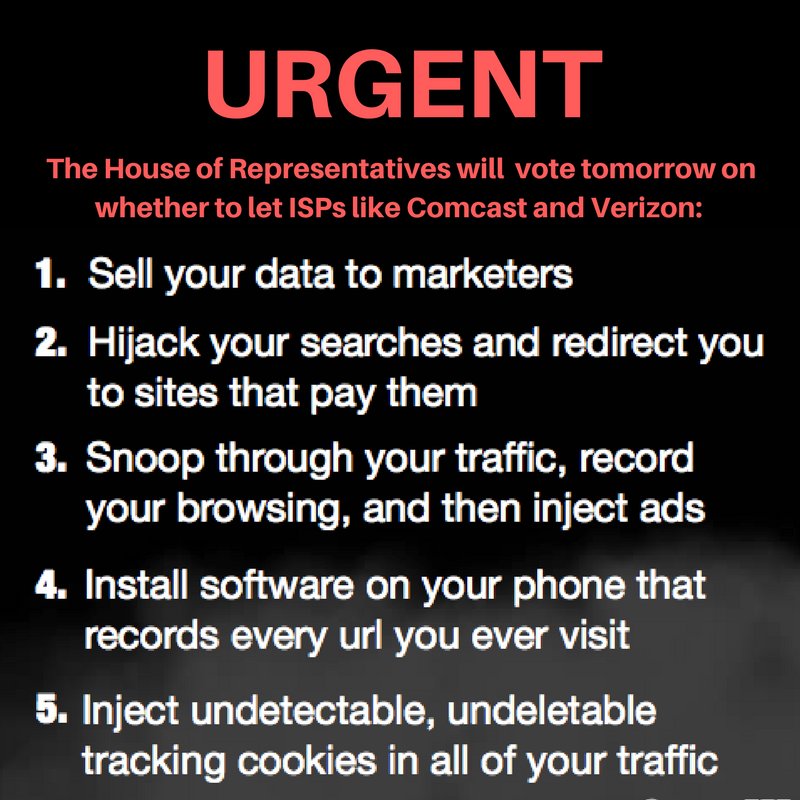
From Fight For The Future:
BREAKING: Congress has scheduled a vote TOMORROW to eliminate Internet privacy rules and allow ISPs to sell your data to advertisers without your permission. It already passed the Senate. This is our last chance to stop it.
Just last week, the Senate voted to gut internet privacy rules that prevent Internet Service Providers (ISPs) from selling your sensitive personal information to advertisers without your consent. [1]
The measure passed the Senate by only two votes. It was close, and there was significant public outcry which means we still have a chance to stop it.
Now the bill moves to the House of Representatives, and we just got word that they scheduled a vote on it TOMORROW. [2] They’re trying to ram it through quickly without discussion or debate. We need to stop them.
Call Congress right now. Tell them to vote NO on repealing the FCC broadband privacy rules.
We’ll connect you with your lawmakers and give you a simple script of what you can say. Here’s the number: (415) 360-0555
Can’t call right now? Help us sound the alarm and get out the word about this urgent assault on all of our Internet privacy rights.
Even creepier, they’ll be able to install software on your phone to track you, and inject undetectable “cookies” into your Internet traffic to record everything you’re doing online. [3]
If this bill passes the House, companies like Comcast, Verizon, and AT&T will be able to constantly (and secretly) collect our online activity and sell our browsing history, financial information, and real-time location, and sell it to advertisers without our permission.
We have less than 24 hours to create enough outcry to delay the vote or stop this bill entirely. There’s so much at stake. Will you call right now?
Call this number and we’ll connect you directly to your representatives: (415) 360-0555
We’ll keep you posted. Thanks for all you do,
-Laila and Evan at Fight for the Future
P.S. We just announced we’re going to put up billboards with the names of every member of Congress who votes for this attack on our privacy. Help us put them up in more districts by chipping in!
Or you can email your representative by clicking here.
Tuesday, March 14, 2017
Vote TODAY: Senate rushing to escalate the drug war
From Drug Policy Alliance:
As soon as this afternoon, the U.S. Senate could vote on a bill that would escalate the drug war by expanding the ability of states to drug test people who file for unemployment insurance. If it passes, it will go to President Trump to be signed into law.
This is our last chance to block it before the vote. Urge your Senators to oppose this harmful legislation.
The vast majority of people who receive unemployment insurance and other public assistance do not use drugs. But more importantly, drug testing programs have been proven again and again to accomplish nothing. They often have faulty results and waste millions of tax dollars.
Instead of following the evidence, Congress is stigmatizing vulnerable people looking for jobs to ramp up the failed drug war.
This is shameful, especially considering that members of Congress rushing to pass this legislation have claimed it will help people who struggle with addiction to opioids and other substances.
Yet most states that have tried these kind of drug testing programs don’t even offer or fund treatment for people who struggle with substance use.
In addition to being ineffective, harmful, and a complete waste of money, mandatory drug testing by states has been deemed illegal and unconstitutional by the courts time and again.
Contact your Senators immediately and tell them to oppose this attempt to escalate the drug war.
And follow-up with a call to your Senators. Find their phone numbers here and you can say:
As a constituent, I am calling to urge my Senator to oppose H.J. Res. 42 which would expand state drug testing of people who file for unemployment insurance. The vast majority of people who receive unemployment insurance and other public assistance do not use drugs. But more importantly, drug testing programs have been proven again and again to accomplish nothing. They often have faulty results, and waste millions of tax dollars. Please oppose H.J. Res. 42. Thank you.
We are doing everything we can to stop this bill from becoming law. But we’re counting on you to help us.
As soon as this afternoon, the U.S. Senate could vote on a bill that would escalate the drug war by expanding the ability of states to drug test people who file for unemployment insurance. If it passes, it will go to President Trump to be signed into law.
This is our last chance to block it before the vote. Urge your Senators to oppose this harmful legislation.
The vast majority of people who receive unemployment insurance and other public assistance do not use drugs. But more importantly, drug testing programs have been proven again and again to accomplish nothing. They often have faulty results and waste millions of tax dollars.
Instead of following the evidence, Congress is stigmatizing vulnerable people looking for jobs to ramp up the failed drug war.
This is shameful, especially considering that members of Congress rushing to pass this legislation have claimed it will help people who struggle with addiction to opioids and other substances.
Yet most states that have tried these kind of drug testing programs don’t even offer or fund treatment for people who struggle with substance use.
In addition to being ineffective, harmful, and a complete waste of money, mandatory drug testing by states has been deemed illegal and unconstitutional by the courts time and again.
Contact your Senators immediately and tell them to oppose this attempt to escalate the drug war.
And follow-up with a call to your Senators. Find their phone numbers here and you can say:
As a constituent, I am calling to urge my Senator to oppose H.J. Res. 42 which would expand state drug testing of people who file for unemployment insurance. The vast majority of people who receive unemployment insurance and other public assistance do not use drugs. But more importantly, drug testing programs have been proven again and again to accomplish nothing. They often have faulty results, and waste millions of tax dollars. Please oppose H.J. Res. 42. Thank you.
We are doing everything we can to stop this bill from becoming law. But we’re counting on you to help us.
Wednesday, February 8, 2017
Net neutrality is not partisan so protect it right away
From Fight For The Future:
The Internet is awesome. It lets us access more information than ever before, find alternatives to mainstream news, keep in touch with our friends, find new music and videos, and more.
Why is it so awesome? Because unlike television and print, what you see and do online is up to *you*—not some corporation or bureaucrat.
But politicians and lobbyists from the cable companies keep trying to mess with that fundamental structure. They want to allow the government and corporate monopolies to slow down or censor certain websites in order to squeeze us for more money, or because they don’t like their politics.
One of the biggest problems is that politicians in Washington, DC have decided to turn the Internet into a political football. They’ve made net neutrality a partisan issue, which is silly because it’s not -- it’s a basic technological principle that has made the Internet what it is today. Now the former lobbyist for Big Cable who's been put in charge of internet regulation, Ajit Pai, says he’s planning to “take a weed whacker” to the basic principle upholding the open web.
We need to show Congress and the FCC that people from all across the political spectrum love the Internet and don’t want politicians to screw it up by getting rid of net neutrality. Sign the petition, and check one of the boxes to show decision makers that people want the Internet to stay awesome, regardless of their political ideology.
When you sign the petition, back it up by indicating where you fall on the political map, and share with everyone you know who feels the same!
The Internet is awesome. It lets us access more information than ever before, find alternatives to mainstream news, keep in touch with our friends, find new music and videos, and more.
Why is it so awesome? Because unlike television and print, what you see and do online is up to *you*—not some corporation or bureaucrat.
But politicians and lobbyists from the cable companies keep trying to mess with that fundamental structure. They want to allow the government and corporate monopolies to slow down or censor certain websites in order to squeeze us for more money, or because they don’t like their politics.
One of the biggest problems is that politicians in Washington, DC have decided to turn the Internet into a political football. They’ve made net neutrality a partisan issue, which is silly because it’s not -- it’s a basic technological principle that has made the Internet what it is today. Now the former lobbyist for Big Cable who's been put in charge of internet regulation, Ajit Pai, says he’s planning to “take a weed whacker” to the basic principle upholding the open web.
We need to show Congress and the FCC that people from all across the political spectrum love the Internet and don’t want politicians to screw it up by getting rid of net neutrality. Sign the petition, and check one of the boxes to show decision makers that people want the Internet to stay awesome, regardless of their political ideology.
When you sign the petition, back it up by indicating where you fall on the political map, and share with everyone you know who feels the same!
Saturday, February 4, 2017
Voters demanded pot policy changes, it’s time for lawmakers to listen
Voters in eight states decided on Election Day to radically amend their longstanding marijuana policies.
In four states – California, Maine, Massachusetts, and Nevada – voters approved initiatives to regulate the production, use, and retail sale of cannabis to adults. In an additional four states – Arkansas, Florida, Montana, and North Dakota – voters decided in favor of ballot measures to permit the dispensing and use of marijuana for therapeutic purposes.
In each of these jurisdictions, proponents of marijuana policy reform were forced to bring the issue directly to the voters because elected officials steadfastly refused to address it legislatively. In the weeks following the election, little has changed.
Despite these voter mandates, many lawmakers remain reluctant to move forward with the legal reforms that the public has demanded. In some cases, legislators and regulators are outright defying voters’ will by proposing measures to undermine the election’s outcomes altogether.
In Arkansas, where 53 percent of voters approved a constitutional amendment — the Arkansas Medical Marijuana Act — state lawmakers immediately passed emergency implementation to delay the law’s enactment, while additional legislation remains pending to prevent the law’s implementation altogether. Separate legislative efforts are also pending to significantly rewrite the law in a manner that is far more restrictive than what voters intended.
A similar scenario is emerging in Florida, where 71 percent of voters endorsed a constitutional amendment providing doctors with the discretion to recommend medical marijuana to patients for whom they believed the benefits “would likely outweigh the potential health risks.” In recent weeks, however, lawmakers and regulators have proposed rules that seek to gut many of the law’s key provisions.
Specifically, newly released regulations seek to: halt the state from licensing would-be medical marijuana providers, forbid doctors from authorizing cannabis for chronic pain patients, and to restrict qualifying patients from obtaining whole-plant cannabis (instead limiting patients’ use to marijuana-infused products only).
Things are little different in North Dakota. Despite the fact that 64 percent of voters passed the Compassionate Care Act in November, leadership in the House and Senate is moving full speed ahead to suspend the law’s enactment.
Voter-initiated plans to regulate the retail production and sale of marijuana to adults have fared little better.
In Massachusetts, a handful of political leaders pushed through emergency legislation during an informal legislative session to delay marijuana sales until July 1, 2018.
The Boston Globe summarized the event this way, “The extraordinary move, made in informal sessions with just a half-dozen legislators present, … unravel[s] a significant part of the legalization measure passed by 1.8 million voters.” Additional measures before lawmakers seek to further undue several other aspects of the law, including adults’ ability to grow marijuana in their private residence.
In Maine, lawmakers have similarly rushed legislation through both chambers to delay the enactment of voter-initiated provisions governing the retail production and sale of marijuana until the spring of 2018. The emergency measure also rolls back specific initiative provisions that permitted on site consumption in specially licensed establishments, as well as the possession of marijuana-infused edible products.
Lawmakers’ decision to disregard the will of their constituents is both arrogant and troubling. Whether or not one supports marijuana law reform, one should find legislators’ attitudes and actions an affront to the democratic process. Americans have been told time and time again that ‘elections have consequences.’ There should not be a ‘marijuana exception’ to this longstanding principle.
Voters made their opinions on marijuana policy clear at the ballot box in November. Lawmakers in these jurisdictions have a responsibility to abide by the will of the people and to do so in a timely manner. Americans have lived with the failings of marijuana prohibition for far too long.
The people’s will should not be compromised, second-guessed, or held hostage by politicians who are unwilling to recognize that they are on the wrong side of history.
Source
That's a good idea. Perhaps our lawmakers need to hear what We The People have to say. You can contact your Congressional Representative and your Senators and bring this to their attention. Give them the link to the source of this article so that they know we mean business.The more of us they hear from the better so let's do it to it.
In four states – California, Maine, Massachusetts, and Nevada – voters approved initiatives to regulate the production, use, and retail sale of cannabis to adults. In an additional four states – Arkansas, Florida, Montana, and North Dakota – voters decided in favor of ballot measures to permit the dispensing and use of marijuana for therapeutic purposes.
In each of these jurisdictions, proponents of marijuana policy reform were forced to bring the issue directly to the voters because elected officials steadfastly refused to address it legislatively. In the weeks following the election, little has changed.
Despite these voter mandates, many lawmakers remain reluctant to move forward with the legal reforms that the public has demanded. In some cases, legislators and regulators are outright defying voters’ will by proposing measures to undermine the election’s outcomes altogether.
In Arkansas, where 53 percent of voters approved a constitutional amendment — the Arkansas Medical Marijuana Act — state lawmakers immediately passed emergency implementation to delay the law’s enactment, while additional legislation remains pending to prevent the law’s implementation altogether. Separate legislative efforts are also pending to significantly rewrite the law in a manner that is far more restrictive than what voters intended.
A similar scenario is emerging in Florida, where 71 percent of voters endorsed a constitutional amendment providing doctors with the discretion to recommend medical marijuana to patients for whom they believed the benefits “would likely outweigh the potential health risks.” In recent weeks, however, lawmakers and regulators have proposed rules that seek to gut many of the law’s key provisions.
Specifically, newly released regulations seek to: halt the state from licensing would-be medical marijuana providers, forbid doctors from authorizing cannabis for chronic pain patients, and to restrict qualifying patients from obtaining whole-plant cannabis (instead limiting patients’ use to marijuana-infused products only).
Things are little different in North Dakota. Despite the fact that 64 percent of voters passed the Compassionate Care Act in November, leadership in the House and Senate is moving full speed ahead to suspend the law’s enactment.
Voter-initiated plans to regulate the retail production and sale of marijuana to adults have fared little better.
In Massachusetts, a handful of political leaders pushed through emergency legislation during an informal legislative session to delay marijuana sales until July 1, 2018.
The Boston Globe summarized the event this way, “The extraordinary move, made in informal sessions with just a half-dozen legislators present, … unravel[s] a significant part of the legalization measure passed by 1.8 million voters.” Additional measures before lawmakers seek to further undue several other aspects of the law, including adults’ ability to grow marijuana in their private residence.
In Maine, lawmakers have similarly rushed legislation through both chambers to delay the enactment of voter-initiated provisions governing the retail production and sale of marijuana until the spring of 2018. The emergency measure also rolls back specific initiative provisions that permitted on site consumption in specially licensed establishments, as well as the possession of marijuana-infused edible products.
Lawmakers’ decision to disregard the will of their constituents is both arrogant and troubling. Whether or not one supports marijuana law reform, one should find legislators’ attitudes and actions an affront to the democratic process. Americans have been told time and time again that ‘elections have consequences.’ There should not be a ‘marijuana exception’ to this longstanding principle.
Voters made their opinions on marijuana policy clear at the ballot box in November. Lawmakers in these jurisdictions have a responsibility to abide by the will of the people and to do so in a timely manner. Americans have lived with the failings of marijuana prohibition for far too long.
The people’s will should not be compromised, second-guessed, or held hostage by politicians who are unwilling to recognize that they are on the wrong side of history.
Source
That's a good idea. Perhaps our lawmakers need to hear what We The People have to say. You can contact your Congressional Representative and your Senators and bring this to their attention. Give them the link to the source of this article so that they know we mean business.The more of us they hear from the better so let's do it to it.
Saturday, January 28, 2017
Subscribe to:
Posts (Atom)