Showing posts with label racism. Show all posts
Showing posts with label racism. Show all posts
Thursday, June 18, 2020

Saturday, November 16, 2019
The Coyote and the Roadrunner-Washington DC style
In the most epic battle in his career. Congressman Adam Schiff is once again searching for what is going to justify his actions. He is taking on the characteristics of a coyote. A Wylie E. Coyote as he tracks his prey who is the rightfully elected President of the people, Donald J.Trump, also known by the codename "Roadrunner".
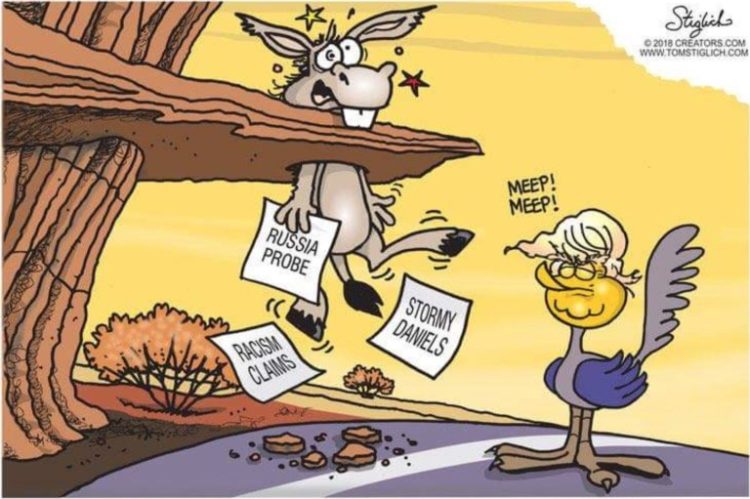
Each and everyday Wylie waits desperately for vindication and success. But to no avail. He has until November 2020 to pull it off or don't even bother. Everything will have dramatically changed after that. He may not have the majority like he does now.
Each and everyday Wylie waits desperately for vindication and success. But to no avail. He has until November 2020 to pull it off or don't even bother. Everything will have dramatically changed after that. He may not have the majority like he does now.
Sunday, November 10, 2019
Socialized Murder
(Tea Party 247) – The National Health Service (NHS) in the UK has announced they will be withdrawing treatment from patients who fail the golden progressive standard of tolerance and acceptance.
That’s right: they’ll be denying medical care to racists or sexists.
Patients will be subject to a “sports-style disciplinary yellow card and then final red card in which treatment would be withdrawn as soon as is safe” the North Bristol NHS Trust announced on their website.
The policy would not just cover “Threatening and offensive language” but also “Racist or sexist language, gestures or behaviour” in a disturbingly ambiguous phrasing, as well as more generally, as well as “malicious allegations.”
This is a concerning caveat, considering the NHS has, in the past, been caught up in large-scale malpractice scandals which were initially denied by hospitals and staff.
“We have staff from many different backgrounds, from all over the world, and we pride ourselves on our commitment to equality which is a fundamental value of the NHS,” commented Andrea Young, Chief Executive for North Bristol NHS Trust.
“We’re sending a strong signal that any racism or discrimination is completely unacceptable – we want staff to challenge and report it and we want everyone to know that it will have consequences.”
The trust does not, conveniently, explain exactly how broad the definition of “offensive” will on which to base withdrawal of treatment.
“We have staff from many different backgrounds, from all over the world, and we pride ourselves on our commitment to equality which is a fundamental value of the NHS,” commented Andrea Young, Chief Executive for North Bristol NHS Trust.
“We’re sending a strong signal that any racism or discrimination is completely unacceptable – we want staff to challenge and report it and we want everyone to know that it will have consequences.”
The trust does not, conveniently, explain exactly how broad the definition of “offensive” will on which to base withdrawal of treatment.
Breitbart explains:
For example, in late 2017 an NHS patient who requested a female nurse to carry out a cervical smear complained when the hospital sent a person with “an obviously male appearance… close-cropped hair, a male facial appearance and voice, large number of tattoos and facial stubble” who insisted “My gender is not male. I’m a transsexual”.
It is not clear whether the patient could have fallen foul of the Bristol policy had it been in place and the nurse had chosen to take offence — and nor is it clear how far the trust’s assurances that it will only withdraw treatment once clinically safe extend, and if patients could, for example, be denied diagnostic procedures or so-called routine
operations such as hip replacements, for which many patients have to wait eight months or more.
British state authorities have recently been showing quite a zeal for political correctness. In 2012, Foster parents caring for “not indigenous White British” children had them taken away by Labour-run Rotherham Borough Council in 2012 because they were members of the UK’s Independence Party (UKIP), then led by Nigel Farage.
Joyce Thacker, the Strategic Director of Children and Young People’s Services said that she was concerned that UKIP opposed mass immigration which made the foster parents incapable of meeting the “cultural and ethnic needs” of non-British children or the “active promotion of multiculturalism.”
Another NHS trust for the area, the University Hospitals Briston NHS Foundation Trust has displayed painful progressive political correctness, once having ordered the removal of the British flag from security staff stab vests after someone claimed that the Union Jack was “offensive.”
Source
Who lives, who dies. You may want to check the Labour Party website to see if your name is on the die list. Are we going to define "racist" as "anybody that believes a certain race is above the rest and that the rest are inferior." Are we going to define "sexism" as the belief that a particular gender is better than the other and the other is inferior". Which is an unbias definition. Or will go the PC route? "Only white males are racists and sexists". With this crowd I'm betting on the latter. What if you've had a bad day or dropped something on your toes and there is momentary pain and you say something offensive? Can you be denied medical services because you unconsciously said something on the prohibited list? What if you going to court because you were accused of a sex crime, just merely accused and you need medical attention. Will they treat you, deny you health care or worse yet murder you because you've been accused of a misogynistic sex crime and the medical staff are indoctrinated with radical feminism? They'll justify it as "one less rapist in the world" when you haven't even been tried for it and no verdict rendered. What if a member of the medical staff doesn't like you and makes a false accusation against you? What if you are a victim of a false accusation of racism and/or sexism? Is a mere accusation considered undeniable proof you are guilty?
Does this mean that a member of the protected class can taunt a white male with insults and throws harmful objects such as rocks at that white male without any repercussions but if that white male attacks back or merely defends himself from being physically attacked he will be punished for it? What if hospital staff try to extort money from the patients (give me money or I put your name on the die list) or their friends or family (give us money or you and/or the patient will die). What if your name is accidentally placed on the die list? Will you live long enough to fight it and win? What if they hate people who contest their decisions and puts you on the die list for doing it? So many questions yet no answers.
That’s right: they’ll be denying medical care to racists or sexists.
Patients will be subject to a “sports-style disciplinary yellow card and then final red card in which treatment would be withdrawn as soon as is safe” the North Bristol NHS Trust announced on their website.
The policy would not just cover “Threatening and offensive language” but also “Racist or sexist language, gestures or behaviour” in a disturbingly ambiguous phrasing, as well as more generally, as well as “malicious allegations.”
This is a concerning caveat, considering the NHS has, in the past, been caught up in large-scale malpractice scandals which were initially denied by hospitals and staff.
“We have staff from many different backgrounds, from all over the world, and we pride ourselves on our commitment to equality which is a fundamental value of the NHS,” commented Andrea Young, Chief Executive for North Bristol NHS Trust.
“We’re sending a strong signal that any racism or discrimination is completely unacceptable – we want staff to challenge and report it and we want everyone to know that it will have consequences.”
The trust does not, conveniently, explain exactly how broad the definition of “offensive” will on which to base withdrawal of treatment.
“We have staff from many different backgrounds, from all over the world, and we pride ourselves on our commitment to equality which is a fundamental value of the NHS,” commented Andrea Young, Chief Executive for North Bristol NHS Trust.
“We’re sending a strong signal that any racism or discrimination is completely unacceptable – we want staff to challenge and report it and we want everyone to know that it will have consequences.”
The trust does not, conveniently, explain exactly how broad the definition of “offensive” will on which to base withdrawal of treatment.
Breitbart explains:
For example, in late 2017 an NHS patient who requested a female nurse to carry out a cervical smear complained when the hospital sent a person with “an obviously male appearance… close-cropped hair, a male facial appearance and voice, large number of tattoos and facial stubble” who insisted “My gender is not male. I’m a transsexual”.
It is not clear whether the patient could have fallen foul of the Bristol policy had it been in place and the nurse had chosen to take offence — and nor is it clear how far the trust’s assurances that it will only withdraw treatment once clinically safe extend, and if patients could, for example, be denied diagnostic procedures or so-called routine
operations such as hip replacements, for which many patients have to wait eight months or more.
British state authorities have recently been showing quite a zeal for political correctness. In 2012, Foster parents caring for “not indigenous White British” children had them taken away by Labour-run Rotherham Borough Council in 2012 because they were members of the UK’s Independence Party (UKIP), then led by Nigel Farage.
Joyce Thacker, the Strategic Director of Children and Young People’s Services said that she was concerned that UKIP opposed mass immigration which made the foster parents incapable of meeting the “cultural and ethnic needs” of non-British children or the “active promotion of multiculturalism.”
Another NHS trust for the area, the University Hospitals Briston NHS Foundation Trust has displayed painful progressive political correctness, once having ordered the removal of the British flag from security staff stab vests after someone claimed that the Union Jack was “offensive.”
Source
Who lives, who dies. You may want to check the Labour Party website to see if your name is on the die list. Are we going to define "racist" as "anybody that believes a certain race is above the rest and that the rest are inferior." Are we going to define "sexism" as the belief that a particular gender is better than the other and the other is inferior". Which is an unbias definition. Or will go the PC route? "Only white males are racists and sexists". With this crowd I'm betting on the latter. What if you've had a bad day or dropped something on your toes and there is momentary pain and you say something offensive? Can you be denied medical services because you unconsciously said something on the prohibited list? What if you going to court because you were accused of a sex crime, just merely accused and you need medical attention. Will they treat you, deny you health care or worse yet murder you because you've been accused of a misogynistic sex crime and the medical staff are indoctrinated with radical feminism? They'll justify it as "one less rapist in the world" when you haven't even been tried for it and no verdict rendered. What if a member of the medical staff doesn't like you and makes a false accusation against you? What if you are a victim of a false accusation of racism and/or sexism? Is a mere accusation considered undeniable proof you are guilty?
Does this mean that a member of the protected class can taunt a white male with insults and throws harmful objects such as rocks at that white male without any repercussions but if that white male attacks back or merely defends himself from being physically attacked he will be punished for it? What if hospital staff try to extort money from the patients (give me money or I put your name on the die list) or their friends or family (give us money or you and/or the patient will die). What if your name is accidentally placed on the die list? Will you live long enough to fight it and win? What if they hate people who contest their decisions and puts you on the die list for doing it? So many questions yet no answers.
Saturday, April 6, 2019
The politicization of cannabis legalization
The pro-legalization of cannabis nationwide is gathering momentum.That is great. What is not-so-great is the left wing politics that are permeating the movement. Specifically in this case racism. Race is a bad indicator to go on because not every black or brown person is cited for marijuana possession. Not only that but Caucasians,specifically men who are cited,will go uncounted due to race and especially gender. The best way the powers that be can make this up is to expunge convictions and overturn ridiculous judgements (being barred from the marijuana industry by judges due to prohibition and other ridiculous conditions.) Regardless of race and/or gender. Also allow market forces dictate the supply and demand when it comes to cannabis,ease up on taxing it to death.
Thursday, April 19, 2018
Kevin Sabet-Sharghi royally steps in it
Marijuana legalization is up for a vote in Illinois. Both sides are present in Illinois to lobby for or against marijuana legalization. Guess who else was out there? Our old friend Kevin Sabet-Sharghi. Leader of Smart Approaches to Marijuana aka SAM. Using the word "smart" to describe this group is like using the word "tiny" when discussing a large person. To prove it the Kev himself made the following statement:
“We think marijuana is taking cues from Big Tobacco,” Sabet said. “This is not about mom and pop stores growing weed, this is all about Wall Street and Silicon Valley, rich white guys who want to get richer off marijuana.”
“I hope we’ll have more balance in this debate, we talk about both revenue and cost, we do a comparison,” Sabet said. “We’re advocating to slow down legalization, smarter policies, more prevention, a holistic way to look at substance abuse.”
Source
2nd paragraph: IOW blah blah blah.
I don't usually take this route but it is difficult to take this guy seriously. Yes he made both a racist and sexist statement. Has anyone else brought this up? As of right now at posting time: no they haven't. I guess the anti-choice,anti-freedom types like the Kev and his cohorts have to rely on both racism and sexism to promote their cause. The more things change the more they stay the same.
“We think marijuana is taking cues from Big Tobacco,” Sabet said. “This is not about mom and pop stores growing weed, this is all about Wall Street and Silicon Valley, rich white guys who want to get richer off marijuana.”
“I hope we’ll have more balance in this debate, we talk about both revenue and cost, we do a comparison,” Sabet said. “We’re advocating to slow down legalization, smarter policies, more prevention, a holistic way to look at substance abuse.”
Source
2nd paragraph: IOW blah blah blah.
I don't usually take this route but it is difficult to take this guy seriously. Yes he made both a racist and sexist statement. Has anyone else brought this up? As of right now at posting time: no they haven't. I guess the anti-choice,anti-freedom types like the Kev and his cohorts have to rely on both racism and sexism to promote their cause. The more things change the more they stay the same.
Sunday, September 3, 2017
Greedy businesspeople in Michigan want to thwart the will of the people
From Marijuana Policy Project:
Until recently, our signature drive to place a marijuana legalization initiative on the Michigan ballot was running smoothly.
There’ve been no serious problems with the campaign’s coalition or petitioning personnel, no problems with the initiative language, no problems in court, and no problems with meeting deadlines.
There are, however, problems with an aspiring marijuana cartel.
You see, a small circle of politically connected businessmen want to own the only companies that can legally grow and produce marijuana in Michigan. Unfortunately, because our initiative is too fair – it would allow regular people to own and run businesses – the creepy businessmen are working to prevent our initiative from reaching the November 2018 ballot, just so they can pass their own version of marijuana legalization in November 2020.
And they don’t care if an extra 40,000 Michiganders (mostly young men of color) get arrested for marijuana because of the two-year delay.
Seeing that our signature drive was ahead of schedule, the creepy businessmen recently convinced their friends in the Michigan government to target our initiative’s biggest source of funding – the dispensaries that provide medical marijuana to patients in all of southeastern Michigan. Almost all dispensaries are now expected to close by September 15.
Please punch back by donating $35 toward the $350,000 we need to complete the Michigan signature drive.
The old-boys club is sacrificing young black men on an altar of greed ... by using their tools in government to take medicine away from patients. You read that correctly: The bad guys are shooting at two groups of disadvantaged people to get what they want.
Now it’s your turn to fight two bad guys for the price of one: Please donate $35 or $1,000 today to defeat the cartel wannabes and corrupt government officials.
Until recently, our signature drive to place a marijuana legalization initiative on the Michigan ballot was running smoothly.
There’ve been no serious problems with the campaign’s coalition or petitioning personnel, no problems with the initiative language, no problems in court, and no problems with meeting deadlines.
There are, however, problems with an aspiring marijuana cartel.
You see, a small circle of politically connected businessmen want to own the only companies that can legally grow and produce marijuana in Michigan. Unfortunately, because our initiative is too fair – it would allow regular people to own and run businesses – the creepy businessmen are working to prevent our initiative from reaching the November 2018 ballot, just so they can pass their own version of marijuana legalization in November 2020.
And they don’t care if an extra 40,000 Michiganders (mostly young men of color) get arrested for marijuana because of the two-year delay.
Seeing that our signature drive was ahead of schedule, the creepy businessmen recently convinced their friends in the Michigan government to target our initiative’s biggest source of funding – the dispensaries that provide medical marijuana to patients in all of southeastern Michigan. Almost all dispensaries are now expected to close by September 15.
Please punch back by donating $35 toward the $350,000 we need to complete the Michigan signature drive.
The old-boys club is sacrificing young black men on an altar of greed ... by using their tools in government to take medicine away from patients. You read that correctly: The bad guys are shooting at two groups of disadvantaged people to get what they want.
Now it’s your turn to fight two bad guys for the price of one: Please donate $35 or $1,000 today to defeat the cartel wannabes and corrupt government officials.
Thursday, July 6, 2017
A couple of disappointments


What do Barrack Obama and Kim Jong Un have in common? They are both disappointments. Obama could have given us a Star Trek future where race was no longer a factor. That you could be anything you wanted without someone holding you down. He could have shown African-Americans a better,brighter future. What does he do? Take us back to the '50's and before with his race baiting and divisive tactics.
Kim was educated outside of North Korea. He knows the western world is nothing like the North Koreans are portraying it. He could have led his people into the 21st century. He could have been the Korean version of Mikhail Gorbachev instead he is the 2nd North Korean leader that is a a reminder of Josef Stalin. Just like his grandpa.
These two showed promise and as it turns out it is a promise broken.
Friday, April 14, 2017
We have his attention

Attorney General Jeff Sessions expressed shock at the swift public backlash to his fiery rhetoric on federal marijuana policy and his opposition to legalization.
Speaking on a range of issues at Luke Air Force Base in Arizona Tuesday, Sessions addressed his opposition to further easement of marijuana laws in states across the country. He also expressed confusion over the amount of attention his comments on marijuana during his confirmation hearing received, reports AZ Central.
Sessions, a stanch opponent of legalization, is currently reviewing the Cole Memorandum, a set of guidelines established in 2013 that direct DOJ to focus marijuana enforcement efforts on violent crimes and distribution in states without legalization laws.
“When they nominated me for attorney general, you would have thought the biggest issue in America was when I said, ‘I don’t think America’s going to be a better place if they sell marijuana at every corner grocery store,'” Sessions said Tuesday, according to AZ Central. “(People) didn’t like that; I’m surprised they didn’t like that.”
Sessions also touched on illegal immigration and border protection Tuesday, reiterating his belief that a wall and bolstered enforcement will greatly cut down on the flow of illegal drugs into the U.S.
Sessions claimed in February “there’s more violence around marijuana than one would think, and there’s big money involved.” It is unclear how aggressive the administration will ultimately be on the issue, but officials in states with legalization laws are preparing for the worst.
The governors of Alaska, Colorado, Oregon and Washington, the first four states to legalize recreational marijuana, sent a letter to Sessions and Secretary of the Treasury Steve Mnuchin April 3, imploring them to leave marijuana policy to the states.
The governors say they previously opposed legal weed but argue the policy is boosting revenue and helping reduce the “inequitable incarceration” of minority groups.
Sessions and the Trump administration could cost the marijuana industry hundreds of thousands of jobs if they interfere with state pot laws. A report released in February by New Frontier Data projects that an unimpeded marijuana market will create more than 250,000 jobs by 2020. The booming projections for growth stand in stark contrast to manufacturing jobs, which are expected to crater by more than 800,000 by 2024.
Source
Wednesday, February 15, 2017
Black Lives Matter Leader Says White People Are ‘Sub-Human’ and Suffer From ‘Genetic Defects’

A Black Lives Matter leader has come under fire after arguing on social media that white people are “sub-human” and suffer from “recessive genetic defects,” and musing about how the race could be wiped out.
In a Facebook post, Black Lives Matter Toronto co-founder Yusra Khogali went on a rant, arguing that black people are the superior race because white people posses “genetic defects” that make them lesser humans, according to the Toronto Sun.
“Whiteness is not humxness, in fact, white skin is sub-humxn,” she wrote. “All phenotypes exist within the black family and white ppl are a genetic defect of blackness.”
She continued explaining her theory, claiming white people are lesser because “[they] have a higher concentration of enzyme inhibitors that suppress melanin production. They are genetically deficient because melanin is present at the inception of life.”
“Melanin enables black skin to capture light and hold it in its memory mode which reveals that blackness converts light into knowledge. Melanin directly communicates with cosmic energy,” she added.
Toronto Police Forced To Withdraw From LGBTQ Pride Parade Following Black Lives Matter Demands
Khogali then proclaimed: “White ppl are recessive genetic defects. This is factual.”
The Black Lives Matter leader then wondered how the white race could be wiped out. According to her, “Black ppl simply through their dominant genes can literally wipe out the white race if we had the power to.”
“Do you ever wonder how black ppl after centuries of colonial violence, genocide and destruction—no matter what systems created to make us extinct… How we keep coming back? It is because we are superhumxns,” she added.
This isn’t the first time the firebrand BLM Toronto chapter co-founder got into hot water. Last week, Heat Street reported about Khogali’s speech during a protest in Toronto, where she accused Canada’s Prime Minister Justin Trudeau of being a “white supremacist terrorist” for welcoming refugees to the country.
During the protest, she was seen shouting: “When Justin Trudeau says that he is a liar! He’s a hypocrite! He is a white supremacist terrorist! That is what he is,” she said. “Do not be fooled by his liberal bullshit. Do not be fooled.”
Last year, according to Newstalk 1010, she also caused a controversy after tweeting: “Plz Allah give me strength to not cuss/kill these men and white folks out here today. Plz plz plz.”
Source
Tuesday, December 20, 2016
Liberals hate the Constitution
The Constitution of the United States has failed
This is not fine.
What kind of nation allows the loser of a national election to become president — and then does it again 16 years later?
What kind of nation retains an electoral process that was originally designed to inflate the influence of slaveholders?
What kind of nation permits its Congress to write a time bomb into law that periodically forces rival factions into a game of chicken that could wreck the world economy?
What kind of nation fights a civil war over the question of whether people of African descent are people or property, and then looks the other way when the loser ignores the resolution of that war? What kind of nation waits until 1965 to guarantee black people’s right to vote?
Americans speak of our Constitution as if it were a religious text. To label a law “unconstitutional” is not simply to say that it violates some procedural rule or legal technicality, it is to label it fundamentally unAmerican. To do so is to question the values of any lawmaker despicable enough to support such a law, and to suggest that those values are at odds with who we are as a nation.
But our Constitution has not served us nearly as well as we would have been served by other systems adopted by our peer nations. Nor has it lived up to the expectations of its drafters.
Now, our country is facing a man of superlative ignorance. A racist. An admitted sexual assaulter of women. A man poised to violate the Constitution the very instant he takes the oath of office. A man who openly encouraged Russia’s efforts to usher him into the White House. A man who owes his election to the underhanded efforts of deep state actors within our nation’s internal police agency. A man who lost the popular vote by nearly 3 million votes. And the Constitution has placed this man in the White House.
The Constitution gave Donald Trump command of the world’s most powerful military and an nuclear arsenal that can eradicate all life on Earth. It let him name a racist as our nation’s top enforcer of its laws. It let him use his office to sell hotel rooms to foreign diplomats. The Electoral College has voted. Trump will be our next president. This is what the Constitution hath wrought.
It did this because our Constitution remains the product of a compromise with moral monsters who believed that human beings could be owned as property. It did this because our Constitution offers no guarantee, or even much in the way of likelihood, that the men and women elected to lead the country will share the preferences of the nation as a whole. It did this because our Constitution fosters voter ignorance. It did this because our Constitution can be gamed — and was gamed quite successfully by the Republican Party.
The price of peace
There are competing theories for why America has an Electoral College. One, offered by Alexander Hamilton in an advocacy document written to persuade the nation to support its new Constitution, is that it would allow “men most capable of analyzing the qualities adapted to” the presidency to determine who should hold that crucial job.
Another theory, which Hamilton did not include in his sales pitch for the Constitution, is that the Electoral College was part of the price northerners had to pay in order to form a union with states whose entire economic model depended on slavery.
Regardless of which theory you prefer, it is undeniable that the Electoral College now serves the second goal of giving a leg up to racists far better than it serves the first. In 2016, the electors themselves are almost entirely obscurities — party activists who are typically selected more for their willingness to cast a vote for their party’s candidate than for their ability to analyse the qualities best adapted to the presidency. Even if they’d wanted to elect someone other than Donald Trump as the president, they lack the stature necessary to quell unrest that would likely ensue.
What the Electoral College has done is steal the presidency from the woman who won it, and given it to a man who openly campaigned on racism and nativism. It’s the sort of outcome that would make many of the Founding Fathers smile — the ones who demanded a terrible price as the cost of Union.
To be sure, there were good men at the Philadelphia convention that drafted the original Constitution. There were men who, as Gouverner Morris said in a speech to the convention, saw slavery as a “nefarious institution” and “the curse of heaven on the States where it prevailed.” There were also delegates from large states who stood for the very simple proposition that a vote from Virginia should count exactly the same amount as a vote from Delaware.
Yet these good men traded away their convictions. The new Constitution explicitly protected slavery. It allowed slave states to count each slave as three-fifths of a person for purposes of calculating representation in the House and the Electoral College, even though those slaves could not vote. And it created the Senate, an anti-democratic body which today counts each person in Wyoming as 67 times more important than each person in California.
The good men in Philadelphia agreed to these terms in service of a singular goal: peace through Union. As Yale’s Akhil Amar explains, the Articles of Confederation, the loose alliance of states that preceded the Constitution, conceived of the United States as “an alliance, a multilateral treaty of sovereign nation-states.” Pennsylvania was as much a separate a sovereign nation from Virginia as Russia is today separate from China. The Articles largely bound these nations into a pact of mutual commerce and defense.
Nevertheless, the framers were well-versed in European history. They knew of the frequent warfare which plagued that continent, and they came to see Union as the best defense against a similar fate. As Amar describes their concerns, “each nation-state might well raise an army, ostensibly to protect itself against Indians or Europeans, but also perhaps to awe its neighbors. America would then recreate continental Europe — borders, armies, dictators, chains, and all.”
The threat from such armies, moreover, was twofold. As Hamilton warned, these armies could themselves be turned against the people, becoming “engines of despotism” that would lead the states in a “progressive direction toward monarchy.” Standing armies were a threat, not just to rival states, but to the people of their home states.
More than two centuries later, the Founding Fathers’ belief that their Constitution would keep America from keeping a standing army is quaint. The United States has the most powerful military in the world, in addition to a network of federal police, intelligence agencies, and an entire cabinet department devoted to internal security. Perhaps these institutions will balk if Trump orders them to impose the kind of tyranny Hamilton feared, but the Constitution sure did not stop them from being built.
It also didn’t save us from war among the states. The early history of the United States was an uneasy peace broken by regional conflicts and near-misses — the Nullification Crisis, Bleeding Kansas, John Brown’s raid on Harper’s Ferry. And then the war came, a four year conflict that killed between 2 and 3 percent of the nation’s entire population.
Our Founding Fathers traded away democracy. They traded away the fundamental principle that every American’s vote is equal. They traded away every person’s inalienable right to freedom. And they’d traded it away for nothing.
Three generations of lost rights
If you go to the American South today, and you speak to a black person over the age of 50, you are most likely speaking to someone who was born into an apartheid state. If you speak to someone over the age of 70, that person probably had their voting rights stolen from them by a white supremacist regime.
This is not ancient history. These are flesh and blood Americans who live and work among us. America became a liberal democracy in 1965, when President Lyndon Johnson signed the Voting Rights Act. Free and fair elections, at least at the nationwide level, are not something we have all that much experience with.
It wasn’t supposed to be this way. When the Civil War was won, the victors demanded a new covenant. They wrote slavery out of our Constitution. They wrote freedmen’s right to vote into the Constitution. And, in the most sweeping and radical change that has ever been written into the Constitution, they completely reworked the balance of power between the states and the people.
The Fourteenth Amendment declared, for the first time in American history, that everyone born in the United States is a citizen and that every citizen enjoys certain rights solely because they are an American (without this amendment, states were free to violate the Bill of Rights). It provided that no one can be stripped of their liberty without appropriate legal process, and it insisted on equal treatment along racial lines.
Yet, for much of the next century, the South gleefully ignored these guarantees. “Black codes” relegated freedmen to a status that was often difficult to distinguish from actual slavery. Black men were arrested for minor or even fabricated offenses, then rented out to whites as cheap labor. Jim Crow segregated African Americans and stripped them of their vote. And if anyone dared to question white supremacy, they were quieted by terrorist groups like the Ku Klux Klan, which often worked in close coordination with the state.
There are many villains in this saga. The resilience of white supremacist government in the South occurred because the Supreme Court largely sat on its hands, often explicitly embracing the South’s most odious practices. It happened because the rest of the nation lost its nerve, abandoning Reconstruction for a peace built from the bones of black Americans. It happened because of immoral men willing to use murder as a tool of political control. But white supremacy also thrived because of the Founding Fathers.
Remember that compromise? The one that gave Alabama exactly the same number of senators as New York? It also prevented Congress from enacting a single civil rights law from 1875 until 1957.
The Civil Rights Act of 1875 was one of Congress’ final serious attempts to reconstruct the South. Enacted just over a year before Rutherford B. Hayes sold out black America in order to secure his presidency, the Act banned racial discrimination by “inns, public conveyances on land or water, theaters, and other places of public amusement.” It survived eight years before it was struck by the Supreme Court.
Though new civil rights legislation sometimes passed the House — five such bills did so in the 12 years following World War II — none of this legislation survived contact with the Senate. The same Senate malapportionment that, for many years, gave slave states parity with free states in Congress’ upper house, despite the fact that the free population in the North significantly exceeded that of the South, now gave the Jim Crow states a far louder voice in the Senate than their population warranted.
That thumb on the scale, combined with the filibuster, was enough to keep civil rights bills from becoming law.
Nearly six decades after the Senate finally ended its blockade of all civil rights laws, malapportionment continues to advantage conservatives and stymie progressives. To give just one example, the 54 senators who make up the current Republican majority (and who effectively kept the Supreme Court in Republican hands by preventing Chief Judge Merrick Garland from being confirmed to fill its vacant seat) represent fewer than 150 million people. The 46 senators in the Democratic majority, meanwhile, represent more than 170 million.
What’s more, according to the group FairVote, “the 46 Democratic caucus members in the 114th Congress received a total of 67.8 million votes in winning their seats, while the 54 Republican caucus members received 47.1 million votes.”
The ungovernable nation
Even setting aside the undemocratic Senate, the United States is an outlier among our peer democracies because of the unusual number of roadblocks our Constitution places before any bill that seeks to become law.
America’s separation of powers, which typically requires consensus among the president, two houses of Congress, and the Supreme Court — not to mention the cooperation of congressional leaders and committee chairs who have outsized power to hold up legislation — is generally taught to schoolchildren as if it were divine wisdom delivered to the Founding Fathers at Mt. Sinai. But it is a highly unusual system, in no small part because so many democracies that adopted similar models failed.
In his seminal essay “The Perils of Presidentialism,” the late Yale political scientist Juan Linz warned about the danger inherent in a constitutional system, like the one in the United States, which elects the nation’s chief executive separately from its legislature. In such a system, it is easy for two irreconcilable factions to each gain control of at least one veto point that enables them to halt the legislative process. Moreover, because both sides “derive their power from the votes of the people in a free competition among well-defined alternatives,” there’s no “democratic principle” that can be cited to break such an impasse.
As one Republican lawmaker defended his party’s actions in the lead up to the 2013 government shutdown, “I too won an election. You want me to just disregard all of my voters and all of the promises that I made and how I got elected?” The shutdown happened because both our Democratic president and our Republican House had an equal claim to democratic legitimacy.
The shutdown is an unhappy memory, but it is hardly the worse case scenario for what can happen if the president and the legislature face a unsolvable disagreement. It is “no accident,” Linz recalled of other nations that have faced such an impasse, “that in some such situations in the past, the armed forces were often tempted to intervene as a mediating power.”
The United States, fortunately, did not reach the point where Obama and former House Speaker John Boenher (R) needed to start counting their loyalists among the nation’s generals and admirals. But there’s still plenty of evidence of the issues that Linz is referencing in U.S. government.
Our stagnant, imperfect democracy leaves many problems — crumbling infrastructure, a job market that still has not fully recovered from the recession — unaddressed or underaddressed. It also denies voters much of the feedback that they need in order to cast their ballots wisely.
A likely reason why Republicans felt hornswoggled when President Obama signed the Affordable Care Act into law is that they had good reason to believe that such a thing wasn’t possible. After all, every Democratic president since Harry Truman (as well as Republican Richard Nixon) promised a universal health plan. Yet, for more than six decades, they failed. Failed health care reform plans were as American as baseball and capitalism. It’s hard to blame Obama’s opponents for thinking they were safe from the horrors of affordable health care for the less fortunate.
Meanwhile, the Republican Party’s fiscal proposals, which include deep cuts to Medicaid and food stamps, a plan to charge seniors up to 40 percent more for inferior health coverage, and big tax cuts for the highest earners, are unpopular with the general public, unpopular with Republicans, and unpopular even with most Republican donors. Pretty much the only people who like these proposals are rich Republican donors.
And yet, somehow, the American people just elected a Republican Congress that is poised to enact these unpopular proposals and a president (albeit not with anything close to a majority vote) who is likely to sign them into law. How can this be? Why did so many voters condemn themselves to policies that they hate?
Vox’s Sarah Kliff offers one explanation for this dichotomy. In a recent trip to a Kentucky town that voted overwhelmingly for Trump, despite the fact that many of its residents depend upon Obamacare for health coverage, she heard a frequent refrain. In Kliff’s words, these voters “just couldn’t fathom the idea that this new coverage would be taken away from them.”
In one of the most heartbreaking interviews in Kliff’s piece, a voter whose husband is waiting for a liver transplant was able to get health insurance for her family thanks to Obamacare. Yet she told Kliff that she backed Trump because “I guess I thought that, you know, he would not do this, he would not take health insurance away knowing it would affect so many people’s lives.”
In 2012, a Democratic super PAC convened a focus group to assess whether Republican candidate Mitt Romney’s support for the GOP’s fiscal proposals could be used against him. Yet the focus group’s reactions to these proposals resembled the conversations Kliff had with Trump voters in Kentucky. When the super PAC “informed a focus group that Romney supported the Ryan budget plan — and thus championed ‘ending Medicare as we know it’ — while also advocating tax cuts for the wealthiest Americans, the respondents simply refused to believe any politician would do such a thing.”
The Constitution of the United States, in other words, built a nation where elections frequently don’t have significant consequences. In doing so, it lulled many voters into a false sense of security. It taught them not to believe politicians’ promises because, chances are, those promises won’t be implemented anyway.
And then, when a party actually does bring about sweeping radical change, the same voters seem flabbergasted that the government they elected actually did what it said it would do.
The risk of permanence
One good thing that can be said about unified Republican control of Congress and the White House is that it is likely to break this cycle. If Republicans succeed in repealing Obamacare, replacing Medicare with a voucher program, slashing Medicaid, cutting Social Security benefits by 20–50 percent, and using the savings to put more money in the wealthiest Americans’ pockets, then it will be hard to pretend that elections don’t matter. Or that voters shouldn’t pay attention to a party’s ideas before they cast a ballot for its candidates.
But the biggest danger arising from unified Republican government isn’t that it will enact bad policies that might be repealed later. It is that the GOP will use its moment at the apex of power to ensure that it can never be displaced from this position.
In many ways, this process began long before Donald Trump even declared his candidacy. Over the last several years, voter suppression laws thrived in Republican-led states. Meanwhile, these laws — many of which are unconstitutional — have survived judicial review thanks to a GOP-dominated Supreme Court that even went so far as to gut a key provision of the Voting Rights Act.
There are also strong arguments that partisan gerrymandering violates either the First Amendment’s protections against viewpoint discrimination, or the Fourteenth Amendment’s guarantee of equal protection under the law. Yet Republicans on the Supreme Court also thwarted efforts to combat such gerrymandering in court. These decisions, combined with geographic factors that advantage Republicans, prevent Democrats from enacting legislation even when they win. In 2012, for example, Democratic House candidates won nearly 1.4 million more votes than Republicans. Yet the GOP kept control of the House.
There are many good things in our Constitution. But they don’t mean very much if the Supreme Court is unwilling to enforce them.
Once Trump adds another Republican justice to replace the late Justice Antonin Scalia, one of the Court’s first orders of business will probably be a long-pending dispute that seeks to hobble public sector unions’ ability to fund themselves — it is highly likely that Trump’s nominee will provide the fifth vote to inflict this wound on unions. That not only means lower wages for government workers in the long run, but also means Democrats will lose much of the political infrastructure that these unions provide.
And enabling voter suppression while carving up unions is really only a small part of the damage a truly partisan Supreme Court could inflict upon democratic governance. In the worse case scenario, a Supreme Court stacked with Trump justices could recreate the early twentieth century, when minimum wage laws, child labor laws, and much of the New Deal were blocked by an ideological Court that did not feel especially constrained by the text of the Constitution.
Despite all the obstacles laid by voter suppression and similar tactics, Democrats could claw their way back into congressional majorities and the White House — only to discover that their efforts to roll back Trump era legislation will be struck down by Republicans on the Supreme Court.
Learning the wrong lessons
If America holds a free and fair election in 2020, and if that election places a Democrat back in the White House, there’s a danger that liberals will learn the wrong lessons from four years of Donald Trump.
To be sure, some of the right lessons are obvious and unlikely to be missed. The Electoral College, for example, is a pathology that will have few informed defenders outside of the party that has twice seen its losing candidate declared the winner.
But conservatives also spent much of the last century spinning a fairly consistent narrative about what’s wrong with the American system of government. In their mythology, the problem with the United States is that it is too democratic. That it is too easy for the federal government to enact new programs and regulations. And that the way to save America is to erect barriers that make it harder for elected officials in Washington to govern.
This narrative is likely to have some appeal to liberals reeling from four years of Trump. The idea that Obamacare, or Medicare, or Social Security, could have been saved if only there’d been more veto points in our system will be appealing. We are likely to see just how bad things can get if government is able to move quickly.
If Brexit does prove to be a calamity, British voters will at least know who to blame.
But liberals will shoot themselves in the foot if they succumb to the appeal of a left-libertarian alliance whose sole goal is to keep future Presidents Trump from doing too much, too quickly. In the short term, they are likely to freeze government in the weakened state that four years of Donald Trump will produce. In the long term, such a single-minded alliance would exacerbate the constitutional defects that brought America to the point we find ourselves in today.
Today, as President-elect Donald Trump waits to take the oath of office, the nation of Great Britain faces a similar crisis. The Brexit campaign, which appealed to much of the same racism and nationalism that drove Trump’s campaign, is victorious. A web of alliances that helped end centuries of warfare within Europe is now at risk. British workers are expected to “make £38 less a week than their E.U. counterparts by the year 2030 once the country leaves the E.U.”
The British parliamentary system, which typically places a single party in charge of the entire government, did not prevent these outcomes. But if Brexit does prove to be a calamity, British voters will at least know who to blame. It was a Tory prime minister who allowed the Brexit vote, and a Tory government will manage the nation’s transition out of the European Union.
There can be no doubt in London that elections have consequences. And no further doubt about who foisted these consequences upon the British people.
And, if Tory candidates campaign on a plan to dismantle their nation’s universal health care system, British voters will know damn well that they better believe that these candidates will actually do it.
They won’t vote, as so many Americans did, to dismantle our social safety net by accident.
Source
This is not fine.
What kind of nation allows the loser of a national election to become president — and then does it again 16 years later?
What kind of nation retains an electoral process that was originally designed to inflate the influence of slaveholders?
What kind of nation permits its Congress to write a time bomb into law that periodically forces rival factions into a game of chicken that could wreck the world economy?
What kind of nation fights a civil war over the question of whether people of African descent are people or property, and then looks the other way when the loser ignores the resolution of that war? What kind of nation waits until 1965 to guarantee black people’s right to vote?
Americans speak of our Constitution as if it were a religious text. To label a law “unconstitutional” is not simply to say that it violates some procedural rule or legal technicality, it is to label it fundamentally unAmerican. To do so is to question the values of any lawmaker despicable enough to support such a law, and to suggest that those values are at odds with who we are as a nation.
But our Constitution has not served us nearly as well as we would have been served by other systems adopted by our peer nations. Nor has it lived up to the expectations of its drafters.
Now, our country is facing a man of superlative ignorance. A racist. An admitted sexual assaulter of women. A man poised to violate the Constitution the very instant he takes the oath of office. A man who openly encouraged Russia’s efforts to usher him into the White House. A man who owes his election to the underhanded efforts of deep state actors within our nation’s internal police agency. A man who lost the popular vote by nearly 3 million votes. And the Constitution has placed this man in the White House.
The Constitution gave Donald Trump command of the world’s most powerful military and an nuclear arsenal that can eradicate all life on Earth. It let him name a racist as our nation’s top enforcer of its laws. It let him use his office to sell hotel rooms to foreign diplomats. The Electoral College has voted. Trump will be our next president. This is what the Constitution hath wrought.
It did this because our Constitution remains the product of a compromise with moral monsters who believed that human beings could be owned as property. It did this because our Constitution offers no guarantee, or even much in the way of likelihood, that the men and women elected to lead the country will share the preferences of the nation as a whole. It did this because our Constitution fosters voter ignorance. It did this because our Constitution can be gamed — and was gamed quite successfully by the Republican Party.
The price of peace
There are competing theories for why America has an Electoral College. One, offered by Alexander Hamilton in an advocacy document written to persuade the nation to support its new Constitution, is that it would allow “men most capable of analyzing the qualities adapted to” the presidency to determine who should hold that crucial job.
Another theory, which Hamilton did not include in his sales pitch for the Constitution, is that the Electoral College was part of the price northerners had to pay in order to form a union with states whose entire economic model depended on slavery.
Regardless of which theory you prefer, it is undeniable that the Electoral College now serves the second goal of giving a leg up to racists far better than it serves the first. In 2016, the electors themselves are almost entirely obscurities — party activists who are typically selected more for their willingness to cast a vote for their party’s candidate than for their ability to analyse the qualities best adapted to the presidency. Even if they’d wanted to elect someone other than Donald Trump as the president, they lack the stature necessary to quell unrest that would likely ensue.
What the Electoral College has done is steal the presidency from the woman who won it, and given it to a man who openly campaigned on racism and nativism. It’s the sort of outcome that would make many of the Founding Fathers smile — the ones who demanded a terrible price as the cost of Union.
To be sure, there were good men at the Philadelphia convention that drafted the original Constitution. There were men who, as Gouverner Morris said in a speech to the convention, saw slavery as a “nefarious institution” and “the curse of heaven on the States where it prevailed.” There were also delegates from large states who stood for the very simple proposition that a vote from Virginia should count exactly the same amount as a vote from Delaware.
Yet these good men traded away their convictions. The new Constitution explicitly protected slavery. It allowed slave states to count each slave as three-fifths of a person for purposes of calculating representation in the House and the Electoral College, even though those slaves could not vote. And it created the Senate, an anti-democratic body which today counts each person in Wyoming as 67 times more important than each person in California.
The good men in Philadelphia agreed to these terms in service of a singular goal: peace through Union. As Yale’s Akhil Amar explains, the Articles of Confederation, the loose alliance of states that preceded the Constitution, conceived of the United States as “an alliance, a multilateral treaty of sovereign nation-states.” Pennsylvania was as much a separate a sovereign nation from Virginia as Russia is today separate from China. The Articles largely bound these nations into a pact of mutual commerce and defense.
Nevertheless, the framers were well-versed in European history. They knew of the frequent warfare which plagued that continent, and they came to see Union as the best defense against a similar fate. As Amar describes their concerns, “each nation-state might well raise an army, ostensibly to protect itself against Indians or Europeans, but also perhaps to awe its neighbors. America would then recreate continental Europe — borders, armies, dictators, chains, and all.”
The threat from such armies, moreover, was twofold. As Hamilton warned, these armies could themselves be turned against the people, becoming “engines of despotism” that would lead the states in a “progressive direction toward monarchy.” Standing armies were a threat, not just to rival states, but to the people of their home states.
More than two centuries later, the Founding Fathers’ belief that their Constitution would keep America from keeping a standing army is quaint. The United States has the most powerful military in the world, in addition to a network of federal police, intelligence agencies, and an entire cabinet department devoted to internal security. Perhaps these institutions will balk if Trump orders them to impose the kind of tyranny Hamilton feared, but the Constitution sure did not stop them from being built.
It also didn’t save us from war among the states. The early history of the United States was an uneasy peace broken by regional conflicts and near-misses — the Nullification Crisis, Bleeding Kansas, John Brown’s raid on Harper’s Ferry. And then the war came, a four year conflict that killed between 2 and 3 percent of the nation’s entire population.
Our Founding Fathers traded away democracy. They traded away the fundamental principle that every American’s vote is equal. They traded away every person’s inalienable right to freedom. And they’d traded it away for nothing.
Three generations of lost rights
If you go to the American South today, and you speak to a black person over the age of 50, you are most likely speaking to someone who was born into an apartheid state. If you speak to someone over the age of 70, that person probably had their voting rights stolen from them by a white supremacist regime.
This is not ancient history. These are flesh and blood Americans who live and work among us. America became a liberal democracy in 1965, when President Lyndon Johnson signed the Voting Rights Act. Free and fair elections, at least at the nationwide level, are not something we have all that much experience with.
It wasn’t supposed to be this way. When the Civil War was won, the victors demanded a new covenant. They wrote slavery out of our Constitution. They wrote freedmen’s right to vote into the Constitution. And, in the most sweeping and radical change that has ever been written into the Constitution, they completely reworked the balance of power between the states and the people.
The Fourteenth Amendment declared, for the first time in American history, that everyone born in the United States is a citizen and that every citizen enjoys certain rights solely because they are an American (without this amendment, states were free to violate the Bill of Rights). It provided that no one can be stripped of their liberty without appropriate legal process, and it insisted on equal treatment along racial lines.
Yet, for much of the next century, the South gleefully ignored these guarantees. “Black codes” relegated freedmen to a status that was often difficult to distinguish from actual slavery. Black men were arrested for minor or even fabricated offenses, then rented out to whites as cheap labor. Jim Crow segregated African Americans and stripped them of their vote. And if anyone dared to question white supremacy, they were quieted by terrorist groups like the Ku Klux Klan, which often worked in close coordination with the state.
There are many villains in this saga. The resilience of white supremacist government in the South occurred because the Supreme Court largely sat on its hands, often explicitly embracing the South’s most odious practices. It happened because the rest of the nation lost its nerve, abandoning Reconstruction for a peace built from the bones of black Americans. It happened because of immoral men willing to use murder as a tool of political control. But white supremacy also thrived because of the Founding Fathers.
Remember that compromise? The one that gave Alabama exactly the same number of senators as New York? It also prevented Congress from enacting a single civil rights law from 1875 until 1957.
The Civil Rights Act of 1875 was one of Congress’ final serious attempts to reconstruct the South. Enacted just over a year before Rutherford B. Hayes sold out black America in order to secure his presidency, the Act banned racial discrimination by “inns, public conveyances on land or water, theaters, and other places of public amusement.” It survived eight years before it was struck by the Supreme Court.
Though new civil rights legislation sometimes passed the House — five such bills did so in the 12 years following World War II — none of this legislation survived contact with the Senate. The same Senate malapportionment that, for many years, gave slave states parity with free states in Congress’ upper house, despite the fact that the free population in the North significantly exceeded that of the South, now gave the Jim Crow states a far louder voice in the Senate than their population warranted.
That thumb on the scale, combined with the filibuster, was enough to keep civil rights bills from becoming law.
Nearly six decades after the Senate finally ended its blockade of all civil rights laws, malapportionment continues to advantage conservatives and stymie progressives. To give just one example, the 54 senators who make up the current Republican majority (and who effectively kept the Supreme Court in Republican hands by preventing Chief Judge Merrick Garland from being confirmed to fill its vacant seat) represent fewer than 150 million people. The 46 senators in the Democratic majority, meanwhile, represent more than 170 million.
What’s more, according to the group FairVote, “the 46 Democratic caucus members in the 114th Congress received a total of 67.8 million votes in winning their seats, while the 54 Republican caucus members received 47.1 million votes.”
The ungovernable nation
Even setting aside the undemocratic Senate, the United States is an outlier among our peer democracies because of the unusual number of roadblocks our Constitution places before any bill that seeks to become law.
America’s separation of powers, which typically requires consensus among the president, two houses of Congress, and the Supreme Court — not to mention the cooperation of congressional leaders and committee chairs who have outsized power to hold up legislation — is generally taught to schoolchildren as if it were divine wisdom delivered to the Founding Fathers at Mt. Sinai. But it is a highly unusual system, in no small part because so many democracies that adopted similar models failed.
In his seminal essay “The Perils of Presidentialism,” the late Yale political scientist Juan Linz warned about the danger inherent in a constitutional system, like the one in the United States, which elects the nation’s chief executive separately from its legislature. In such a system, it is easy for two irreconcilable factions to each gain control of at least one veto point that enables them to halt the legislative process. Moreover, because both sides “derive their power from the votes of the people in a free competition among well-defined alternatives,” there’s no “democratic principle” that can be cited to break such an impasse.
As one Republican lawmaker defended his party’s actions in the lead up to the 2013 government shutdown, “I too won an election. You want me to just disregard all of my voters and all of the promises that I made and how I got elected?” The shutdown happened because both our Democratic president and our Republican House had an equal claim to democratic legitimacy.
The shutdown is an unhappy memory, but it is hardly the worse case scenario for what can happen if the president and the legislature face a unsolvable disagreement. It is “no accident,” Linz recalled of other nations that have faced such an impasse, “that in some such situations in the past, the armed forces were often tempted to intervene as a mediating power.”
The United States, fortunately, did not reach the point where Obama and former House Speaker John Boenher (R) needed to start counting their loyalists among the nation’s generals and admirals. But there’s still plenty of evidence of the issues that Linz is referencing in U.S. government.
Our stagnant, imperfect democracy leaves many problems — crumbling infrastructure, a job market that still has not fully recovered from the recession — unaddressed or underaddressed. It also denies voters much of the feedback that they need in order to cast their ballots wisely.
A likely reason why Republicans felt hornswoggled when President Obama signed the Affordable Care Act into law is that they had good reason to believe that such a thing wasn’t possible. After all, every Democratic president since Harry Truman (as well as Republican Richard Nixon) promised a universal health plan. Yet, for more than six decades, they failed. Failed health care reform plans were as American as baseball and capitalism. It’s hard to blame Obama’s opponents for thinking they were safe from the horrors of affordable health care for the less fortunate.
Meanwhile, the Republican Party’s fiscal proposals, which include deep cuts to Medicaid and food stamps, a plan to charge seniors up to 40 percent more for inferior health coverage, and big tax cuts for the highest earners, are unpopular with the general public, unpopular with Republicans, and unpopular even with most Republican donors. Pretty much the only people who like these proposals are rich Republican donors.
And yet, somehow, the American people just elected a Republican Congress that is poised to enact these unpopular proposals and a president (albeit not with anything close to a majority vote) who is likely to sign them into law. How can this be? Why did so many voters condemn themselves to policies that they hate?
Vox’s Sarah Kliff offers one explanation for this dichotomy. In a recent trip to a Kentucky town that voted overwhelmingly for Trump, despite the fact that many of its residents depend upon Obamacare for health coverage, she heard a frequent refrain. In Kliff’s words, these voters “just couldn’t fathom the idea that this new coverage would be taken away from them.”
In one of the most heartbreaking interviews in Kliff’s piece, a voter whose husband is waiting for a liver transplant was able to get health insurance for her family thanks to Obamacare. Yet she told Kliff that she backed Trump because “I guess I thought that, you know, he would not do this, he would not take health insurance away knowing it would affect so many people’s lives.”
In 2012, a Democratic super PAC convened a focus group to assess whether Republican candidate Mitt Romney’s support for the GOP’s fiscal proposals could be used against him. Yet the focus group’s reactions to these proposals resembled the conversations Kliff had with Trump voters in Kentucky. When the super PAC “informed a focus group that Romney supported the Ryan budget plan — and thus championed ‘ending Medicare as we know it’ — while also advocating tax cuts for the wealthiest Americans, the respondents simply refused to believe any politician would do such a thing.”
The Constitution of the United States, in other words, built a nation where elections frequently don’t have significant consequences. In doing so, it lulled many voters into a false sense of security. It taught them not to believe politicians’ promises because, chances are, those promises won’t be implemented anyway.
And then, when a party actually does bring about sweeping radical change, the same voters seem flabbergasted that the government they elected actually did what it said it would do.
The risk of permanence
One good thing that can be said about unified Republican control of Congress and the White House is that it is likely to break this cycle. If Republicans succeed in repealing Obamacare, replacing Medicare with a voucher program, slashing Medicaid, cutting Social Security benefits by 20–50 percent, and using the savings to put more money in the wealthiest Americans’ pockets, then it will be hard to pretend that elections don’t matter. Or that voters shouldn’t pay attention to a party’s ideas before they cast a ballot for its candidates.
But the biggest danger arising from unified Republican government isn’t that it will enact bad policies that might be repealed later. It is that the GOP will use its moment at the apex of power to ensure that it can never be displaced from this position.
In many ways, this process began long before Donald Trump even declared his candidacy. Over the last several years, voter suppression laws thrived in Republican-led states. Meanwhile, these laws — many of which are unconstitutional — have survived judicial review thanks to a GOP-dominated Supreme Court that even went so far as to gut a key provision of the Voting Rights Act.
There are also strong arguments that partisan gerrymandering violates either the First Amendment’s protections against viewpoint discrimination, or the Fourteenth Amendment’s guarantee of equal protection under the law. Yet Republicans on the Supreme Court also thwarted efforts to combat such gerrymandering in court. These decisions, combined with geographic factors that advantage Republicans, prevent Democrats from enacting legislation even when they win. In 2012, for example, Democratic House candidates won nearly 1.4 million more votes than Republicans. Yet the GOP kept control of the House.
There are many good things in our Constitution. But they don’t mean very much if the Supreme Court is unwilling to enforce them.
Once Trump adds another Republican justice to replace the late Justice Antonin Scalia, one of the Court’s first orders of business will probably be a long-pending dispute that seeks to hobble public sector unions’ ability to fund themselves — it is highly likely that Trump’s nominee will provide the fifth vote to inflict this wound on unions. That not only means lower wages for government workers in the long run, but also means Democrats will lose much of the political infrastructure that these unions provide.
And enabling voter suppression while carving up unions is really only a small part of the damage a truly partisan Supreme Court could inflict upon democratic governance. In the worse case scenario, a Supreme Court stacked with Trump justices could recreate the early twentieth century, when minimum wage laws, child labor laws, and much of the New Deal were blocked by an ideological Court that did not feel especially constrained by the text of the Constitution.
Despite all the obstacles laid by voter suppression and similar tactics, Democrats could claw their way back into congressional majorities and the White House — only to discover that their efforts to roll back Trump era legislation will be struck down by Republicans on the Supreme Court.
Learning the wrong lessons
If America holds a free and fair election in 2020, and if that election places a Democrat back in the White House, there’s a danger that liberals will learn the wrong lessons from four years of Donald Trump.
To be sure, some of the right lessons are obvious and unlikely to be missed. The Electoral College, for example, is a pathology that will have few informed defenders outside of the party that has twice seen its losing candidate declared the winner.
But conservatives also spent much of the last century spinning a fairly consistent narrative about what’s wrong with the American system of government. In their mythology, the problem with the United States is that it is too democratic. That it is too easy for the federal government to enact new programs and regulations. And that the way to save America is to erect barriers that make it harder for elected officials in Washington to govern.
This narrative is likely to have some appeal to liberals reeling from four years of Trump. The idea that Obamacare, or Medicare, or Social Security, could have been saved if only there’d been more veto points in our system will be appealing. We are likely to see just how bad things can get if government is able to move quickly.
If Brexit does prove to be a calamity, British voters will at least know who to blame.
But liberals will shoot themselves in the foot if they succumb to the appeal of a left-libertarian alliance whose sole goal is to keep future Presidents Trump from doing too much, too quickly. In the short term, they are likely to freeze government in the weakened state that four years of Donald Trump will produce. In the long term, such a single-minded alliance would exacerbate the constitutional defects that brought America to the point we find ourselves in today.
Today, as President-elect Donald Trump waits to take the oath of office, the nation of Great Britain faces a similar crisis. The Brexit campaign, which appealed to much of the same racism and nationalism that drove Trump’s campaign, is victorious. A web of alliances that helped end centuries of warfare within Europe is now at risk. British workers are expected to “make £38 less a week than their E.U. counterparts by the year 2030 once the country leaves the E.U.”
The British parliamentary system, which typically places a single party in charge of the entire government, did not prevent these outcomes. But if Brexit does prove to be a calamity, British voters will at least know who to blame. It was a Tory prime minister who allowed the Brexit vote, and a Tory government will manage the nation’s transition out of the European Union.
There can be no doubt in London that elections have consequences. And no further doubt about who foisted these consequences upon the British people.
And, if Tory candidates campaign on a plan to dismantle their nation’s universal health care system, British voters will know damn well that they better believe that these candidates will actually do it.
They won’t vote, as so many Americans did, to dismantle our social safety net by accident.
Source
Sunday, September 11, 2016
Not only does Hillary Clinton insult Trump supporters but she is a racist on top of it

'Basket' case: Clinton regrets 'generalistic deplorables' jibe as Trump supporters pounce
Javier E. David,CNBC Sat, Sep 10 11:16 AM PDT .
Democratic presidential contender HIllary Clinton was forced on Saturday to walk back her contention that half of Donald Trump's supporters were part of a "basket of deplorables" , as the remark was met with a barrage of criticism that it insulted average American voters.
At a New York fundraiser on Friday, the former Secretary of State cautioned her supporters not to take a victory for granted, with recent polls showing the presidential race tightening. She then categorized Trump's base as divided between people yearning for change, but disparaged the other half as "a basket of deplorables."
In a campaign statement on Saturday, the former Secretary of State apologized in part for the crack, saying that she was "wrong" to suggest half of Trump's backers were deplorable. However, she added that she would continue to speak out against what she said was intolerance on the campaign trail.
The controversy came days after the two contenders traded barbs over their respective credentials to serve as commander in chief, after an NBC News forum on the subject failed to produce a clear winner.
Meanwhile, the real estate mogul and his supporters pounced on Clinton's remark, with even some of his most implacable GOP critics siding with him on the issue. Trump himself calling it "a new low", while his campaign called on her to apologize for a sentiment they say betrays contempt for voters.
The remark, which some observers compared to 2012 GOP nominee's infamous "47 percent" comment that undermined his standing with many voters — for which he was forced to apologize —appeared poised to roil an already polarizing and volatile race where both candidates have struggled to connect with key voting blocs.
For Trump, a durable electoral coalition has thus far proven elusive given his charged remarks about immigrants. In light of this, Clinton has made a concerted effort to define Trump by legions of supporters known euphemistically as the "Alt-Right"
Trump's most prominent backers have furiously denied being motivated by racism, and are instead deeply concerned about the economy. At the same time, many of the GOP contenders supporters have been linked to bigoted behavior and opinions, especially on social media.
Clinton's backers were equally as quick to rally to her defense, unleashing a wave of furious sparring on social media between both camps.
However, even Republicans critical of Trump's candidacy in general distanced themselves from Clinton's broadside. A number of "Alt Right' Republican critics found themselves defending Trump's umbrage at Clinton's remark.
Tom Nichols, a "Never Trump" Republican and a national security expert who has backed Clinton over Trump, likened her remark to Romney's "47 percent" jibe in 2012.
Source
Monday, June 6, 2016
The passing of the greatest
As we all mourn the passing of Cassius Clay,later to be known as Muhammad Ali we look at all the areas of his life. Sports fans and sports media will profile his boxing career. Here we will discuss his fights outside the boxing ring. This was back in the '60's and 70's. Things were a lot different then than they are today in 2016. Racist Jim Crow laws were still in place throughout the American south with the Ku Klux Klan calling the shots. In a environment such as this you can see how blacks were genuinely oppressed. Ali's refusal to fight in Vietnam was a noble one. His reasons very sound and very accurate. Why should a black man die for a racist country that mistreats him? Ali pointed out that unlike the KKK,the Vietcong did nothing to him and he has no ill will toward them. Those are very sound reasons. Ali refused to help his oppressors. He even told them that if they didn't like it they could send him to jail. A lot of brave men throughout history sacrificed their livelihoods to do the right thing. Edward Snowden is a recent example. Just as Ali's actions initially caused him a lot of trouble he was later vindicated but he did bounce back to retire in 1981. Not only that but it made him a hero. Ali was fighting not only a boxing opponent but a racist society that was content to keep him down but failed to do so. Muhammad Ali is more than a boxing champ. He is an American hero.
Sunday, July 21, 2013
On Treyvon Martin and American society


What has our society become? We take an Olympic hero,Michael Phelps,who brought the gold back from the Olympics in China and chastise him for smoking a bongload of weed. Putting him through the ringer to the point of almost destroying his ability to land endorsement deals thus destroying him financially. Meanwhile we take a little punk like Trayvon Martin,a little shit that poses with guns and almost tried to kill another man and we make an sympathic person out of him. We're are your priorities,America? It seems that you have no problem putting down white people,even if they do good and bring pride to nation yet your excuse minorities even when they bring shame to America. Your heads are clearly up your asses. The black community only wants to listen to these two blacks:


Yet you shame these two blacks:


Are you sure Sharpton and Jackson are on your side? Tell you what,black community,the next time you need money for anything hit Jesse and/or Al up. See if they kick you down. They claim to be on your side right? So sharing the wealth they have shouldn't be a problem. I mean if they genuinely love their people then helping them financially shouldn't be a problem,right? So go ahead and do that. Tell them your rent needs to be paid. Tell them your utility bills need to be paid. Tell them you need the money for you and your children to feed yourselves. Go ahead tell them. They claim to be on your side so helping you out should be no problem. Right? See what their response is,that is if they respond. I'm trying to remember what public schools Jesse sent his kids to. You know his son,Jesse Jackson Jr. The one who is going to prison on corruption charges,that one. What public school did he send him to? That's right,Jackson sent his kids to private school. I guess a watereddown education is good for your kids but not his. In fact Jesse Jackson is famous for the following quote: "There is nothing more painful to me at this stage of my life than to walk down the street and hear footsteps and start thinking about robbery — then look around and see somebody white and feel relieved." He said this at a PUSH convention. Source. Whenever Jesse needs money he shakes down businesses like Burger King for money. Then there is Al Sharpton,who is as sharp as a dull knife. Al's claim to fame is assisting an racist false rape accuser and helping illegal aliens take jobs away from black people. Then we have the contrasts between the two movie directors:


One of these directors spoke out against jewish control of the media and is crucified for it and he told Heath Ledger not to do Brokeback Mountain and was crucified by gay groups for doing it. The other director almost got innocent people killed. The people who almost died have the surname of Zimmerman. The latter director was given a pass or if he was held accountable it was very light in comparison. Mel Gibson doesn't dog black people in his movies while Spike Lee dogs white people every chance he gets. Which leaves me one question,black America and that is: If Treyvon Martin were white would you be taking to the streets demanding revenge? If George Zimmerman were black would you be demanding his hide? This shows that black America is unified,that is when they're not killing each other.
Subscribe to:
Posts (Atom)