IRS Official Offers Tax Advice To Marijuana Businesses And Says Feds Expect Industry To Keep GrowingPublished 1 day ago on September 28, 2021By Kyle Jaeger
The Internal Revenue Service (IRS) says it expects the marijuana industry to continue to grow, and it’s offering some tips to cannabis businesses on staying compliant with taxes while the plant remains federally prohibited.
In a blog post on Monday, IRS’s De Lon Harris said that the “evolving and complex issue my organization has been focused on is the tax implications for the rapidly growing cannabis/marijuana industry.”
“The specific rules and regulations regarding how [marijuana] is taxed at the federal level provides the IRS an opportunity to promote voluntary compliance, not only through audits, but also through outreach and education,” he said, noting the rapid expansion of state-legal cannabis markets. “And while there are 14 states that still ban cannabis use, we expect both unlicensed and licensed marijuana businesses to grow.”
“It’s tricky from a business perspective, because even though states are legalizing marijuana and treating its sale as a legal business enterprise, it’s still considered a Schedule 1 controlled substance under federal law,” Harris wrote. “That means a cannabis/marijuana business has additional considerations under the law, creating unique challenges for members of the industry.”
The official, who serves as commissioner of IRS’s Small Business/Self Employed (SB/SE) Examination division, recognized that the status quo means that marijuana businesses are forced to operate on a largely cash-only basis, and federal prohibition also means that companies in the sector are precluded to taking key tax deductions.
However, while the tax statute known as 280E means the industry is ineligible for most federal tax deductions and credits, he noted that marijuana firms “can deduct their cost of goods sold, which is basically the cost of their inventory.”
“What isn’t deductible are the normal overhead expenses, such as advertising expenses, wages and salaries, and travel expenses, to name a few,” Harris said. “I understand this nuance can be a challenge for some business owners, and I also realize small businesses don’t always have a lot of resources available to them.
The official previewed a new “Cannabis/Marijuana Initiative” the agency is launching that will provide specific job training to tax officials to effectively carry out audits within the industry, ensure that there’s consistency in the IRS’s policy for cannabis, work with stakeholders to ensure tax compliance and help to identify non-compliant businesses.
“I’m very focused on the success of this strategy because it’s very important for business owners to understand that under our nation’s tax laws, and specifically Internal Revenue Code 61, all income is taxable, even if someone is running a business that’s considered illegal under federal law,” he said. “This is a truly groundbreaking effort for our agency.”
“Our strategy is not limited to pushing information out via our website in the hope that business owners will find it. I’ve made it a priority for my SB/SE organization to engage with the cannabis/marijuana industry through speaking events and other outreach. I have done three of these types of events over the last year, and what I have heard is a genuine desire to comply with the tax laws regarding the industry. Through this extended outreach, we hope to help small business owners and others fully understand the unique tax rules before there are any compliance issues.”
“Since the unique circumstances of the cannabis industry can make tax preparation challenging, I hope that new and experienced business owners take my advice in this post and use our resources to ensure they understand their tax obligations and avoid penalties associated with non-compliance,” the blog post concludes. “We’re always here to help with tools, information and guidance.”
This is yet another signal that while marijuana remains federally illegal, agencies are increasingly recognizing that a policy shift is happening in states and may well be on the horizon at the congressional level.
As leadership in the House and Senate work to advance legislation to deschedule cannabis, lawmakers have also pushed to enact clear, statutory protections for financial institutions that work with state-legal marijuana businesses. And that would be accomplished through House-passed standalone legislation, or an amendment that was attached to a defense spending bill this week.
In the interim, banks and credit unions are operating under 2014 guidance from the Financial Crimes Enforcement Network (FinCEN) that lays out reporting requirements for those that choose to service the marijuana industry. FinCEN released a report last week showing that there were 706 financial institutions that said they were actively serving cannabis clients as of the last quarter.
IRS separately hosted a forum last month dedicated to tax policy for marijuana businesses and cryptocurrency.
The seminar, which was presented by a representative of the National Association of Tax Professionals (NATP), examined issues such as allowable tax deductions while cannabis remains federally illegal and how different states approach taxing marijuana. It also covered issues related to paying taxes on earnings in Bitcoin and other forms of digital currency.
Earlier this year, IRS Commissioner Charles Rettig told Congress that the agency would “prefer” for state-legal marijuana businesses to be able to pay taxes electronically, as the current largely cash-based system under federal cannabis prohibition is onerous and presents risks to workers.
Former Treasury Secretary Steven Mnuchin said in 2019 that he’d like to see Congress approve legislation resolving the cannabis banking issue and he pointed to the fact that IRS has had to build “cash rooms” to deposit taxes from those businesses as an example of the problem.
IRS released updated guidance on tax policy for the marijuana industry last year, including instructions on how cannabis businesses that don’t have access to bank accounts can pay their tax bills using large amounts of cash.
The update appears to be responsive to a Treasury Department internal watchdog report that was released earlier in the year. The department’s inspector general for tax administration had criticized IRS for failing to adequately advise taxpayers in the marijuana industry about compliance with federal tax laws. And it directed the agency to “develop and publicize guidance specific to the marijuana industry.”
Harris’s predecessor at IRS SB/SE also participated in an informational webinar in December, offering candid insights on a variety of cannabis industry issues from the federal perspective.
Source
When the IRS says we can make money at this then legalization is just around the corner. The IRS knows there is a lot of money involved in cannabis. Money the IRS wants in their coffers. As do the politicians. That means keep the the pressure on. Do not let up or give up.
Showing posts with label activism. Show all posts
Showing posts with label activism. Show all posts
Wednesday, September 29, 2021

Sunday, June 14, 2020
Tucker Carlson is under fire

The intolerant left is going after Tucker Carlson for speaking the truth. A truth the left would love to censor. A truth the left doesn't want people to know. Several advertisers have withdrawn their commercials from Tucker Carlson's show. Among the most prominent of the sponsors are T-Mobile, Disney and Papa John's Pizza. Let's contact them and tell them since they are no longer interested in advertising during Carlson Tucker's show then we are no longer interested in giving them our money. That's right. We boycott them. Hey dudes, Carlson Tucker has put in on the line for us the least we can to support him now in his time of need. This is what I mean along with this.
When you contact these companies address your concerns to the following CEO's:
T-Mobile CEO Mike Sievert: MediaRelations@T-Mobile.com
Papa John's CEO John Schnatter: Click Here
Disney CEO Bob Chapek: TWDC.Corp.Communications@Disney.com.
Friday, January 17, 2020
Wednesday, November 6, 2019
Stand up to the left by saying no to impeachment
From Senator Rand Paul of RandPAC:
The left is up in arms, resorting against to violent threats against me. Social media is a firestorm or attacks. And many of my Senate colleagues ran to hide.
What is it all about? Once again it’s about left and their obsession with Donald Trump
It’s about their hatred and their quest to impeach
Will you stand with me and with President Trump today?
I need your help – because I need the President and my colleagues to know the social media mobs won’t win. That the fake news media won’t win. That we will have the courage to stand up and fight.
The partisan impeachment witch hunt is speeding up. The democrats voted nearly unanimously for a full inquiry. But witnesses can and are still being deposed in secret. And the so called whistle blower is being kept hidden.
We all deserve to face our accusers.
It’s time to END the witch hunt once and for all.
Please stand with us today
SUPPORT RANDPAC
And if you can help me spread the work through RandPac, I would appreciate it. It’s time to activate those who are sick and tired of the left and their dirty attacks
I can do more of that with YOUR help today.
ADD YOUR NAME
SUPPORT RANDPAC
In Liberty,
Rand Paul
Sign The Petition
The left is up in arms, resorting against to violent threats against me. Social media is a firestorm or attacks. And many of my Senate colleagues ran to hide.
What is it all about? Once again it’s about left and their obsession with Donald Trump
It’s about their hatred and their quest to impeach
Will you stand with me and with President Trump today?
I need your help – because I need the President and my colleagues to know the social media mobs won’t win. That the fake news media won’t win. That we will have the courage to stand up and fight.
The partisan impeachment witch hunt is speeding up. The democrats voted nearly unanimously for a full inquiry. But witnesses can and are still being deposed in secret. And the so called whistle blower is being kept hidden.
We all deserve to face our accusers.
It’s time to END the witch hunt once and for all.
Please stand with us today
SUPPORT RANDPAC
And if you can help me spread the work through RandPac, I would appreciate it. It’s time to activate those who are sick and tired of the left and their dirty attacks
I can do more of that with YOUR help today.
ADD YOUR NAME
SUPPORT RANDPAC
In Liberty,
Rand Paul
Sign The Petition
Tuesday, June 11, 2019
Meet the new boss same as the old boss
A powerful House Committee cleared a drug policy reform amendment for consideration on the House floor on Monday. But at the same time, it blocked a separate marijuana reform proposal from advancing.
The measure moving to a full House vote, introduced by Rep. Alexandria Ocasio-Cortez (D-NY), would eliminate a long-standing rider on a spending bill that prohibits federal agencies from using funds for “any activity that promotes the legalization of any drug or other substance in Schedule I” of the Controlled Substances Act.
The congresswoman argued in a summary of her proposal that the current provision impedes valuable research into substances that have therapeutic potentials such as psilocybin and MDMA. Cannabis is also listed among those substances as a Schedule I drug.
The amendment blocked from advancing to the floor, filed by Rep. Lou Correa (D-CA), would have prevented the Department of Education from denying or limiting “any funding or assistance to institutions of higher education” that allow the use or possession of medical cannabis on campus in states where it is legal.
Rep. Jim McGovern (D-MA), chair of the House Rules Committee, said last year that he was “not going to block marijuana amendments like my predecessor has done.”
“I’m not going to block marijuana amendments,” he said last year shortly after Democrats took back control of the House in the midterm elections. “People ought to bring them to the floor, they should be debated and people ought to vote the way they feel appropriate.”
The rider that Ocasio-Cortez’s amendment would remove has been attached to spending legislation for the U.S. Departments of Labor, Health and Human Services and Education since at least 1996.
The congresswoman’s effort comes at an especially relevant time, as jurisdictions across the U.S. are pursuing psilocybin reform with a focus on the fungi’s medical potential. Voters in Denver approved a local measure to decriminalize the substance in May, and last week the Oakland City Council unanimously passed a similar measure that also applies to other psychedelics including ayahuasca, mescaline and ibogaine.
Just before the Rules Committee meeting on Monday, Reps. Ro Khanna (D-CA) and Matt Gaetz (R-FL) signed on as cosponsors of the amendment.
Alexandria Ocasio-Cortez
✔
@AOC
We now have *bipartisan support* for our amendment allowing expanded research into psychedelics.
This is important, as several studies have shown promise in treatment-resistant PTSD, severe depression, & more.
The War on Drugs has caused so much harm. It’s time to reverse it.
Tom Angell 🌳📰
✔
@tomangell
NEW: Reps. @mattgaetz and @RoKhanna have just been added as cosponsors of @AOC’s amendment to expand research on psilocybin, MDMA and other psychedelic drugs.
The Rules Committee decides tonight whether this can go to the House floor...
BACKGROUND:https://www.forbes.com/sites/tomangell/2019/06/08/aoc-pushes-to-make-it-easier-to-study-shrooms-and-other-psychedelic-drugs/ …
View image on Twitter
19.5K
1:37 PM - Jun 10, 2019
Twitter Ads info and privacy
4,436 people are talking about this
Correa’s amendment on medical marijuana at colleges and universities would have helped undercut a major reason some administrators say they won’t allow even approved patients to bring cannabis on campus: the threatened loss of federal funds over a failure to bar federally illegal drug use and possession.
“It is frustrating that patients who are seeking to improve their position in life by attending college would be forced to choose between their education and their medication,” University of Utah NORML Director Pedro Padilla told Marijuana Moment.
While the Democratic-controlled House has produced several wide-ranging marijuana bills this congressional session, including a cannabis banking bill expected to hit the floor in the coming weeks, it’s apparent that there’s strong interest in advancing reform through the appropriations process.
House Appropriations Committee reports released so far this year call for the expansion of research into medical cannabis, funding the implementation of hemp regulations, tackling the challenges associated with impaired driving, creating an alternative regulatory framework for CBD and ensuring that military veterans don’t lose their benefits due to their involvement in state-legal cannabis markets.
A committee report published on Monday also implored the federal government to reevaluate its employment polices as it pertains to workers who use cannabis in accordance with state law.
McGovern did not say during Monday’s Rules Committee meeting why he chose to block the medical marijuana amendment from advancing despite his previous pledges to allow such proposals to advance for consideration by the full House.
He had joined marijuana policy reform advocates in criticizing his predecessor, then-Rep. Pete Sessions (R-TX), for consistently impeding cannabis proposals from advancing.
The overall spending bill and amendments made in order will be debated on the floor this week.
This is bullshit. We voted these people into office to represent us not undermine us. I am really pissed off over this one. If you are too and you live in his district you can contact him and ask why he pulled this stunt.
The measure moving to a full House vote, introduced by Rep. Alexandria Ocasio-Cortez (D-NY), would eliminate a long-standing rider on a spending bill that prohibits federal agencies from using funds for “any activity that promotes the legalization of any drug or other substance in Schedule I” of the Controlled Substances Act.
The congresswoman argued in a summary of her proposal that the current provision impedes valuable research into substances that have therapeutic potentials such as psilocybin and MDMA. Cannabis is also listed among those substances as a Schedule I drug.
The amendment blocked from advancing to the floor, filed by Rep. Lou Correa (D-CA), would have prevented the Department of Education from denying or limiting “any funding or assistance to institutions of higher education” that allow the use or possession of medical cannabis on campus in states where it is legal.
Rep. Jim McGovern (D-MA), chair of the House Rules Committee, said last year that he was “not going to block marijuana amendments like my predecessor has done.”
“I’m not going to block marijuana amendments,” he said last year shortly after Democrats took back control of the House in the midterm elections. “People ought to bring them to the floor, they should be debated and people ought to vote the way they feel appropriate.”
The rider that Ocasio-Cortez’s amendment would remove has been attached to spending legislation for the U.S. Departments of Labor, Health and Human Services and Education since at least 1996.
The congresswoman’s effort comes at an especially relevant time, as jurisdictions across the U.S. are pursuing psilocybin reform with a focus on the fungi’s medical potential. Voters in Denver approved a local measure to decriminalize the substance in May, and last week the Oakland City Council unanimously passed a similar measure that also applies to other psychedelics including ayahuasca, mescaline and ibogaine.
Just before the Rules Committee meeting on Monday, Reps. Ro Khanna (D-CA) and Matt Gaetz (R-FL) signed on as cosponsors of the amendment.
Alexandria Ocasio-Cortez
✔
@AOC
We now have *bipartisan support* for our amendment allowing expanded research into psychedelics.
This is important, as several studies have shown promise in treatment-resistant PTSD, severe depression, & more.
The War on Drugs has caused so much harm. It’s time to reverse it.
Tom Angell 🌳📰
✔
@tomangell
NEW: Reps. @mattgaetz and @RoKhanna have just been added as cosponsors of @AOC’s amendment to expand research on psilocybin, MDMA and other psychedelic drugs.
The Rules Committee decides tonight whether this can go to the House floor...
BACKGROUND:https://www.forbes.com/sites/tomangell/2019/06/08/aoc-pushes-to-make-it-easier-to-study-shrooms-and-other-psychedelic-drugs/ …
View image on Twitter
19.5K
1:37 PM - Jun 10, 2019
Twitter Ads info and privacy
4,436 people are talking about this
Correa’s amendment on medical marijuana at colleges and universities would have helped undercut a major reason some administrators say they won’t allow even approved patients to bring cannabis on campus: the threatened loss of federal funds over a failure to bar federally illegal drug use and possession.
“It is frustrating that patients who are seeking to improve their position in life by attending college would be forced to choose between their education and their medication,” University of Utah NORML Director Pedro Padilla told Marijuana Moment.
While the Democratic-controlled House has produced several wide-ranging marijuana bills this congressional session, including a cannabis banking bill expected to hit the floor in the coming weeks, it’s apparent that there’s strong interest in advancing reform through the appropriations process.
House Appropriations Committee reports released so far this year call for the expansion of research into medical cannabis, funding the implementation of hemp regulations, tackling the challenges associated with impaired driving, creating an alternative regulatory framework for CBD and ensuring that military veterans don’t lose their benefits due to their involvement in state-legal cannabis markets.
A committee report published on Monday also implored the federal government to reevaluate its employment polices as it pertains to workers who use cannabis in accordance with state law.
McGovern did not say during Monday’s Rules Committee meeting why he chose to block the medical marijuana amendment from advancing despite his previous pledges to allow such proposals to advance for consideration by the full House.
He had joined marijuana policy reform advocates in criticizing his predecessor, then-Rep. Pete Sessions (R-TX), for consistently impeding cannabis proposals from advancing.
The overall spending bill and amendments made in order will be debated on the floor this week.
This is bullshit. We voted these people into office to represent us not undermine us. I am really pissed off over this one. If you are too and you live in his district you can contact him and ask why he pulled this stunt.
Monday, March 4, 2019
Stand up to Facebook's tyranny
From Demand Progress:
This may be the moment when we finally take back control of the internet from big corporate monopolies.
After nearly a year of scandal, Facebook is on the ropes. The Federal Trade Commission is considering serious penalties for Facebook’s violations of federal laws and court orders regarding our privacy and our data.
The FTC is considering fining Facebook as much as $1 billion.1 That may sound like a lot. But it's not. It's barely a few days' revenue for the company. And it won't produce lasting change.
We can't trust Facebook to regulate itself. There's too much at stake, and they've proven themselves to be bad faith actors over and over again.
This is a critical moment. Add your name: Tell the FTC to break up Facebook. We’ll immediately send your message to all five FTC commissioners.
Facebook owns many other social media apps -- including Instagram and WhatsApp. As long as Facebook has a near monopoly on the way we connect with each other, they will be able to get away with privacy violations, because we’d have nowhere else to go.
Facebook's monopoly led the British Parliament this week to call the company "digital gangsters" for their repeated violations of the law and of users' rights. They also pointed out that Facebook's dominant market position is a serious problem and has to be addressed.2
Facebook has repeatedly sold out users' privacy for shareholder profit, and will keep doing so until they’re broken up.
Sign the petition: It's time to tell the FTC to break up Facebook.
Parliament concluded that the Cambridge Analytica scandal could have been prevented, but Facebook's own internal policies allowed the massive personal data breach to continue unchecked.3 Cambridge Analytica harvested millions of Facebook users' personal data without their permission, in order to build psychological profiles to target users with political disinformation.
Their report also found that Facebook's monopoly on online ads is destroying the media and leading to mass layoffs of journalists.4
That's just the tip of the iceberg. The damage Facebook has done is massive. They even knowingly did things like let kids run up huge credit card bills and refused to issue refunds to parents.5
The FTC is debating what to do about Facebook right now. They can't let Facebook off with a fine. Even a big fine won't be enough to change their behavior. As long as Facebook has a near-monopoly on social media, they won’t have any incentive to change.
Tell the FTC that Facebook is too big to regulate itself. It's time to break it up.
Thanks for taking action,
Robert and the team at Demand Progress
1. Washington Post, "The U.S. government and Facebook are negotiating a record, multibillion-dollar fine for the company’s privacy lapses,"
2.The Guardian, "Facebook labelled 'digital gangsters' by report on fake news,"
3.Ibid.
4.Ibid.
5.The Guardian, "Facebook let children run up huge bills, court papers show,"
This may be the moment when we finally take back control of the internet from big corporate monopolies.
After nearly a year of scandal, Facebook is on the ropes. The Federal Trade Commission is considering serious penalties for Facebook’s violations of federal laws and court orders regarding our privacy and our data.
The FTC is considering fining Facebook as much as $1 billion.1 That may sound like a lot. But it's not. It's barely a few days' revenue for the company. And it won't produce lasting change.
We can't trust Facebook to regulate itself. There's too much at stake, and they've proven themselves to be bad faith actors over and over again.
This is a critical moment. Add your name: Tell the FTC to break up Facebook. We’ll immediately send your message to all five FTC commissioners.
Facebook owns many other social media apps -- including Instagram and WhatsApp. As long as Facebook has a near monopoly on the way we connect with each other, they will be able to get away with privacy violations, because we’d have nowhere else to go.
Facebook's monopoly led the British Parliament this week to call the company "digital gangsters" for their repeated violations of the law and of users' rights. They also pointed out that Facebook's dominant market position is a serious problem and has to be addressed.2
Facebook has repeatedly sold out users' privacy for shareholder profit, and will keep doing so until they’re broken up.
Sign the petition: It's time to tell the FTC to break up Facebook.
Parliament concluded that the Cambridge Analytica scandal could have been prevented, but Facebook's own internal policies allowed the massive personal data breach to continue unchecked.3 Cambridge Analytica harvested millions of Facebook users' personal data without their permission, in order to build psychological profiles to target users with political disinformation.
Their report also found that Facebook's monopoly on online ads is destroying the media and leading to mass layoffs of journalists.4
That's just the tip of the iceberg. The damage Facebook has done is massive. They even knowingly did things like let kids run up huge credit card bills and refused to issue refunds to parents.5
The FTC is debating what to do about Facebook right now. They can't let Facebook off with a fine. Even a big fine won't be enough to change their behavior. As long as Facebook has a near-monopoly on social media, they won’t have any incentive to change.
Tell the FTC that Facebook is too big to regulate itself. It's time to break it up.
Thanks for taking action,
Robert and the team at Demand Progress
1. Washington Post, "The U.S. government and Facebook are negotiating a record, multibillion-dollar fine for the company’s privacy lapses,"
2.The Guardian, "Facebook labelled 'digital gangsters' by report on fake news,"
3.Ibid.
4.Ibid.
5.The Guardian, "Facebook let children run up huge bills, court papers show,"
Sunday, February 17, 2019

Friday, April 20, 2018
62 Percent Of Americans Oppose Jeff Sessions’ War On Weed
The current U.S. administration’s stance on marijuana makes us feel like we’ve travelled back in time to the Nixon-era War on Drugs.
In fact, Donald Trump has expressed an interest in reviving the drug war, citing the Phillipines as an example of a place where strong penalties have worked to reduce the amount of drug-related crime (except it really hasn’t).
But almost two-thirds of Americans don’t agree with the position that the federal government has taken on marijuana enforcement federally.
According to the 2018 Civilized Cannabis Culture Poll, conducted with market research company PSB, 62 percent of Americans either oppose or strongly oppose Attorney General Jeff Sessions’ war on weed.
This is something that is evident when you look at the strides that individual states have made with regards to decriminalization and legalization, as the substance is still highly prosecutable under federal law.
Surprisingly, 27 per cent of cannabis users in the United States actually support the position that the federal government has taken with regards to marijuana, although it certainly seems like they’re shooting themselves in the foot there.
But it seems that Jeff Sessions doesn’t really need our permission: he’s still working at a total crackdown of marijuana usage and distribution, even though it’s not what most Americans want.
Source
I suggest sharing this with our elected officials in the House,Senate and even the Donald himself. Especially Trump because Trump has the power to snap Sessions back into line. The more of us they hear from the better so let's contact them right away.
In fact, Donald Trump has expressed an interest in reviving the drug war, citing the Phillipines as an example of a place where strong penalties have worked to reduce the amount of drug-related crime (except it really hasn’t).
But almost two-thirds of Americans don’t agree with the position that the federal government has taken on marijuana enforcement federally.
According to the 2018 Civilized Cannabis Culture Poll, conducted with market research company PSB, 62 percent of Americans either oppose or strongly oppose Attorney General Jeff Sessions’ war on weed.
This is something that is evident when you look at the strides that individual states have made with regards to decriminalization and legalization, as the substance is still highly prosecutable under federal law.
Surprisingly, 27 per cent of cannabis users in the United States actually support the position that the federal government has taken with regards to marijuana, although it certainly seems like they’re shooting themselves in the foot there.
But it seems that Jeff Sessions doesn’t really need our permission: he’s still working at a total crackdown of marijuana usage and distribution, even though it’s not what most Americans want.
Source
I suggest sharing this with our elected officials in the House,Senate and even the Donald himself. Especially Trump because Trump has the power to snap Sessions back into line. The more of us they hear from the better so let's contact them right away.
Thursday, April 19, 2018
Top Senate Democrat Pushes Bill To End Marijuana Prohibition
In one of the clearest signs yet that the politics of marijuana are rapidly shifting in favor of those who support legalization, one of Congress's most vocal longtime proponents of the war on drugs is filing legislation to end federal cannabis prohibition.
Democratic Senate Minority Leader Chuck Schumer of New York announced on Thursday that he will soon introduce a bill to remove marijuana from the Controlled Substances Act altogether so that states can set their own policies.
"The legislation is long overdue," he said in an interview with VICE News. "I've seen too many people's lives ruined because they had small amounts of marijuana and served time in jail much too long."
The news comes on the same day that Sen. Bernie Sanders (I-VT) joined two other potential 2020 Democratic presidential candidates in sponsoring even more far-reaching marijuana legislation.
That bill, the Marijuana Justice Act, would not only exempt cannabis from the Controlled Substances Act, but would also withhold funding from states that have racially disparate marijuana enforcement rates.
“With this announcement, Senator Schumer has effectively made it clear that a legislative priority for the Democratic Party is to end the federal prohibition of marijuana," Justin Strekal, political director of NORML, said. "As Democratic Leader, it is his role to ensure that the caucus as a whole falls in line with this public policy position -- a position that is held by more than 60 percent of Americans."
Schumer's bill would also "create some funding for minority and women-owned marijuana businesses, provide money for research into overall effects of marijuana and its specific effect on driving impairment," VICE News reported.
In 2004, Schumer was recognized by the Partnership for a Drug-Free America as a "Guardian of a Drug-Free America" for his work on drug enforcement legislation. In 2011 he sought to crack down on Bitcoin, seeing it as facilitating illegal drug transactions on the Internet.
Schumer first showed signs he was shifting away from his support for outright cannabis prohibition in 2014, when he said during an MSNBC interview that he supported letting states enact their own marijuana laws without federal interference.
Describing states as “laboratories,” he said, "I think having the states experiment is a good idea.”
The next year, in 2015, he started turning that talk into action by signing on as a cosponsor of legislation to allow states implement their own medical cannabis laws without federal interference.
Earlier this year, the Democratic Senate leader criticized the move by U.S. Attorney General Jeff Sessions to rescind Obama-era guidance that has generally allowed states to implement marijuana legalization policies.
Chuck Schumer
✔
@SenSchumer
6 Jan
The Attorney General’s decision to rescind the Cole memo was a very bad one & I oppose it.
Chuck Schumer
✔
@SenSchumer
I believe that the States should continue to be the labs of democracy when it comes to recreational & medical marijuana. Jeff, this is one place where states’ rights works. Let each state decide.
1:27 PM - Jan 6, 2018
1,959
723 people are talking about this
Now, Schumer is introducing a bill to end the federal war on marijuana altogether.
VICE News
✔
@vicenews
BREAKING: Senator Chuck Schumer (@SenSchumer) changes position and says he will submit a bill aimed at decriminalizing marijuana. See the exclusive interview on VICE News Tonight at 7:30PM on @HBO
1:17 PM - Apr 19, 2018
1,817
1,121 people are talking about this
By removing the drug from the Controlled Substances Act altogether, a process known as descheduling, states will be free to set whatever marijuana laws they want, and people following those laws will be protected from federal intervention as long as their cannabis activity doesn't cross state lines or violate local policies.
Schumer also told VICE News that he has no problem supporting legalizing marijuana on the state level in New York.
“My personal view is legalization is just fine,” he said. “The best thing to do is let each state decide on its own.”
But Strekal, of NORML, said that simply ending criminalization isn't enough, and that communities harmed by the drug war should be able to benefit from the newly legal economy.
“As states start dialing back their war on marijuana consumers, it is important that those who were impacted by this oppressive prohibition are able to see previous harms remedied, and be provided the opportunity to participate in the benefits that come along with legalization and regulation," he said.
Source
While I am not a fan of excluding white males this is a start and with Schumer leading the charge for the Democrats to legalize marijuana this is a tremendous boost. With Schumer backing this bill chances are it will get farther than it would otherwise. Schumer has done a good thing and for that we should thank him. Click here to contact Senator Chuck Schumer and thank him for backing this bill. The more of us he hears from the better so let's contact him right away.
Democratic Senate Minority Leader Chuck Schumer of New York announced on Thursday that he will soon introduce a bill to remove marijuana from the Controlled Substances Act altogether so that states can set their own policies.
"The legislation is long overdue," he said in an interview with VICE News. "I've seen too many people's lives ruined because they had small amounts of marijuana and served time in jail much too long."
The news comes on the same day that Sen. Bernie Sanders (I-VT) joined two other potential 2020 Democratic presidential candidates in sponsoring even more far-reaching marijuana legislation.
That bill, the Marijuana Justice Act, would not only exempt cannabis from the Controlled Substances Act, but would also withhold funding from states that have racially disparate marijuana enforcement rates.
“With this announcement, Senator Schumer has effectively made it clear that a legislative priority for the Democratic Party is to end the federal prohibition of marijuana," Justin Strekal, political director of NORML, said. "As Democratic Leader, it is his role to ensure that the caucus as a whole falls in line with this public policy position -- a position that is held by more than 60 percent of Americans."
Schumer's bill would also "create some funding for minority and women-owned marijuana businesses, provide money for research into overall effects of marijuana and its specific effect on driving impairment," VICE News reported.
In 2004, Schumer was recognized by the Partnership for a Drug-Free America as a "Guardian of a Drug-Free America" for his work on drug enforcement legislation. In 2011 he sought to crack down on Bitcoin, seeing it as facilitating illegal drug transactions on the Internet.
Schumer first showed signs he was shifting away from his support for outright cannabis prohibition in 2014, when he said during an MSNBC interview that he supported letting states enact their own marijuana laws without federal interference.
Describing states as “laboratories,” he said, "I think having the states experiment is a good idea.”
The next year, in 2015, he started turning that talk into action by signing on as a cosponsor of legislation to allow states implement their own medical cannabis laws without federal interference.
Earlier this year, the Democratic Senate leader criticized the move by U.S. Attorney General Jeff Sessions to rescind Obama-era guidance that has generally allowed states to implement marijuana legalization policies.
Chuck Schumer
✔
@SenSchumer
6 Jan
The Attorney General’s decision to rescind the Cole memo was a very bad one & I oppose it.
Chuck Schumer
✔
@SenSchumer
I believe that the States should continue to be the labs of democracy when it comes to recreational & medical marijuana. Jeff, this is one place where states’ rights works. Let each state decide.
1:27 PM - Jan 6, 2018
1,959
723 people are talking about this
Now, Schumer is introducing a bill to end the federal war on marijuana altogether.
VICE News
✔
@vicenews
BREAKING: Senator Chuck Schumer (@SenSchumer) changes position and says he will submit a bill aimed at decriminalizing marijuana. See the exclusive interview on VICE News Tonight at 7:30PM on @HBO
1:17 PM - Apr 19, 2018
1,817
1,121 people are talking about this
By removing the drug from the Controlled Substances Act altogether, a process known as descheduling, states will be free to set whatever marijuana laws they want, and people following those laws will be protected from federal intervention as long as their cannabis activity doesn't cross state lines or violate local policies.
Schumer also told VICE News that he has no problem supporting legalizing marijuana on the state level in New York.
“My personal view is legalization is just fine,” he said. “The best thing to do is let each state decide on its own.”
But Strekal, of NORML, said that simply ending criminalization isn't enough, and that communities harmed by the drug war should be able to benefit from the newly legal economy.
“As states start dialing back their war on marijuana consumers, it is important that those who were impacted by this oppressive prohibition are able to see previous harms remedied, and be provided the opportunity to participate in the benefits that come along with legalization and regulation," he said.
Source
While I am not a fan of excluding white males this is a start and with Schumer leading the charge for the Democrats to legalize marijuana this is a tremendous boost. With Schumer backing this bill chances are it will get farther than it would otherwise. Schumer has done a good thing and for that we should thank him. Click here to contact Senator Chuck Schumer and thank him for backing this bill. The more of us he hears from the better so let's contact him right away.
Thursday, September 14, 2017
Senator Orrin Hatch is starting to see the light
A conservative Republican U.S. senator spoke about the "possible benefits of medical marijuana as an alternative to opioids" on the Senate floor on Wednesday afternoon, and introduced bipartisan legislation aimed at expanding cannabis research.
Sen. Orrin Hatch, who has represented Utah in Congress since 1977, has historically not been a champion of marijuana law reform, and continues to oppose full recreational legalization.
But in a floor speech he said that "in our zeal to enforce the law, we too often blind ourselves to the medicinal benefits of natural substances like cannabis."
While I certainly do not support the use of marijuana for recreational purposes, the evidence shows that cannabis possesses medicinal properties that can truly change people’s lives for the better," the senator said. "And I believe, Mr. President, that we would be remiss if we threw out the baby with the bathwater.
Hatch's new bill, the Marijuana Effective Drug Study (MEDS) Act of 2017 would ease researchers' access to marijuana for studies on its medical benefits and would require the National Institute on Drug Abuse (NIDA) to develop recommendations for good manufacturing practices for growing and producing cannabis for research.
In a pun-filled statement about the legislation, Hatch said it is "high time to address research into medical marijuana," adding:
"Our country has experimented with a variety of state solutions without properly delving into the weeds on the effectiveness, safety, dosing, administration and quality of medical marijuana. All the while, the federal government strains to enforce regulations that sometimes do more harm than good. To be blunt, we need to remove the administrative barriers preventing legitimate research into medical marijuana, which is why I’ve decided to roll out the MEDS Act.”
Sens. Brian Schatz (D-HI), Chris Coons (D-DE), Cory Gardner (R-CO) and Thom Tillis (R-NC) are initial cosponsors of the bill.
In his floor remarks, Hatch spotlighted impediments to research that currently exist because of marijuana's status under federal law.
We lack the science to support use of medical marijuana products like CBD oils not because researchers are unwilling to do the work, but because of bureaucratic red tape and over-regulation," he said. "Under current law, those who want to complete research on the benefits of medical marijuana must engage in a complex application process and interact with several federal agencies. These regulatory acrobatics can take researchers over a year, if not more, to complete. And the longer researchers have to wait, the longer patients have to suffer.
Cannabis is currently classified under Schedule I of the Controlled Substances Act. That's the most restrictive category, and is supposed to be reserved for drugs with no medical value and a high potential for abuse. Researchers have long complained that the classification creates additional hurdles that don't exist for studies on other substances.
The Senate Appropriations Committee issued a report last week expressing concern about Schedule I's research roadblocks.
There are several other pending marijuana bills in the Senate that would change federal laws to allow protections to people who use medical cannabis legally in accordance with state laws, but Hatch has not yet added his name as cosponsor of any of them. One such comprehensive bill has three Republican and three Democratic cosponsors.
Activists in Hatch's home state of Utah are currently collecting signatures to qualify a medical cannabis ballot initiative for 2018. A recent poll found that 79% of the state's likely voters support the concept.
Hatch is a member of the Church of Jesus Christ of Latter-day Saints, which is opposing the pending Utah ballot initiative.
"We believe that society is best served by requiring marijuana to go through further research and the FDA approval process that all other drugs must go through before they are prescribed to patients," the Church said in a statement earlier this year.
While Hatch hasn't revealed his position on the ballot measure, he did speak of a young Utah constituent who suffers from seizures and could benefit from medical cannabis.
"This poor family is seeking help, yearning for a way for their child to live a safe and healthy life," he said. "Compounds found in marijuana could significantly mitigate the severity of my friend’s seizures and even help him lead a normal life. But current regulations prevent the development of any such treatment from going forward. So this young man is left to suffer."
But despite Hatch's support for research and acknowledgment of marijuana's medical benefits, he isn't exactly a fan of how many state laws regulate the drug.
"If we make medical marijuana accessible to those who really need it, we should not increase access to recreational marijuana, nor should we do anything to promote the industry that has developed around marijuana dispensaries," he said, adding:
Mr. President, the recreational marijuana industry has its fair share of budding entrepreneurs. But these men and women are in no way qualified to issue prescriptions or give any medical advice whatsoever to people suffering from chronic conditions. Only experienced medical professionals who have undergone years of education and formal training are qualified to consult patients seeking a marijuana-derived treatment. Only licensed professionals know how to accurately diagnose illnesses and use approved medical treatments to safely treat disease.
The senator also expressed discomfort with the smoking of medical cannabis, saying he believes that "treatment options should focus on non-combustive forms of marijuana."
Hatch introduced a similar marijuana research bill last year, but did not so clearly endorse cannabis's medical potential in the related press release as he did in his floor remarks this time.
A growing body of research suggests that legal marijuana access is associated with reduced opioid addiction and overdose rates.
Source
Let's thank Senator Orrin Hatch for taking this stand. Let's tell him the positive things associated with marijuana and why marijuana should be legal at the federal level.
Sen. Orrin Hatch, who has represented Utah in Congress since 1977, has historically not been a champion of marijuana law reform, and continues to oppose full recreational legalization.
But in a floor speech he said that "in our zeal to enforce the law, we too often blind ourselves to the medicinal benefits of natural substances like cannabis."
While I certainly do not support the use of marijuana for recreational purposes, the evidence shows that cannabis possesses medicinal properties that can truly change people’s lives for the better," the senator said. "And I believe, Mr. President, that we would be remiss if we threw out the baby with the bathwater.
Hatch's new bill, the Marijuana Effective Drug Study (MEDS) Act of 2017 would ease researchers' access to marijuana for studies on its medical benefits and would require the National Institute on Drug Abuse (NIDA) to develop recommendations for good manufacturing practices for growing and producing cannabis for research.
In a pun-filled statement about the legislation, Hatch said it is "high time to address research into medical marijuana," adding:
"Our country has experimented with a variety of state solutions without properly delving into the weeds on the effectiveness, safety, dosing, administration and quality of medical marijuana. All the while, the federal government strains to enforce regulations that sometimes do more harm than good. To be blunt, we need to remove the administrative barriers preventing legitimate research into medical marijuana, which is why I’ve decided to roll out the MEDS Act.”
Sens. Brian Schatz (D-HI), Chris Coons (D-DE), Cory Gardner (R-CO) and Thom Tillis (R-NC) are initial cosponsors of the bill.
In his floor remarks, Hatch spotlighted impediments to research that currently exist because of marijuana's status under federal law.
We lack the science to support use of medical marijuana products like CBD oils not because researchers are unwilling to do the work, but because of bureaucratic red tape and over-regulation," he said. "Under current law, those who want to complete research on the benefits of medical marijuana must engage in a complex application process and interact with several federal agencies. These regulatory acrobatics can take researchers over a year, if not more, to complete. And the longer researchers have to wait, the longer patients have to suffer.
Cannabis is currently classified under Schedule I of the Controlled Substances Act. That's the most restrictive category, and is supposed to be reserved for drugs with no medical value and a high potential for abuse. Researchers have long complained that the classification creates additional hurdles that don't exist for studies on other substances.
The Senate Appropriations Committee issued a report last week expressing concern about Schedule I's research roadblocks.
There are several other pending marijuana bills in the Senate that would change federal laws to allow protections to people who use medical cannabis legally in accordance with state laws, but Hatch has not yet added his name as cosponsor of any of them. One such comprehensive bill has three Republican and three Democratic cosponsors.
Activists in Hatch's home state of Utah are currently collecting signatures to qualify a medical cannabis ballot initiative for 2018. A recent poll found that 79% of the state's likely voters support the concept.
Hatch is a member of the Church of Jesus Christ of Latter-day Saints, which is opposing the pending Utah ballot initiative.
"We believe that society is best served by requiring marijuana to go through further research and the FDA approval process that all other drugs must go through before they are prescribed to patients," the Church said in a statement earlier this year.
While Hatch hasn't revealed his position on the ballot measure, he did speak of a young Utah constituent who suffers from seizures and could benefit from medical cannabis.
"This poor family is seeking help, yearning for a way for their child to live a safe and healthy life," he said. "Compounds found in marijuana could significantly mitigate the severity of my friend’s seizures and even help him lead a normal life. But current regulations prevent the development of any such treatment from going forward. So this young man is left to suffer."
But despite Hatch's support for research and acknowledgment of marijuana's medical benefits, he isn't exactly a fan of how many state laws regulate the drug.
"If we make medical marijuana accessible to those who really need it, we should not increase access to recreational marijuana, nor should we do anything to promote the industry that has developed around marijuana dispensaries," he said, adding:
Mr. President, the recreational marijuana industry has its fair share of budding entrepreneurs. But these men and women are in no way qualified to issue prescriptions or give any medical advice whatsoever to people suffering from chronic conditions. Only experienced medical professionals who have undergone years of education and formal training are qualified to consult patients seeking a marijuana-derived treatment. Only licensed professionals know how to accurately diagnose illnesses and use approved medical treatments to safely treat disease.
The senator also expressed discomfort with the smoking of medical cannabis, saying he believes that "treatment options should focus on non-combustive forms of marijuana."
Hatch introduced a similar marijuana research bill last year, but did not so clearly endorse cannabis's medical potential in the related press release as he did in his floor remarks this time.
A growing body of research suggests that legal marijuana access is associated with reduced opioid addiction and overdose rates.
Source
Let's thank Senator Orrin Hatch for taking this stand. Let's tell him the positive things associated with marijuana and why marijuana should be legal at the federal level.
Tuesday, September 12, 2017
Congressman Sessions blocks marijuana vote

Meet Congressman Pete Sessions (R),prohibitionist extraordinaire. Most prohibitionist Congresspersons get to vote on a pro-marijuana bill or two. Sessions has the power to block not just one but two pro-marijuana bills. Those bills are the Rohrabacher-Blumenauer amendment and the Amendment To Expand Veterans’ Access to Medical Marijuana. It seems when you are the chair of the Congressional Rules Committee you get to do what you want. That is bullshit. Since when does one politician get to thwart the will of the people? if you are a constituent of Pete Sessions let him know you are less than pleased with what he has done. If you are not contact your Congressperson and protest what Sessions has done to these bills. The more of us they hear from the better.
Thursday, August 10, 2017
Poll: Americans’ Support For Marijuana Law Reform At All Time High
A record percentage of American voters support reforming the nation’s marijuana laws, according to polling data released by Quinnipiac University.
Sixty-one percent of voters believe that “the use of marijuana should be made legal in the United States” — the highest percentage ever reported by the poll. Support for legalization is strongest among those between the ages of 35 to 49 (77 percent), those between the ages of 18 and 34 (71 percent), Democrats (70 percent), and Independents (67 percent). Support is weakest among those age 65 or older (42 percent) and Republicans (37 percent).
With regard to the use of medical cannabis, 94 percent of voters say that adults ought to be able to legally consume it therapeutically. Among those polled, no group expressed less than 90 percent support for the issue.
Finally, 75 percent of voters oppose “the government enforcing federal laws against marijuana in states that have already legalized medical or recreational marijuana.” Super-majorities of every group polled, except for Republicans (59 percent), hold this position.
The Quinnipiac poll possesses a margin of error of +/- 3.4 percent.
Source
This would be great to share with out public officials. Let's contact our Congressional Representative and our Senators. It would also be a good idea to contact the Speaker of the House and the The Senate Majority Leader along with the House Minority Leader and the Senate Minority Leader let them know we are serious about marijuana legalization at the federal level.
Sixty-one percent of voters believe that “the use of marijuana should be made legal in the United States” — the highest percentage ever reported by the poll. Support for legalization is strongest among those between the ages of 35 to 49 (77 percent), those between the ages of 18 and 34 (71 percent), Democrats (70 percent), and Independents (67 percent). Support is weakest among those age 65 or older (42 percent) and Republicans (37 percent).
With regard to the use of medical cannabis, 94 percent of voters say that adults ought to be able to legally consume it therapeutically. Among those polled, no group expressed less than 90 percent support for the issue.
Finally, 75 percent of voters oppose “the government enforcing federal laws against marijuana in states that have already legalized medical or recreational marijuana.” Super-majorities of every group polled, except for Republicans (59 percent), hold this position.
The Quinnipiac poll possesses a margin of error of +/- 3.4 percent.
Source
This would be great to share with out public officials. Let's contact our Congressional Representative and our Senators. It would also be a good idea to contact the Speaker of the House and the The Senate Majority Leader along with the House Minority Leader and the Senate Minority Leader let them know we are serious about marijuana legalization at the federal level.
Thursday, May 18, 2017
7th annual NCIA lobby days draw in citizen lobbyists to cannabis cause
More than a dozen pending congressional bills sit, waiting for committee hearings and the support of additional sponsors. But while 2017’s federal legislation season sees little hope for a vote in either chamber, that didn’t stop more than 240 citizen lobbyists from storming the offices of friendly and opposed congressional offices, May 15-17, for the 7th annual version of the NCIA Lobby Days.
As they have done for years, constituent business owners shared stories of hardship from onerous, IRS section 280-E rules (creating high business taxes averaging 60 to 70%), experiences of pricey or non-existent access to banking and credit unions, and a continuing push-back against the “anti-science bias” brought by attorney general Jeff Sessions, vilifying the positive patient reports from medical marijuana options. In years past, the “hands-off” attitude of the former Obama administration gave Lobby Day visitors some level of comfort, but the daily whirlwind, Trump administration mini-scandals gave cannabis supporters some break with staffers.
Building on a positive, but fairly powerless, base in both the House and Senate democratic leaders who had been the only cannabis supporters 3 and 4 years back. Co-signers and top cannabis supportive legislators have grown, and most supportive states (counted by NORML’s annual “most supportive” list) include California (9 members), Oregon, Illinois, New York and Colorado.
In March, freshman Congressman Thomas Garrett (R-VA) introduced the same bill brought last year by Sen. Bernie Sanders (I-VT), which would remove all marijuana classification from the Controlled Substances Act. Movement in Virginia to add medical, and other Democratic member support by Rep. Don Beyer (D-VA) and Garrett’s co-sponsor Rep. Scott W. Taylor (R-VA) has helped push Virginia into a pro-cannabis leadership role, right in the important DC bedroom communities.
“This step allows states to determine appropriate medicinal use and allows for industrial hemp growth, something that will provide a major economic boost to agricultural development in Southside Virginia.” Thomas Garrett
Some NCIA group lobbyists also came back to Senators who’s state’s have — or in 2018 — will have adult-use legal options in their states. Important in any continuing search for support are those Republicans like Sen. Dean Heller (R-Nev), Sen. Susan Collins (R-Maine), Rep. Carlos Curbelo and Rep. Matt Gaetz (both south Florida Republicans), Rep. Darren Soto (D-Orlando) and Sen. Lisa Murkowski (R-Alaska), who have all signaled their independence from the “war on drugs” mantra being re-issued by AG Sessions. Perhaps the greatest Democratic disappointment continues to be the adamant hatred of liberalized marijuana policies from California’s Sen. Diane Feinstein, a critical member of the Senate Judiciary committee.
Other states rising to the defense of moving sane cannabis liberalization are Florida (two new bills from members introduced), New Jersey (where local legislators promised to push for a legislation bill as soon as Gov. Chris Christies‘ regime ends in one year), strong support from Hawaii and popular Rep. Tulsi Gabbard (D-HI), and even support from moderate Republications in Pennsylvania.
In the race to fill Jeff Session’s senate seat in the special election set for later in 2017, many supporters threw their encouragement to current Rep. Mo Brooks (R-AL), who has called for treating marijuana policy as a states’ rights issue. “It’s important to re-visit and re-engage our key supporters, even as we expand the growing number of smart legislators who see the wisdom of backing MJ reforms now,” said a long-time Denver retailer.
At the tail end of Lobby Days, Colorado Senators Corey Gardner (R) and Michael Bennet (D) introduced a new bill to protect any banking interests that open account for cannabis firms. All pending, these are the captions to the federal bills addressing various areas of MJ concern:
Small Business Tax Equity Act (bicameral)
Marijuana Revenue and Regulation Act (bicameral)
The Veterans Equal Access Act
Regulate Marijuana Like Alcohol Act
Ending Federal Marijuana Prohibition Act of 2017
Respect State Marijuana Laws Act of 2017
LUMMA (Legitimate Use of Medicinal Marijuana Act)
Compassionate Access Act
States’ Medical Marijuana Property Rights Act
Source
A lot of petitions to the above mentioned bills can be found here.
As they have done for years, constituent business owners shared stories of hardship from onerous, IRS section 280-E rules (creating high business taxes averaging 60 to 70%), experiences of pricey or non-existent access to banking and credit unions, and a continuing push-back against the “anti-science bias” brought by attorney general Jeff Sessions, vilifying the positive patient reports from medical marijuana options. In years past, the “hands-off” attitude of the former Obama administration gave Lobby Day visitors some level of comfort, but the daily whirlwind, Trump administration mini-scandals gave cannabis supporters some break with staffers.
Building on a positive, but fairly powerless, base in both the House and Senate democratic leaders who had been the only cannabis supporters 3 and 4 years back. Co-signers and top cannabis supportive legislators have grown, and most supportive states (counted by NORML’s annual “most supportive” list) include California (9 members), Oregon, Illinois, New York and Colorado.
In March, freshman Congressman Thomas Garrett (R-VA) introduced the same bill brought last year by Sen. Bernie Sanders (I-VT), which would remove all marijuana classification from the Controlled Substances Act. Movement in Virginia to add medical, and other Democratic member support by Rep. Don Beyer (D-VA) and Garrett’s co-sponsor Rep. Scott W. Taylor (R-VA) has helped push Virginia into a pro-cannabis leadership role, right in the important DC bedroom communities.
“This step allows states to determine appropriate medicinal use and allows for industrial hemp growth, something that will provide a major economic boost to agricultural development in Southside Virginia.” Thomas Garrett
Some NCIA group lobbyists also came back to Senators who’s state’s have — or in 2018 — will have adult-use legal options in their states. Important in any continuing search for support are those Republicans like Sen. Dean Heller (R-Nev), Sen. Susan Collins (R-Maine), Rep. Carlos Curbelo and Rep. Matt Gaetz (both south Florida Republicans), Rep. Darren Soto (D-Orlando) and Sen. Lisa Murkowski (R-Alaska), who have all signaled their independence from the “war on drugs” mantra being re-issued by AG Sessions. Perhaps the greatest Democratic disappointment continues to be the adamant hatred of liberalized marijuana policies from California’s Sen. Diane Feinstein, a critical member of the Senate Judiciary committee.
Other states rising to the defense of moving sane cannabis liberalization are Florida (two new bills from members introduced), New Jersey (where local legislators promised to push for a legislation bill as soon as Gov. Chris Christies‘ regime ends in one year), strong support from Hawaii and popular Rep. Tulsi Gabbard (D-HI), and even support from moderate Republications in Pennsylvania.
In the race to fill Jeff Session’s senate seat in the special election set for later in 2017, many supporters threw their encouragement to current Rep. Mo Brooks (R-AL), who has called for treating marijuana policy as a states’ rights issue. “It’s important to re-visit and re-engage our key supporters, even as we expand the growing number of smart legislators who see the wisdom of backing MJ reforms now,” said a long-time Denver retailer.
At the tail end of Lobby Days, Colorado Senators Corey Gardner (R) and Michael Bennet (D) introduced a new bill to protect any banking interests that open account for cannabis firms. All pending, these are the captions to the federal bills addressing various areas of MJ concern:
Small Business Tax Equity Act (bicameral)
Marijuana Revenue and Regulation Act (bicameral)
The Veterans Equal Access Act
Regulate Marijuana Like Alcohol Act
Ending Federal Marijuana Prohibition Act of 2017
Respect State Marijuana Laws Act of 2017
LUMMA (Legitimate Use of Medicinal Marijuana Act)
Compassionate Access Act
States’ Medical Marijuana Property Rights Act
Source
A lot of petitions to the above mentioned bills can be found here.
Sunday, May 7, 2017
Trump is planning to effectively kill the office that has traditionally spearheaded the 'War on Drugs'
The Trump administration plans to cut 96% of the budget of the Office of National Drug Control Policy (ONDCP), effectively eliminating the federal agency that has traditionally been used to spearhead the war on drugs, according to multiple media reports.
The White House Office of Management and Budget's proposed fiscal year 2018 budget reduces the funding request for ONDCP from $388 million in 2017 to $24 million, according to a leaked memo first reported by CBS News.
The cuts would eliminate approximately half ONDCP's staff, around 33 employees, as well as "intelligence, research and budget functions at the agency, as well as the Model State Drug Laws and Drug Court grant programs," CBS reported Friday.
"These cuts are frankly heartbreaking and, if carried out, cause us to lose many good people who contribute greatly to ONDCP's mission and core activities," Acting Director Richard Baum wrote in an email to ONDCP staff obtained by CBS.
Baum added that news is "discouraging," but told staff "not to panic" and that "events are unfolding."
In addition, the budget proposes to eliminate multiple grant programs administered by ONDCP, including the High Intensity Drug Trafficking Areas (HIDTA) program and the Drug-Free Communities Support program, which the memo called "duplicative of other efforts across the Federal government and supplant State and local responsibilities."
Staff was notified of the budget cuts on Friday. Baum, who was aware of the impending cuts last week, had reportedly been lobbying Jared Kushner, Trump's senior adviser and son-in-law, to keep the agency's budget intact.
In February, when rumors first began circulating that Trump might cut ONDCP's budget, a coalition of medical and drug policy organizations sent a letter to Mick Mulvaney, the director of the Office of Management and Budget, urging for ONDCP to remain at the center of efforts to fight drug use.
"At a time when drugs now kill more people than firearms or car crashes, it is more important than ever for ONDCP to remain a strong voice in the White House and a visible presence nationally," the letter read.
But some drug policy experts are cautiously optimistic at the agency's elimination.
"Unfortunately, the ONDCP has a history of advancing predominatively counter-productive policies," Grant Smith, deputy director of national affairs at the Drug Policy Alliance, told Business Insider, noting that DPA has supported the "dismantling" of the agency.
Smith noted that elimination of the agency could actually accelerate efforts to treat drug use as a public health, rather than criminal issue, if it means less funding for programs like HIDTA.
But that depends, Smith said, on if the nation's drug policy is in the hands of Attorney General Jeff Sessions, who has called for cracking down on drug offenders, or someone else.
The ONDCP was first created in 1988 by the Anti-Drug Abuse Act at the height of the crack epidemic and the so-called War on Drugs.
Tom Angell, the founder of pro- marijuana legalization group Marijuana Majority, told Business Insider that it was only during the last years of the Obama Administration, under the direction of then-ONDCP director Michael Botticelli, that the agency made positive efforts towards harm reduction and treatment policies. Traditionally, according to Smith, the agency has been at the forefront of efforts to prosecute and stigmatize drug use.
ONDCP's proposed elimination comes after Trump signed an executive order in March to establish a national commission to address the opioid crisis, headed by New Jersey Gov. Chris Christie. The commission, which was due to receive "administrative support" from ONDCP, was tasked with coming up with strategies to address the crisis.
Many experts said the president's action is "underwhelming."
The reports come one day after Rep. Tom Marino announced that he was withdrawing from consideration for the appointment of ONDCP director, the position more informally known as the Drug Czar, after more than a month of speculation that he would serve. The Pennsylvania Republican was one of Trump’s earliest supporters in Congress.
The White House didn't immediately respond to a request for comment.
Source
This is great. The Drug Czar has always argued against marijuana legalization. Against the will of the people but now the people no longer have to fund it. The agency that was working against their interests. Let's contact President Trump and thank him for this decision. The more of us he hears from the better.
The White House Office of Management and Budget's proposed fiscal year 2018 budget reduces the funding request for ONDCP from $388 million in 2017 to $24 million, according to a leaked memo first reported by CBS News.
The cuts would eliminate approximately half ONDCP's staff, around 33 employees, as well as "intelligence, research and budget functions at the agency, as well as the Model State Drug Laws and Drug Court grant programs," CBS reported Friday.
"These cuts are frankly heartbreaking and, if carried out, cause us to lose many good people who contribute greatly to ONDCP's mission and core activities," Acting Director Richard Baum wrote in an email to ONDCP staff obtained by CBS.
Baum added that news is "discouraging," but told staff "not to panic" and that "events are unfolding."
In addition, the budget proposes to eliminate multiple grant programs administered by ONDCP, including the High Intensity Drug Trafficking Areas (HIDTA) program and the Drug-Free Communities Support program, which the memo called "duplicative of other efforts across the Federal government and supplant State and local responsibilities."
Staff was notified of the budget cuts on Friday. Baum, who was aware of the impending cuts last week, had reportedly been lobbying Jared Kushner, Trump's senior adviser and son-in-law, to keep the agency's budget intact.
In February, when rumors first began circulating that Trump might cut ONDCP's budget, a coalition of medical and drug policy organizations sent a letter to Mick Mulvaney, the director of the Office of Management and Budget, urging for ONDCP to remain at the center of efforts to fight drug use.
"At a time when drugs now kill more people than firearms or car crashes, it is more important than ever for ONDCP to remain a strong voice in the White House and a visible presence nationally," the letter read.
But some drug policy experts are cautiously optimistic at the agency's elimination.
"Unfortunately, the ONDCP has a history of advancing predominatively counter-productive policies," Grant Smith, deputy director of national affairs at the Drug Policy Alliance, told Business Insider, noting that DPA has supported the "dismantling" of the agency.
Smith noted that elimination of the agency could actually accelerate efforts to treat drug use as a public health, rather than criminal issue, if it means less funding for programs like HIDTA.
But that depends, Smith said, on if the nation's drug policy is in the hands of Attorney General Jeff Sessions, who has called for cracking down on drug offenders, or someone else.
The ONDCP was first created in 1988 by the Anti-Drug Abuse Act at the height of the crack epidemic and the so-called War on Drugs.
Tom Angell, the founder of pro- marijuana legalization group Marijuana Majority, told Business Insider that it was only during the last years of the Obama Administration, under the direction of then-ONDCP director Michael Botticelli, that the agency made positive efforts towards harm reduction and treatment policies. Traditionally, according to Smith, the agency has been at the forefront of efforts to prosecute and stigmatize drug use.
ONDCP's proposed elimination comes after Trump signed an executive order in March to establish a national commission to address the opioid crisis, headed by New Jersey Gov. Chris Christie. The commission, which was due to receive "administrative support" from ONDCP, was tasked with coming up with strategies to address the crisis.
Many experts said the president's action is "underwhelming."
The reports come one day after Rep. Tom Marino announced that he was withdrawing from consideration for the appointment of ONDCP director, the position more informally known as the Drug Czar, after more than a month of speculation that he would serve. The Pennsylvania Republican was one of Trump’s earliest supporters in Congress.
The White House didn't immediately respond to a request for comment.
Source
This is great. The Drug Czar has always argued against marijuana legalization. Against the will of the people but now the people no longer have to fund it. The agency that was working against their interests. Let's contact President Trump and thank him for this decision. The more of us he hears from the better.
Tuesday, April 25, 2017
It’s Time For Congressional Action On Marijuana Policy
West Virginia recently became the 30th state to authorize the physician-recommended use of marijuana or marijuana-infused products. An additional fourteen states permit patients to access products containing cannabidiol, a specific chemical compound available in the cannabis plant. And this past January, scholars at the National Academy of Sciences determined that there exists “conclusive evidence” that the herb is effective for the treatment of chronic pain and other diseases. Nonetheless, federal law continues to declare that neither marijuana nor any of its organic constituents possess any “accepted medical use in treatment in the United States.” This sort of Flat Earth contention no longer passes the smell test.
That is why it remains exceedingly curious and excruciatingly frustrating that members of Congress steadfastly refuse to amend federal law in a manner that comports with this new reality. Ninety-four percent of US voters now believe that medical cannabis therapy ought to be legal and regulated, according to survey data provided last week by Quinnipiac University, and the overwhelming majority of Americans now reside in jurisdictions that have amended their laws in a manner that recognizes the therapeutic utility of the cannabis plant. It is high time that federal lawmakers do the same, and do so soon.
The failure of Congress to amend federal marijuana laws places the millions of patients who rely on these state-sanctioned programs at legal risk. That is because an existing federal provision protecting these programs could potentially expire later this week. The provision, known as the Rohrabacher-Farr amendment, maintains that federal funds can not be used to prevent states from “implementing their own state laws that authorize the use, distribution, possession or cultivation of medical marijuana.” In December, Congress re-authorized the amendment as part of a short term spending package through April 28, 2017, at which time the budget — and the Amendment — will expire unless it is reauthorized by Congress.
In recent years, strong majorities of Congress have voted in favor of keeping this budgetary provision in place and it is vital that they do so again, especially now that the incoming administration has threatened to increase anti-marijuana enforcement efforts in states that have legalized it. Yet Congress can do far more.
Several bipartisan pieces of legislation are pending before the House and Senate that would rectify the existing, and ultimately untenable, conflict between state and federal marijuana laws. Among these, SB 777 | HR 1810 would amend the federal tax code in a manner that acknowledges the legitimacy of state-licensed marijuana businesses, HR 1820 would expand medical cannabis access to eligible military veterans, and HR 715 would reclassify marijuana and cannabidiol under federal law in a manner that for the first recognizes their therapeutic utility.
In addition, both HR 975, ‘The Respect State Marijuana Laws Act,’ and HR 1227 provide states with the flexibility and autonomy to establish their own marijuana policies free from federal interference. More than seven out of ten voters, including majorities of self-identified Democrats, Independents, and Republicans, support allowing states — not the federal government — the power to arbitrate pot policy.
So why are members of Congress dragging their feet? Many reflexively contend that more research is needed before the federal government can act. But this excuse fails to stand up to scrutiny.
Unlike modern pharmaceuticals, cannabis possesses an extensive history of human use dating back thousands of years, thus providing society with ample empirical evidence as to its relative safety and efficacy. Moreover, cannabis and its compounds are among some of the more studied biologically active substances of modern times. A search on PubMed using the term ‘marijuana’, yields nearly 25,000 scientific papers referencing the plant and/or its components. This totality of peer-reviewed research is far greater than that which exists for most other controlled substances, particularly pharmaceuticals. For example, a similar search for ‘hydrocodone’ (a commonly prescribed opioid pain medication) yields fewer than 1,000 citations in the peer-reviewed literature, while a search for ‘adderall’ (a prescription amphetamine often provided to young people to treat ADHD) reveals only 201 papers.
While cannabis’ Schedule I classification under federal law makes clinical research far more onerous than it should be, it does not preclude it all together. FDA-approved placebo controlled studies exist assessing the safety and efficacy of cannabis, and a recent literature review identifies an estimated 140 controlled trials involving some 8,000 patient participants. A recent review of several of these trials concludes, “Based on evidence currently available the Schedule I classification is not tenable; it is not accurate that cannabis has no medical value, or that information on safety is lacking.”
In short, we know enough about the relative safety and efficacy of cannabis, as well as the failures of cannabis prohibition, to allow adults the option to consume it and to allow states the autonomy to regulate it as best they see fit. It is time for members of Congress to acknowledge this reality and to amend federal laws in a manner that comports with majority public opinion and the plant’s rapidly changing legal and cultural status.
Source
Good idea. Let's tell our Represetative and Senators about this. Let's tell Trump about it too.
That is why it remains exceedingly curious and excruciatingly frustrating that members of Congress steadfastly refuse to amend federal law in a manner that comports with this new reality. Ninety-four percent of US voters now believe that medical cannabis therapy ought to be legal and regulated, according to survey data provided last week by Quinnipiac University, and the overwhelming majority of Americans now reside in jurisdictions that have amended their laws in a manner that recognizes the therapeutic utility of the cannabis plant. It is high time that federal lawmakers do the same, and do so soon.
The failure of Congress to amend federal marijuana laws places the millions of patients who rely on these state-sanctioned programs at legal risk. That is because an existing federal provision protecting these programs could potentially expire later this week. The provision, known as the Rohrabacher-Farr amendment, maintains that federal funds can not be used to prevent states from “implementing their own state laws that authorize the use, distribution, possession or cultivation of medical marijuana.” In December, Congress re-authorized the amendment as part of a short term spending package through April 28, 2017, at which time the budget — and the Amendment — will expire unless it is reauthorized by Congress.
In recent years, strong majorities of Congress have voted in favor of keeping this budgetary provision in place and it is vital that they do so again, especially now that the incoming administration has threatened to increase anti-marijuana enforcement efforts in states that have legalized it. Yet Congress can do far more.
Several bipartisan pieces of legislation are pending before the House and Senate that would rectify the existing, and ultimately untenable, conflict between state and federal marijuana laws. Among these, SB 777 | HR 1810 would amend the federal tax code in a manner that acknowledges the legitimacy of state-licensed marijuana businesses, HR 1820 would expand medical cannabis access to eligible military veterans, and HR 715 would reclassify marijuana and cannabidiol under federal law in a manner that for the first recognizes their therapeutic utility.
In addition, both HR 975, ‘The Respect State Marijuana Laws Act,’ and HR 1227 provide states with the flexibility and autonomy to establish their own marijuana policies free from federal interference. More than seven out of ten voters, including majorities of self-identified Democrats, Independents, and Republicans, support allowing states — not the federal government — the power to arbitrate pot policy.
So why are members of Congress dragging their feet? Many reflexively contend that more research is needed before the federal government can act. But this excuse fails to stand up to scrutiny.
Unlike modern pharmaceuticals, cannabis possesses an extensive history of human use dating back thousands of years, thus providing society with ample empirical evidence as to its relative safety and efficacy. Moreover, cannabis and its compounds are among some of the more studied biologically active substances of modern times. A search on PubMed using the term ‘marijuana’, yields nearly 25,000 scientific papers referencing the plant and/or its components. This totality of peer-reviewed research is far greater than that which exists for most other controlled substances, particularly pharmaceuticals. For example, a similar search for ‘hydrocodone’ (a commonly prescribed opioid pain medication) yields fewer than 1,000 citations in the peer-reviewed literature, while a search for ‘adderall’ (a prescription amphetamine often provided to young people to treat ADHD) reveals only 201 papers.
While cannabis’ Schedule I classification under federal law makes clinical research far more onerous than it should be, it does not preclude it all together. FDA-approved placebo controlled studies exist assessing the safety and efficacy of cannabis, and a recent literature review identifies an estimated 140 controlled trials involving some 8,000 patient participants. A recent review of several of these trials concludes, “Based on evidence currently available the Schedule I classification is not tenable; it is not accurate that cannabis has no medical value, or that information on safety is lacking.”
In short, we know enough about the relative safety and efficacy of cannabis, as well as the failures of cannabis prohibition, to allow adults the option to consume it and to allow states the autonomy to regulate it as best they see fit. It is time for members of Congress to acknowledge this reality and to amend federal laws in a manner that comports with majority public opinion and the plant’s rapidly changing legal and cultural status.
Source
Good idea. Let's tell our Represetative and Senators about this. Let's tell Trump about it too.
Monday, April 17, 2017
End marijuana prohibition this 4/20
From The National Organization For The Reform of Marijuana Laws (NORML):
It’s that time of the year again. Long recognized as the national marijuana holiday, April 20th presents us with an opportunity to make our voices heard:
When Jeff Sessions was nominated Attorney General, NORML worked with all of you to send out a “Thunderclap,” a powerful social media tool that enabled us to reach more than 2 million people with our #JustSayNoToSessions campaign. While we were unable to stop Sessions from being confirmed, he did hear the message loud and clear. Just last week, he said:
When they nominated me for Attorney General, you would have thought the biggest issue in America was when I said, ‘I don’t think America’s going to be a better place if they sell marijuana at every corner grocery store, (People) didn’t like that; I’m surprised they didn’t like that.
Now, with the establishment of the Cannabis Caucus and the introduction of the Ending Marijuana Prohibition Act of 2017, we must make every member of Congress feel the same pressure.
NORML has been in this fight for over 47 years because we believe that responsible adults who choose to consume marijuana should not be be persecuted or stigmatized. Despite our recent victories, the forces of the prohibition-industrial complex remain strong and the government’s marijuana misinformation campaign that has spanned from Reefer Madness to D.A.R.E. is still deeply entrenched. However, just as we have for decades, we will fight on and not be deterred.
We must continue to educate our legislators and neighbors alike. That is why on this 4/20 we are calling upon Americans to contact their members of Congress and say “Enough is Enough” to marijuana prohibition.
Our work is powered by the generous support of thousands throughout the country who share our belief that adults should be able to consume marijuana free of any social stigma or criminal penalties. To ensure we continue to only represent the interests of marijuana consumers, not big money interests, we depend on small grassroots donations from people like you. This year, the average contribution to NORML was just $26.
Keep us going by making a contribution or signing up to be a monthly supporter to receive special updates and offers.
So thank you for all that you have done in the fight so far. Together, we will legalize marijuana nationwide.
The NORML Team
Click here to sign up for the Thunderclap and demand that Congress end marijuana prohibition.
It’s that time of the year again. Long recognized as the national marijuana holiday, April 20th presents us with an opportunity to make our voices heard:
When Jeff Sessions was nominated Attorney General, NORML worked with all of you to send out a “Thunderclap,” a powerful social media tool that enabled us to reach more than 2 million people with our #JustSayNoToSessions campaign. While we were unable to stop Sessions from being confirmed, he did hear the message loud and clear. Just last week, he said:
When they nominated me for Attorney General, you would have thought the biggest issue in America was when I said, ‘I don’t think America’s going to be a better place if they sell marijuana at every corner grocery store, (People) didn’t like that; I’m surprised they didn’t like that.
Now, with the establishment of the Cannabis Caucus and the introduction of the Ending Marijuana Prohibition Act of 2017, we must make every member of Congress feel the same pressure.
NORML has been in this fight for over 47 years because we believe that responsible adults who choose to consume marijuana should not be be persecuted or stigmatized. Despite our recent victories, the forces of the prohibition-industrial complex remain strong and the government’s marijuana misinformation campaign that has spanned from Reefer Madness to D.A.R.E. is still deeply entrenched. However, just as we have for decades, we will fight on and not be deterred.
We must continue to educate our legislators and neighbors alike. That is why on this 4/20 we are calling upon Americans to contact their members of Congress and say “Enough is Enough” to marijuana prohibition.
Our work is powered by the generous support of thousands throughout the country who share our belief that adults should be able to consume marijuana free of any social stigma or criminal penalties. To ensure we continue to only represent the interests of marijuana consumers, not big money interests, we depend on small grassroots donations from people like you. This year, the average contribution to NORML was just $26.
Keep us going by making a contribution or signing up to be a monthly supporter to receive special updates and offers.
So thank you for all that you have done in the fight so far. Together, we will legalize marijuana nationwide.
The NORML Team
Click here to sign up for the Thunderclap and demand that Congress end marijuana prohibition.
Wednesday, April 5, 2017
These ‘Path To Marijuana Reform’ Bills Can Make Cannabis Legal Nationally
Two Oregon Democratic lawmakers on Thursday introduced an aggressive package of bills that aims to protect existing state marijuana laws while at the same time paving the way for the federal regulation of the burgeoning cannabis industry.
Senator Ron Wyden and Representatives Earl Blumenauer introduced The Path to Marijuana Reform Act, which permit states to create and regulate their own regulatory policies free from federal interference. The bold legislation also calls for removing cannabis from the U.S. Controlled Substances Act.
“The federal government must respect the decision Oregonians made at the polls and allow law-abiding marijuana businesses to go to the bank just like any other legal business.” Wyden said. “This three-step approach will spur job growth and boost our economy all while ensuring the industry is being held to a fair standard.”
The three steps Wyden refers to are clearly outlined in the proposal:
Small Business Tax Equity Act
This legislation would repeal the tax penalty that singles out state-legal marijuana businesses and bars them from claiming deductions and tax credits.
Responsibly Addressing The Marijuana Policy Gap Act
This legislation would reduce the gap between Federal and State law by removing federal criminal penalties and civil asset forfeiture for individuals and businesses acting in compliance with state law. It would also reduce barriers for state-legal marijuana businesses by ensuring access to banking, bankruptcy protection, marijuana research, and advertising. It would protect individual marijuana consumers in states that have legalized marijuana, by providing an expungement process for certain marijuana violations, ensuring access to public housing and federal financial aid for higher education, and ensuring that a person cannot be deported or denied entry to the U.S. solely for consuming marijuana in compliance with state law. Finally, it would remove unfair burdens by ensuring veterans have access to state-legal medical marijuana, and protecting Native American tribes from punishment under federal marijuana laws.
Marijuana Revenue And Regulation Act
This legislation would responsibly deschedule, tax, and regulate marijuana. It would impose an excise tax on marijuana products similar to current federal excise taxes on alcohol and tobacco, escalating annually to a top rate equal to 25 percent of the sales price. Marijuana producers, importers, and wholesalers would be required to obtain a permit from the Department of Treasury, and the marijuana industry would be regulated in a manner similar to alcohol. Strict rules would prohibit sale or distribution of marijuana in states where it is illegal under state law.
The legislation “is another sign that the growing public support for ending our failed war on cannabis consumers nationwide is continuing to translate into political support amongst federal officials,” said Erik Altieri, executive director of NORML, a top marijuana reform group. “With marijuana legalization being supported by 60 percent of all Americans while Congress’ approval rating is in the low teens, ending our country’s disastrous prohibition against marijuana would not just be good policy, but good politics.”
Oregon is one of eight states where adult recreational marijuana is legal. There are 29 states that have medical marijuana programs. More than 60 million Americans over the age of 21 live in states that allow some form of marijuana consumption. And poll after poll consistently shows that about 60 percent of Americans support legalization of cannabis.
“Too many people are trapped between federal and state laws,” Blumenauer said. “It’s not right, and it’s not fair. We need change now – and this bill is the way to do it.”
Source
This is great. Let your Representative and Senators know about these reforms. Let them know you back them and that you want them to back them as well. The more of us they hear from the better.
Senator Ron Wyden and Representatives Earl Blumenauer introduced The Path to Marijuana Reform Act, which permit states to create and regulate their own regulatory policies free from federal interference. The bold legislation also calls for removing cannabis from the U.S. Controlled Substances Act.
“The federal government must respect the decision Oregonians made at the polls and allow law-abiding marijuana businesses to go to the bank just like any other legal business.” Wyden said. “This three-step approach will spur job growth and boost our economy all while ensuring the industry is being held to a fair standard.”
The three steps Wyden refers to are clearly outlined in the proposal:
Small Business Tax Equity Act
This legislation would repeal the tax penalty that singles out state-legal marijuana businesses and bars them from claiming deductions and tax credits.
Responsibly Addressing The Marijuana Policy Gap Act
This legislation would reduce the gap between Federal and State law by removing federal criminal penalties and civil asset forfeiture for individuals and businesses acting in compliance with state law. It would also reduce barriers for state-legal marijuana businesses by ensuring access to banking, bankruptcy protection, marijuana research, and advertising. It would protect individual marijuana consumers in states that have legalized marijuana, by providing an expungement process for certain marijuana violations, ensuring access to public housing and federal financial aid for higher education, and ensuring that a person cannot be deported or denied entry to the U.S. solely for consuming marijuana in compliance with state law. Finally, it would remove unfair burdens by ensuring veterans have access to state-legal medical marijuana, and protecting Native American tribes from punishment under federal marijuana laws.
Marijuana Revenue And Regulation Act
This legislation would responsibly deschedule, tax, and regulate marijuana. It would impose an excise tax on marijuana products similar to current federal excise taxes on alcohol and tobacco, escalating annually to a top rate equal to 25 percent of the sales price. Marijuana producers, importers, and wholesalers would be required to obtain a permit from the Department of Treasury, and the marijuana industry would be regulated in a manner similar to alcohol. Strict rules would prohibit sale or distribution of marijuana in states where it is illegal under state law.
The legislation “is another sign that the growing public support for ending our failed war on cannabis consumers nationwide is continuing to translate into political support amongst federal officials,” said Erik Altieri, executive director of NORML, a top marijuana reform group. “With marijuana legalization being supported by 60 percent of all Americans while Congress’ approval rating is in the low teens, ending our country’s disastrous prohibition against marijuana would not just be good policy, but good politics.”
Oregon is one of eight states where adult recreational marijuana is legal. There are 29 states that have medical marijuana programs. More than 60 million Americans over the age of 21 live in states that allow some form of marijuana consumption. And poll after poll consistently shows that about 60 percent of Americans support legalization of cannabis.
“Too many people are trapped between federal and state laws,” Blumenauer said. “It’s not right, and it’s not fair. We need change now – and this bill is the way to do it.”
Source
This is great. Let your Representative and Senators know about these reforms. Let them know you back them and that you want them to back them as well. The more of us they hear from the better.
Monday, April 3, 2017
Trump adviser advises Trump to leave marijuana to the states

When President Trump was still Candidate Donald J. Trump, he made many remarks regarding honoring States Rights when it came to the individual States to decide on the issue of marijuana.
In the now famous November 23, 2015 GQ video, then Candidate Trump talks about legalized marijuana, and in it he said “Legalized marijuana is always a very difficult question . . . for medicinal purposes, for medical purposes . . . absolutely, its fine”.
Tens of millions of Liberty minded Americans believed him when he said this and took his message to heart, fully expecting him to end the ineffectual and wasteful War on Weed. Americans were not wrong to believe President Trump, as he was also on record a month earlier in the Washington Post, on October 29, 2015, being quoted as saying “”In terms of marijuana and legalization, I think that should be a state issue, state-by-state.”
These voters were relieved that is, until the position of Attorney General Jeff Sessions reached the public domain. While Jeff Sessions is an excellent jurist and an astute politician, he unfortunately is also an adherent to outmoded thinking on marijuana. As a product of the Religious South, it is natural that AG Sessions would take the dimmest view of marijuana, but there is little room left for debate as to the origin of the marijuana prohibition laws and how they were formulated as a tool to bludgeon both the poor and minorities, the largest consumers of the formerly legal plant. Perhaps Attorney General Sessions has forgotten his Genesis from the Old Testament:
“I give you every seed-bearing plant on the face of the whole earth and every tree that has fruit with seed in it. They will be yours for food.” Genesis 1:29
Or perhaps he was never familiar with some of the lessor known quotes of Thomas Jefferson:
“If the people let government decide what foods they eat and what medicines they take, their bodies will soon be in as sorry a state as are the souls of those who live under tyranny.” Thomas Jefferson
Jeff Sessions states his position plainly: “Good people don’t smoke marijuana”. This plainly false statement, made in all earnestness, clearly demonstrates how far from the mainstream Sessions is on this topic. Very few Americans would agree with him on this, as evidenced in the wave of legalization that washed over the United States over the past five years. More importantly, sick people use marijuana whose medicinal value is proven yet strangely still denied by the Federal Government.
In many States, the road to medical legalization was hard fought, often with State Constitutional amendments requiring over 60% of the popular vote. The Trump Administration should be mindful that the recreational marijuana measures that passed in several states all passed this same way, with overwhelming popular support. This was clearly the Will of the People. It is not Jeff Sessions place to prosecute his version of morality and President Trump should not allow him to do so.
Just the idea of Sessions re-ignites the marijuana drug war has caused consternation within the fledgling State Legal Marijuana Industry. Investments have floundered, confusion introduced, and little in the way of relief has been forthcoming from the White House. This chaos has opened the door for the Cartels. They were being driven out of shriveling black markets, but are now able to reconstitute their distribution networks, filling the gaps left open by patchwork Federal enforcement and by the industries fear, uncertainty, and doubt.
Cracking down on legalized marijuana will starve States out of much needed revenue streams. Colorado is a great success story when looked at from a tax base point of view, and much needed revenue is coming in to fund education and government services. Colorado generated over sixty-six million dollars in tax revenue in 2015 and has increased by double digits’ year over year since. Losing that money will put them deep into the red and cause a burden upon the whole State, as well as throwing thousands of people out of work while destroying a billion-dollar industry.
I urge President Trump to honor his word and keep his promise, irrespective of what his Cabinet members may say. There are so many other ways that law enforcement can be put to good use rather than to persecute harmless farmers and shopkeepers who are abiding by State law.
Source
Monday, March 27, 2017
Don't let ISP's invade your privacy
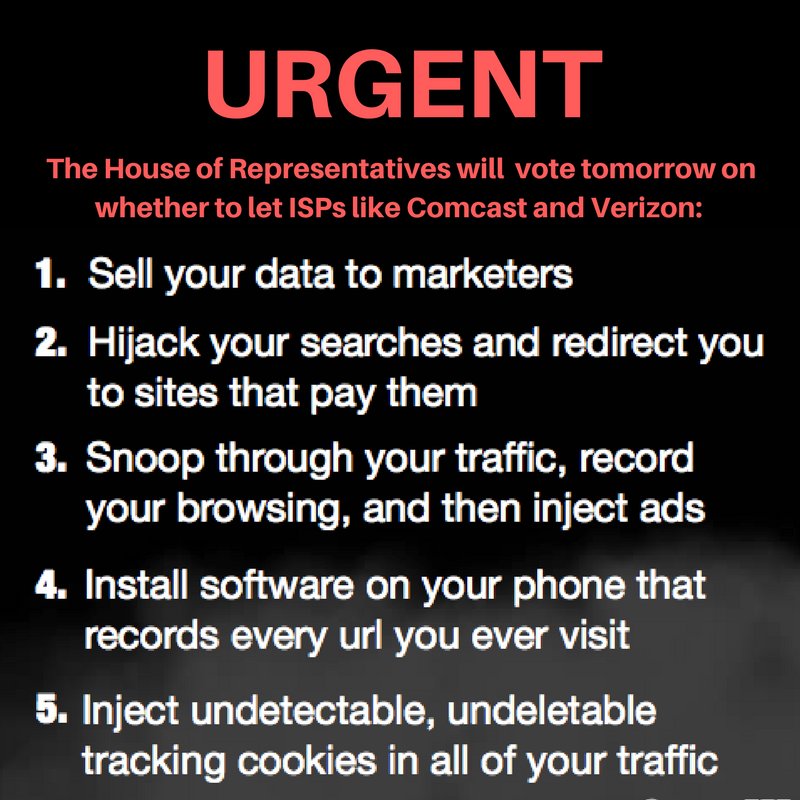
From Fight For The Future:
BREAKING: Congress has scheduled a vote TOMORROW to eliminate Internet privacy rules and allow ISPs to sell your data to advertisers without your permission. It already passed the Senate. This is our last chance to stop it.
Just last week, the Senate voted to gut internet privacy rules that prevent Internet Service Providers (ISPs) from selling your sensitive personal information to advertisers without your consent. [1]
The measure passed the Senate by only two votes. It was close, and there was significant public outcry which means we still have a chance to stop it.
Now the bill moves to the House of Representatives, and we just got word that they scheduled a vote on it TOMORROW. [2] They’re trying to ram it through quickly without discussion or debate. We need to stop them.
Call Congress right now. Tell them to vote NO on repealing the FCC broadband privacy rules.
We’ll connect you with your lawmakers and give you a simple script of what you can say. Here’s the number: (415) 360-0555
Can’t call right now? Help us sound the alarm and get out the word about this urgent assault on all of our Internet privacy rights.
Even creepier, they’ll be able to install software on your phone to track you, and inject undetectable “cookies” into your Internet traffic to record everything you’re doing online. [3]
If this bill passes the House, companies like Comcast, Verizon, and AT&T will be able to constantly (and secretly) collect our online activity and sell our browsing history, financial information, and real-time location, and sell it to advertisers without our permission.
We have less than 24 hours to create enough outcry to delay the vote or stop this bill entirely. There’s so much at stake. Will you call right now?
Call this number and we’ll connect you directly to your representatives: (415) 360-0555
We’ll keep you posted. Thanks for all you do,
-Laila and Evan at Fight for the Future
P.S. We just announced we’re going to put up billboards with the names of every member of Congress who votes for this attack on our privacy. Help us put them up in more districts by chipping in!
Or you can email your representative by clicking here.
Tuesday, March 14, 2017
Vote TODAY: Senate rushing to escalate the drug war
From Drug Policy Alliance:
As soon as this afternoon, the U.S. Senate could vote on a bill that would escalate the drug war by expanding the ability of states to drug test people who file for unemployment insurance. If it passes, it will go to President Trump to be signed into law.
This is our last chance to block it before the vote. Urge your Senators to oppose this harmful legislation.
The vast majority of people who receive unemployment insurance and other public assistance do not use drugs. But more importantly, drug testing programs have been proven again and again to accomplish nothing. They often have faulty results and waste millions of tax dollars.
Instead of following the evidence, Congress is stigmatizing vulnerable people looking for jobs to ramp up the failed drug war.
This is shameful, especially considering that members of Congress rushing to pass this legislation have claimed it will help people who struggle with addiction to opioids and other substances.
Yet most states that have tried these kind of drug testing programs don’t even offer or fund treatment for people who struggle with substance use.
In addition to being ineffective, harmful, and a complete waste of money, mandatory drug testing by states has been deemed illegal and unconstitutional by the courts time and again.
Contact your Senators immediately and tell them to oppose this attempt to escalate the drug war.
And follow-up with a call to your Senators. Find their phone numbers here and you can say:
As a constituent, I am calling to urge my Senator to oppose H.J. Res. 42 which would expand state drug testing of people who file for unemployment insurance. The vast majority of people who receive unemployment insurance and other public assistance do not use drugs. But more importantly, drug testing programs have been proven again and again to accomplish nothing. They often have faulty results, and waste millions of tax dollars. Please oppose H.J. Res. 42. Thank you.
We are doing everything we can to stop this bill from becoming law. But we’re counting on you to help us.
As soon as this afternoon, the U.S. Senate could vote on a bill that would escalate the drug war by expanding the ability of states to drug test people who file for unemployment insurance. If it passes, it will go to President Trump to be signed into law.
This is our last chance to block it before the vote. Urge your Senators to oppose this harmful legislation.
The vast majority of people who receive unemployment insurance and other public assistance do not use drugs. But more importantly, drug testing programs have been proven again and again to accomplish nothing. They often have faulty results and waste millions of tax dollars.
Instead of following the evidence, Congress is stigmatizing vulnerable people looking for jobs to ramp up the failed drug war.
This is shameful, especially considering that members of Congress rushing to pass this legislation have claimed it will help people who struggle with addiction to opioids and other substances.
Yet most states that have tried these kind of drug testing programs don’t even offer or fund treatment for people who struggle with substance use.
In addition to being ineffective, harmful, and a complete waste of money, mandatory drug testing by states has been deemed illegal and unconstitutional by the courts time and again.
Contact your Senators immediately and tell them to oppose this attempt to escalate the drug war.
And follow-up with a call to your Senators. Find their phone numbers here and you can say:
As a constituent, I am calling to urge my Senator to oppose H.J. Res. 42 which would expand state drug testing of people who file for unemployment insurance. The vast majority of people who receive unemployment insurance and other public assistance do not use drugs. But more importantly, drug testing programs have been proven again and again to accomplish nothing. They often have faulty results, and waste millions of tax dollars. Please oppose H.J. Res. 42. Thank you.
We are doing everything we can to stop this bill from becoming law. But we’re counting on you to help us.
Subscribe to:
Posts (Atom)